Anthony Albanese has warned Australia faces a hazardous summer, likely including floods, cyclones and extreme heat, due to the immediate threat of the climate change and a rising “super El Niño”.
Speaker alongside national leaders at a climate summit in Fiji, the prime minister said the expected nasty summer and the demonstrated impact on Pacific island countries – including low-lying Tuvalu – showed the world could not afford to let the goal of limiting global heating to 1.5C “just slip from our grasp”.
“Climate change is not a problem for the future. It is here right now, and we know that sea levels here in the western Pacific are rising at more than twice the global average. We know also that the forecast of super El Niño may test us all,” he said
“In Australia, we are expecting a summer of floods, of cyclones, of extreme heat, and extreme behaviour…The science told us that if we didn’t act to address global emissions this is precisely what would occur, and tragically that is playing out.”
Albanese’s comments came after a delegation of national and global agency leaders visited Tuvalu to see the impact of the climate crisis on one of the countries most at risk. A collection of three reef islands and six atolls, Tuvalu is home to about 10,000 people and mostly less than 2 metres above sea level.
The visit was promised by the Albanese government last year as part of a compromise deal when it missed out on hosting the Cop31 climate conference. Cop31 will be in Turkey next month; Fiji and Tuvalu are hosting a preparatory meeting.
Tuvalu was wet and grey for the visit, and the capital of Funafuti – spectacular from the air on a clear day – was visible only in strips between heavy rain clouds during descent.
After a cultural welcome and a tour of a climate resilience project, leaders held a “sautalaga” meeting – an exchange of views – where they expressed support for the country and urged more rapid action to cut emissions and provide island states with the money needed to adapt.
The delegation heard from Melelusi Sokotia, a 13-year-old local student, who said her friends dreamed of “becoming teachers, doctors, builders” but spent their lives wondering if their island would survive into their adult lives. “We all have one single dream: to grow safely here in Tuvalu,” she said. “We are not asking for peace. We are asking for help and partnership. Please work together to protect small islands like ours.”
Tuvalu’s prime minister, Feleti Teo, stressed island states needed faster access to global climate finance to deal with worsening extreme events. “Why should countries like Tuvalu take on more debt to protect ourselves from a climate crisis we did so little to cause? We should not have to borrow our way out of a crisis.”
The Fijian prime minister, Sitiveni Rabuka, said the world was on the brink of overshooting the goal of limiting global heating to 1.5C – agreed in the 2015 Paris agreement – and must bring forward plans to cut emissions. “That is not radical. It is in line with our agreement, our obligation, and the scientific reality,” he said. “The transition away from fossil fuels was agreed to by all of us in Dubai [at the Cop28 summit in 2023]. It is not a new ask, and it is not open for renegotiation.”
Australia has faced criticism at the talks for arguing for greater climate action while continuing to new expanded coal and gas developments. An Australian state regulator last week approved a major coalmine development that would be the largest in New South Wales’ history if it receives federal approval.
Albanese, attending his first UN climate conference as prime minister since his election in 2022, said a message from the Tuvalu trip was that “climate change must be understood as being something more than about science or targets”. “It must be understood that effectively it’s about people,” he said.
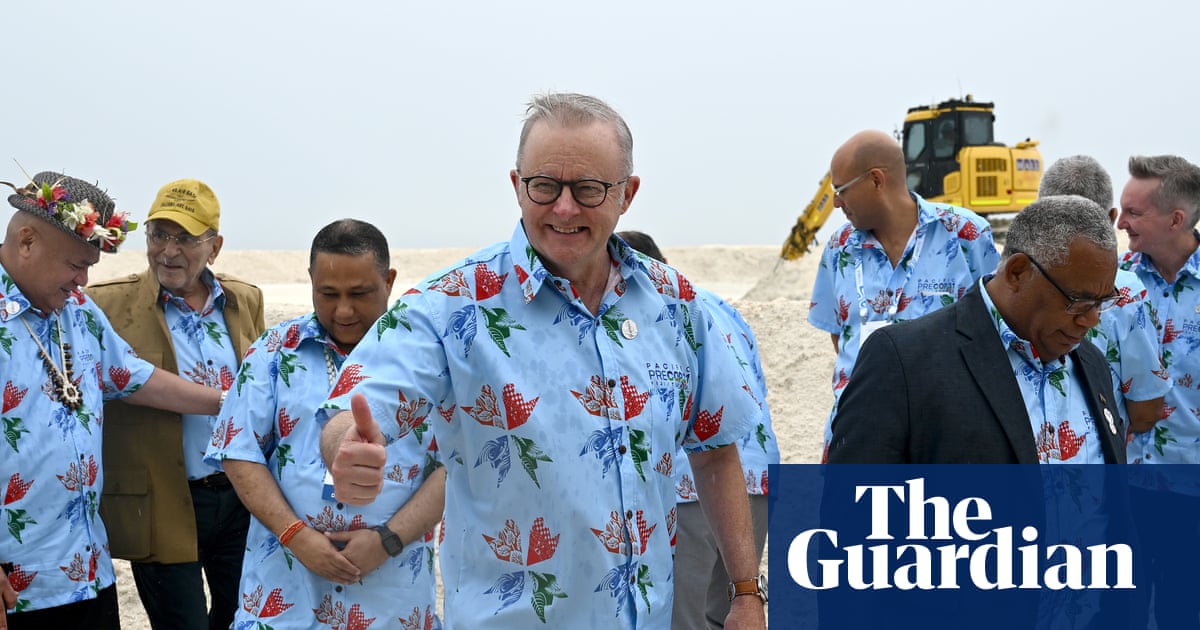
The delegation, which include former Australian prime minister Julia Gillard, now the chair of health charity Wellcome, were shown a land reclamation project to extend the atoll by about 20 hectares using sand and gravel dredged from its lagoon.
Tuvalu’s director of climate change, Jamie Ovia, told the visitors sea level rise was projected to increase the annual cost of damage from flooding and storm surges to US$34m a year by 2050 and $63m – more than Tuvalu’s GDP – by 2100.
He said the coastal fishing catch could be reduced by 16% and tuna stocks worth $4m a year could be lost as seas warmed. “We need time to adapt,” Ovia said. “Tuvalu is doing our part. Will you act with Tuvalu and will you act in time?”
Disclaimer : This story is auto aggregated by a computer programme and has not been created or edited by DOWNTHENEWS. Publisher: theguardian.com