
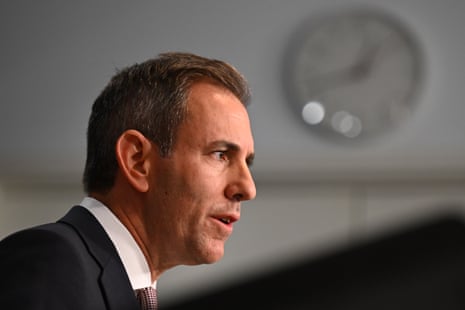
Treasurer Jim Chalmers is responding to today’s national accounts and says the numbers are solid considering the circumstances.
Speaking to reporters in Parliament House, Chalmers points to increasing business investment which he calls “incredibly welcome”, and says that annual growth in Australia “is faster than almost every major advanced economy, and it’s above the OECD average”.
Our economy has got no shortage of challenges, but it has also got some very sturdy foundations, and you can see that in today’s data.
This is the equal fastest annual growth in almost three years, it shows how resilient our economy is at a time of very substantial global economic volatility and instability, but the really big story here is about the private sector, and particularly when it comes to business investment. Private sector investment in Australia is booming.
He adds that it’s the “sixth consecutive quarter that new private final demand has contributed more to growth than public demand”. It’s a point the government has been very keen to keep talking about, in response to criticism that government spending is fuelling inflation.
Entry level house prices ‘should go down’ says Bragg
Well here’s something you don’t hear everyday … the shadow housing minister Andrew Bragg says that house prices, at least for the entry-level properties, should go down.
Bragg says that the government’s 5% deposit scheme for first home buyers has ballooned prices in a market where supply is already constrained.
Speaking to the media a little earlier today, Bragg said:
I think Australians are looking for authentic leadership. They’re over the bullshit. What they want to hear from their politicians are honest answers. And the honest truth is that house prices in this country are too high for young people and they should go down.
I think for, at the entry-level, certainly, that’s the case. And the fact that Canberra has a deliberate design feature to pump-prime prices at the bottom end, at the entry-level, I think is is wrong. The reason that the 5% deposit scheme has become such a wrecking ball is because it’s not means-tested, it’s not place-capped, and it’s been put into an environment where supply is constrained.
Earlier Jim Chalmers was asked about the comments and was pretty disparaging, saying “I think he [Bragg] will say anything that gets his name in the paper.” The government has said it wants to see “sustainable growth”, with Treasury forecasts showing that growth in the housing market would slow 2% under their changes to capital gains tax and negative gearing.
First three months of 2026 another record-breaking quarter for solar, wind and batteries – Clean Energy Regulator
Rooftop solar installations set a new record in the first three months of 2026, as Australian households added 791 megawatts of new capacity – a Q1 high according to new data from the Clean Energy Regulator.
Renewables supplied 47% of grid electricity between January and March, which was also a new record for the quarter.
Growth in home batteries surged, with more than 400,000 batteries installed across the country by mid May – a total of 11.4 gigawatt-hours of storage capacity, the CER said.
New investment in large-scale renewables has also picked up, with investment decisions made on 2.4 gigawatts of new wind and solar projects so far this year – an amount that already exceeds 2025.
The regulator said distributed energy was reshaping grid dynamics, with real-world data showing solar‑battery households importing less from the grid and exporting more during evening peak periods.
CER chair David Parker said strong growth in household batteries and solar was already changing the way distributed energy resources contributed to the grid.
As more Australians install solar and batteries, they are changing how they generate, store and use electricity.
Australian economy ‘not an environment for optimism or growth’, Tim Wilson says
Tim Wilson has gone on the attack following today’s national accounts data for the March quarter showing slowing economic growth and falling productivity.
Wilson says the economy was in a weaker position going into the war in the Middle East and the treasurer, Jim Chalmers, was making the situation worse with his latest budget.
It’s slightly a different view to Chalmers, who said any growth in the current global circumstances is a good thing.
Wilson told reporters:
Now we’re in a position where we’ve got higher taxes, higher inflation, and of course Australian households doing weaker and we have record small business insolvencies. This is not an environment for optimism or growth, Australians need hope and it’s not going to come from higher taxes, higher inflation and lower living standards.
These numbers show what is to come, and unfortunately the treasurer is making a bad problem worse through his budget.
A former Australian Capital Territory opposition leader has quit the Liberal party, citing threats of violence and a toxic culture as reasons for leaving the organisation, AAP reports.
Canberra Liberal Leanne Castley announced she would leave the party and sit in ACT parliament as an independent on the crossbench. She said in a statement:
I have simply had enough of being part of an organisation with such a toxic culture … In the last 18 months, I have experienced bullying, intimidation, lies, and even a threat of physical assault. I can no longer be part of an organisation which tolerates this conduct.
Castley became ACT opposition leader after the party’s 2024 election loss.
However, she stepped down from leading the party in November after her decision to suspend two Liberals from the party room – Peter Cain and her predecessor in the role Elizabeth Lee – created turmoil.
Castley later told ABC Radio the bullying towards her had taken place from when she became opposition leader. She said:
It’s not one person, it’s not one issue, it’s been an 18-month campaign … At some point I had to put a line in the sand and say, OK, I’m walking away.
The Liberal leader, Mark Parton, denied the party had a toxic culture but said the organisation had treated bullying concerns, telling ABC Radio:
I don’t condone bullying, intimidation or inappropriate behaviour of any kind.
Greens say ‘no confidence’ in managing private employment provider sector
Greens senator Barbara Pocock has unleashed on the private employment provider sector in Senate estimates.
Addressing the employment department secretary, Simon Duggan, who was appearing before the education and employment legislation committee, Pocock said:
The revolution that John Howard made 30 years ago in privatising this service, and we have seen a number of individuals make an enormous amount of money out of this system, off the backs of some of the most vulnerable people in Australia.
What I see from the evidence I’ve heard today is that an enormous amount of this system will still remain in private hands.
Mr Duggan, you’re asking me to have confidence that we’ll better contract and manage that system. I don’t have that confidence.
At the end of these contracts are real people whose lives matter, an increasing number of them homeless, and all kinds of issues are complicating their lives. So I don’t share the Minister’s confidence.
One of the other committee members piped in: “That’s not a question” before the committee moved on.
Defence using Palantir software to help ‘select targets on the battlefield’
Australia’s contracts with US tech company Palantir have come under scrutiny in Senate estimates. Defence currently has two contracts with Palantir Technologies Australia Pty Ltd worth a combined $14m.
Greens senator David Shoebridge asked how many Palantir staff were “embedded” within defence. Maj Gen Richard Vagg, head land capability, said that Palantir staff were assisting defence but were not “embedded”:
The system that we’re using with Palantir is the Maven Smart Suite. … We use Palantir field service representatives to help us in some of the work to set the systems, but they are [in] no way embedded into the organisations that are currently trialling and using that system.
Shoebridge:
To be clear, that’s the same software or a variant of the same software that Israel has been using to identify targets in Gaza and Lebanon, that the US used to identify targets in Iran, including the bombing [of] the school that killed hundreds of Iranian schoolchildren.
Vagg:
Yes senator, it is the same suite of products. But it is a different system. And those systems you refer to, they have the AI function initiated in those: we don’t. We’re using it to understand how you would collate all the data to give commanders the right situational awareness and ability to select targets on the battlefield.
Shoebridge:
Did anyone in defence do an ethical check about buying a software platform from US company Palantir that has been used to commit genocide in Gaza, to target civilians in Lebanon, and was used to kill 200 schoolchildren in the opening 24 hours of the US war on Iran?
Lt Gen Susan Coyle, chief of joint capabilities, said:
The initial approach to market was done utilising our digital transformation agency’s software and enterprise resource planning panel. The company is listed on that panel as authorised for use.
The line of questioning was ended by committee chair, Labor senator Raff Ciccone.
Palantir, the $375bn tech company co-founded by Donald Trump-supporting billionaire Peter Thiel, supplies software to the US’s Immigration and Customs Enforcement (ICE), the Israeli military, and the UK’s Ministry of Defence.
The Maven Smart System is an AI-driven, cloud-based command and control platform. It aggregates various streams of battlefield intelligence – satellite imagery, radar, drone footage, radio transmissions – into a single stream of information.
Australians only have ‘defensive roles’ in Iran war, defence chief says
Australian defence personnel embedded within the US military have been given orders limiting them to “defensive roles” in the US-Israel-led conflict with Iran, Senate estimates has heard.
The chief of the defence force, Adm David Johnston, said embedded Australian service personnel had a “clear understanding” of their duties “limiting them to defensive roles only”.
Three Australian naval personnel were onboard a US nuclear submarine that torpedoed and sank the Iranian frigate Dena off the coast of Sri Lanka in the first days of the conflict in March. More than 100 people were killed or drowned.
Johnston said there were currently 729 ADF personnel embedded in the US and UK militaries, with up to 60 presently serving on US nuclear boats.
Greens senator David Shoebridge asked Johnston:
Was it in Australia’s national interest for the US to sink an Iranian frigate on the high seas thousands of kilometres from the conflict zone and then leave the survivors to drown … was [it] in our national interest to have Australians part of that activity?
Johnston told the committee:
It was in our national interest to have our people on board US Virginia-class submarines training: learning, understanding and building their competencies so that as our Virginias enter service we have people who are safe and proficient operating those platforms.
Shoebridge asked how Australians would understand their orders and rules of engagement during combat situations.
“Senator, I am confident that our people have clarity on what they are authorised to do,” Johnston said.
I’m not aware of any circumstances you would describe of individuals finding it uncertain the manner in which they are to respond.
Numerous investigations into payslip harassment but no recent cases, estimates hears
In the Senate Education and Employment Legislation Committee, DEWR’s First Assistant Secretary Lisa Schofield said there have “been a number” of investigations into payslip harassment, but no recent cases.
But welfare advocates say it is still one of the biggest complaints they get from people looking for assistance.
When about payslip compliance by Greens senator Senator Barbara Pocock, Schofield said:
Schofield: When we discovered that behaviour, we issued a lot of guidance, additional notifications, directions put to providers…. Probably over about four to six months from memory, and that really led to a drop in that behaviour.
Pocock: How do you know that behaviour dropped?
Schofield: We’re not seeing the complaints and the issues kind of coming through the system that we had been seeing before.
Advocate Jeremy Poxon has said this is “a lie”, saying he has been “helping multiple people who say they’re being bullied for their payslips”.
Chalmers tight lipped on Aukus cost saving
The government isn’t revealing how much money it will save by acquiring three used Virginia-class submarines from the US, instead of two second-hand and one new – as was announced over the weekend.
Chalmers is asked just how much will be saved – whether in the millions or billions – but won’t say.
This will make the investment a bit cheaper but we don’t update that from week to week, we do that from budget to budget and you can expect us to do that at the next opportunity.
Another journalist follows up and asks why the budget – handed down less than a month ago – didn’t include the discount, if the government was in talks with the US and knew the announcement was coming.
Chalmers avoids the question.
The standard way to account for changes in defence spending is from budget update to budget update.
We might find out in the mid-financial year budget update in December.
Global assumptions could be ‘even more severe’: Chalmers
Speaking of Pat Commins, our economics editor asks Jim Chalmers whether these numbers actually show a sharper slowdown in the economy that’s likely to get worse.
Chalmers starts off saying again that any growth is “really solid in the circumstances” when considering the impacts of the war in the Middle East.
The treasurer does note that this data from the March quarter does not capture the worst parts from the war, and warns that things could get even worse than what’s been predicted.
The fact we’ve got any growth at all given the challenging global circumstances I think is welcome.
We can expect some challenging times ahead … even the very serious global assumptions that feed our forecasts, they could be even more severe. We’ve made that clear, we’ve been very upfront on that.
Productivity drops 0.6% in March quarter, but fall ‘not surprising’, Chalmers says
Jim Chalmers says productivity “came off a bit” in the numbers – which show that productivity fell 0.6% in the March quarter.
The treasurer says that increasing private investment will help and that the government is using the budget to help improve productivity.
Productivity came off a bit, but increased through the year, and obviously we’re doing much more in the budget and elsewhere to try and turn that productivity performance around.
Despite all of the doomsayers and everyone who wants to talk the Australian economy down, we’re seeing a boom in private investment, that’s a good thing, and in time by seeing these investment figures flow through into our economy, that will be an important part of shifting what has been a couple of decades now of poor performance on productivity.
It is not surprising that the quarterly productivity number fell, but we did not see productivity go backwards for the preceding five quarters.
Why is productivity important, you might ask. Have a read here of this explainer from my colleague, Patrick Commins.
Disclaimer : This story is auto aggregated by a computer programme and has not been created or edited by DOWNTHENEWS. Publisher: theguardian.com



