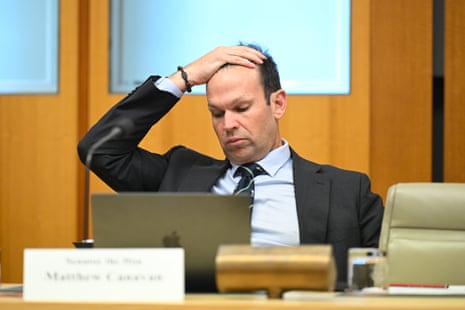
The Nationals leader, Matt Canavan, says “Labor must push back on Trump’s new tariffs”, arguing they’re unfair and a breach of the free trade agreement.
Canavan has given the most muscular opposition to America’s proposed tariffs, announced yesterday by the US trade representative. In a statement he claimed the trade barriers were “unjustified and a clear breach of the Free Trade Agreement Australia has with the US”.
“We are great friends with Americans but these latest tariffs are based on a fig leaf of a justification,” Canavan said.
Just weeks after the US supreme court struck out the Trump administration’s first tariffs, the US launched an investigation of whether Australia fails to impose and effectively enforce a prohibition on the importation of goods produced with forced labour.
Canavan noted that Australia has strict laws against the use of forced labour and modern slavery, and that the US investigation “has not provided detailed evidence that Australia fails to stop products made with forced labour”.
Its report is a smokescreen to justify tariffs it clearly intended to put on in any case.
Whistleblower warns of violent threats against people Australia removed to Nauru
A whistleblower has warned of the “serious threats of physical violence” non-citizens from the NZYQ cohort removed from Australia to Nauru face.
This morning in the federation chamber, independent MP Andrew Wilkie read out a statement from an anonymous whistleblower who was fearful of being named for their own personal safety and employment security.
Using parliamentary privilege, Wilkie said the person’s statement claimed:
Through my employment, I am involved in the process which sees individuals removed from Australia and taken to the Republic of Nauru. I have come to hold grave concerns about the physical safety of individuals removed to Nauru …
In numerous conversations, serious threats of physical violence were made in relation to those removed to Nauru. These were not idly made threats. They were said with a tone and gravity that indicated, at best, an indifference to the dignity and wellbeing of the removed cohort, and at worst, an active desire to cause them serious harm. I came to understand that those responsible for overseeing the removed cohort had a fundamental lack of respect for the humanity and rights of the cohort. The threats included comments that those removed were quote absolute blank pieces of blank, who in Nauru would be mistreated in such a way to make quote very clear how they are going to be managed for the rest of their lives.
I was absolutely shocked by such unashamed and gratuitous threats of violence … I have repeatedly tried to raise concerns about these matters through appropriate channels. To date, I have seen no evidence that my concerns have been addressed.
Wong pushes back on Trump’s latest tariffs
The federal government is racing to understand the latest tariff plan by the US president, Donald Trump.
In Senate estimates on Thursday, the foreign affairs minister, Penny Wong, criticised the proposed 12.5% tariff on Australia, justified on the grounds that Australia could do more to stop slavery.
Australia continues to assert our view that we are not supportive of tariffs, and we continue to value open trade that has benefited both Australia and the United States.
It is the government’s position that we do not believe there is a basis for these additional trade measures, and that is what we will continue to robustly put.
Australia already faces a 10% tariff on goods exported to the US.
The trade minister, Don Farrell, has objected to the new tariff in Paris overnight, during talks with Trump’s trade representative at an OECD conference.
$1.99 billion in outstanding child support payments or debts
The Department of Social Services is up in Senate estimates today and it’s just been revealed there is $1.99 billion in outstanding child support.
That involves 221,145 cases, with the average debt being $8,675.
The department’s child support manager, Lauren Power, said:
41.8% of the value of the debt is under arrangement at the moment. That figure has increased over the last four years.
The $1.99 billion figure refers to all child support debt accumulated since the scheme commenced in 1988. So some of it would be quite longstanding… and some of it accrued more recently.
World Cup players scared to speak out: Craig Foster
Former Socceroos captain Craig Foster says there has been a “chilling” effect on the voice of footballers concerned that speaking up about human rights abuses could cost them their World Cup dream, AAP reports.
Human rights and geopolitical tensions are in the spotlight as the games approach.
But there has been little commentary from other players across the 48 teams as the tournament nears, in stark comparison to when the Socceroos were involved in a video campaign criticising 2022 host Qatar’s human rights record.
“It’s extraordinary that we’ve seen very few, if any, statements from any of the athletes participating in this tournament – no doubt because they realise the risks that that brings,” Foster said.
The prominent human rights advocate was speaking on a media briefing held by the Sports & Rights Alliance and Human Rights Watch. Foster said players faced censorship and would be concerned about the safety of their family, friends and colleagues, along with fans potentially being racially profiled by ICE, and couldn’t fully focus on performance. He said:
We’ve seen a very significant chilling effect on the voice of players, and on their right to speak out on various violations, many of which, of course, the US are participating in right now …
And undoubtedly because players will know that that would have almost certainly prejudiced their opportunity to actually travel to the US, be granted a visa and participate in their own World Cup.
Germany football director Rudi Völler this week urged members of the squad to avoid making political statements while at the World Cup. Foster said:
Players would have, and teams would have, been advised long before now about the very severe risks.
Tim Wilson, the Liberal shadow treasurer, says cutting tobacco excise should be “part of the solution” to eliminating the black market for cigarettes.
New data yesterday revealed 80% of cigarettes smoked by the nation last year were sourced illegally, meaning they did not attract the excise. Legal cigarettes are typically far more expensive, mostly due to the heavy tax.
Speaking on ABC Radio Melbourne this morning, Wilson said:
No one can tell me how much we need to cut excise to get the illegal tobacco out. About 12 months ago, there was talk of it being somewhere around 30% [cut] would get the illegal gangs out. Now it seems like it’s closer to 60%. And so it’s clearly got to be part of the solution …
We haven’t reached a formal position, but there’s absolutely an appetite from a lot of my colleagues that something needs to be done.
Illicit cigarette consumption doubled from 2016 to 2019 then doubled again by the end of 2022. Both Coalition and Labor governments have hiked the excise. Wilson denied the former Coalition government’s excise increases were responsible for the growth.
It’s been a trajectory consistently over multiple governments to do this. And it’s quite clear that it isn’t working and is now fuelling behaviour.
An excise cut would mean legal cigarettes face less tax, potentially boosting big tobacco companies’ sales and profits. Wilson said:
Well, presently, the people who are profiteering most are legal gangs and organised crime. They then go to do things like fund terrorism and antisemitism and social disruption. And so, in a choice between the two very bad options, ones who actively subvert the law and harm other Australians are absolutely worse.
Victorian opposition leader joins calls to cut tobacco excise
The Victorian opposition leader, Jess Wilson, has backed calls to reduce the federal tobacco excise, saying the price of legal cigarettes drives people to buy illegal ones. It follows data released by the Australian Bureau of Statistics, which found that 80% of the cigarettes smoked last year were cheaper illegal products.
Speaking outside parliament, Wilson told reporters:
We should consider reducing the federal exercise on tobacco, given what we’re seeing play out on the ground when it comes to the illegal tobacco wars, particularly here in Victoria.
We’re seeing an underground operation here when it comes to illegal tobacco, and in part over time that has been driven by the rise in the excise, seeing people go to the underworld market.
She said the state Labor government had failed to “lobby their federal counterparts in Canberra – the federal Labor government – to actually do something about the excise”.
The NSW premier, Chris Minns, has previously called for overhaul of the tobacco excise, saying it was no longer working “as a matter of tax or health policy”.
Most homes listed for auction last week did not sell
Most homes listed for auction in the last week of May did not sell, as interest rates and budget changes for investors reduce buyer demand.
Data from Cotality showed just 49% of the 2,659 homes listed for auctions across Australia last week sold. This was the lowest level since May 2020, when much of the country faced Covid lockdowns.
Of the other 51%, 13.6% were withdrawn (most of them in Sydney) and 37.3% homes went to auction but were passed in.
Annabelle Mezieres, a Cotality economist, said the drop was due to buyers stepping back, not sellers. The same week last year had similar auction volumes but a clearance rate of 66.2%.
Melbourne’s clearance rate was 51.9%, its lowest since April 2023. Sydney’s was 46.5%, lower than the 49.3% recorded the week before. Most homes listed for auction in Brisbane and Canberra did not sell.
Part of the decline in buyer interest has likely been because the federal government scrapped negative gearing for new investors in established homes. Banks have already changed their lending rules accordingly.
The treasurer, Jim Chalmers, this week said of the falling clearance rates:
If we are making it easier for first home buyers to get a fair crack at auctions, then that’s a good thing.
The Nationals leader, Matt Canavan, says “Labor must push back on Trump’s new tariffs”, arguing they’re unfair and a breach of the free trade agreement.
Canavan has given the most muscular opposition to America’s proposed tariffs, announced yesterday by the US trade representative. In a statement he claimed the trade barriers were “unjustified and a clear breach of the Free Trade Agreement Australia has with the US”.
“We are great friends with Americans but these latest tariffs are based on a fig leaf of a justification,” Canavan said.
Just weeks after the US supreme court struck out the Trump administration’s first tariffs, the US launched an investigation of whether Australia fails to impose and effectively enforce a prohibition on the importation of goods produced with forced labour.
Canavan noted that Australia has strict laws against the use of forced labour and modern slavery, and that the US investigation “has not provided detailed evidence that Australia fails to stop products made with forced labour”.
Its report is a smokescreen to justify tariffs it clearly intended to put on in any case.
Queensland government commits to reforming Adoption Act
The Queensland child safety minister, Amanda Camm, says the government will reform the Adoption Act, after tabling a months-long commission of inquiry into the state’s child safety system yesterday.
This morning, she was asked about one of the commission’s most controversial recommendations: an end to the legislated principle setting adoption as a last resort for Indigenous children. The rule does not apply to non-Indigenous children.
Commissioner Paul Anastassiou said government should “entrench adoption as the third permanency option for all children regardless of cultural background”. He acknowledged it came over the “strong submissions from First Nations stakeholders against adoption”.
Camm said she would “always put the interests of children first, no matter their cultural background, no matter where they live in this state”.
If they are a child known or in the child safety system, our government will prioritise their safety and wellbeing first, and that’s our commitment.
We’ll consider that recommendation, and we will bring forward reforms that are in the interests of children.
Can you negatively gear a new granny flat from next year?
Can you negatively gear a new granny flat once the new budget rules come into effect from the middle of next year?
You might be wondering, and so was Liberal senator Andrew Bragg in estimates this morning.
Just a reminder: under the proposed tax changes, only new home builds that “genuinely add to housing supply” can be negatively geared from 1 July 2027.
There are a variety of examples about what genuinely adds to housing supply, such as you won’t be able to knock down a home and then negatively gear the rebuild.
So: “Is a granny flat in or out?” asked Bragg.
The Treasury secretary, Jenny Wilkinson, reads out the line in the budget glossy tax explainer.
A granny flat adjacent to an established property that is not eligible for negative gearing would not be eligible.
She adds that the new rules will eventually be firmed up when the legislation is finalised.
Pocock pushes the Coalition and Greens to work together to delay budget bill
David Pocock says he would welcome the Coalition and Greens working together to delay the government’s tax legislation being rushed through the parliament.
Earlier this morning Angus Taylor told a press conference he was open to working with anyone – including the Greens – after reports in the AFR that formal negotiations were taking place between the two parties to support a longer inquiry into both the tax legislation and the NDIS overhaul. Taylor said:
We’ll work with whoever we can to stop this toxic legislation getting through the parliament. Well, they’re dirty, rotten taxes, that’s the, that’s the underlying problem here.
On Sky News, Pocock said the bill is “something that absolutely needs scrutiny” and added that he also had serious concerns over the discretionary powers the bill would give to Jim Chalmers.
I think both the NDIS changes and changes to CGT should have a lengthy Senate inquiry process.
I’ve been really concerned abut the number of bills the government has been introducing to parliament that gives a minister extraordinary powers … we have to maintain parliamentary oversight and I’ll be pushing the Greens and the Coalition to ensure we do that.
I do think we shouldn’t be handing those powers to the treasurer, any of those changes should come through parliament
Drew Hutton speaks out after resigning from the Greens
A co-founder of the Greens has spoken out after handing in his resignation to the party, weeks after winning a court battle that saw the party reinstate his membership and pay tens of thousands of dollars of his legal costs.
Drew Hutton, who is nearly 80, says he will back “progressive independent candidates” who are committed to “changing the federal government’s Sex Discrimination Act so that it clearly defined a woman as a biological female”.
Hutton says he will not back teals, who he describes as “woke”.
His Greens life membership was officially terminated last July after his online comments sparked a lengthy internal conflict over what the party considered his pursuit of debate harmful to trans people but he framed as an issue of free speech.
But in March, the Greens accepted they had denied him natural justice and were forced to reverse that decision. Hutton says the party paid $55,000 – about half – of his legal fees.
Hutton says after he was reinstated, he tried to persuade the party to “have another look at gender policy and their approach to freedom of speech”.
“But, basically they’ve taken out a fatwa on me,” he says.
Hutton says his politics haven’t changed since 1984, when he founded the Brisbane Greens and that he remains committed to the four pillars of ecological sustainability, grassroots participatory democracy, social justice and peace and non-violence.
“This [the Greens] is a big part of my life’s work – I don’t know whether I feel more sad or bitter about it,” he says. “Probably bitter.”
The Greens put out a statement to “wish Drew well” and recognise his “significant contribution to progressive and green politics in Queensland” in “years past”.
Following from our previous post …
Although the Victorian and New South Wales governments introduced several reforms to combat the illegal tobacco trade, data released by the Australian Bureau of Statistics yesterday shows these measures haven’t made much of an impact. The amount of nicotine consumed nationwide soared by 40% between 2017 and 2025, despite population growth rising by just 14%.
The ABS also found that 80% of the cigarettes smoked last year were cheaper illegal products.
It’s led to calls for the federal government tobacco excise to be lowered to reduce criminal incentive, including by the NSW premier, Chris Minns.
Asked whether he backed Minns’ call, the Victorian minister, Enver Erdogan, said the “price differential between the legal and illegal products” was one of “multiple factors for the growth of this illicit trade”. He continued:
I know that many in the sector – the convenience stores – have said that that is a big factor for them, and they feel that, especially with cost of living [and] affordability being a factor for many people that use these legal products otherwise. That’s what the industry says. From my perspective I’m focused on making sure we crack down and making it harder to profit and sell.
Pressed on whether he would support a reduction to the excise, Erdogan said:
It is a factor for the growth. I think that’s undeniable – the federal assistant minister has said that too. So I think it is the reason for the growth of the sector, but what we need to do now is work together across the commonwealth. We have to make sure we crack down, make sure less of this product enters our country, make sure those settings are correct, but also that law enforcement in our state takes tough action.
Victorian government introduces laws to shut down illegal tobacco shops, with minister conceding price factor in growth of trade
The Victorian government will introduce legislation to parliament today to give police and its tobacco watchdog the power to shut down shops selling illicit cigarettes.
The minister for casino, gaming and liquor regulation, Enver Erdogan, told reporters the bill, first announced in March, will allow authorities to issue 90-day closure notices to shops found selling illicit tobacco. Police and Tobacco Licensing Victoria will also be able to apply to the magistrates’ court for longer-term closure orders.
Businesses that defy the orders will face fines of $2.4m and up to 20 years in jail, which he said are the nation’s “harshest” penalties.
When asked why the state was lagging in introducing the powers, given NSW introduced similar laws last month, Erdogan said:
In Victoria, we’ve never had a tobacco licensing scheme, so a lot of the work last year was focused on setting up the regulator in the first place, and the enforcement began in February. We know that this is a national problem, even states that had a long-term regulator – regulators for 10 to 20 years – they still have this issue. The criminal organised crime elements are very similar in Melbourne and Sydney, to be frank, and our crackdown is quite serious. I want to thank Victoria police who have made hundreds of arrests.
Treasury says 90% of young Australians better off under budget measures
The Treasury secretary, Jenny Wilkinson, says about 90% of young people will face lower taxes as a consequence of the tax changes in last month’s budget and which the government plans to pass through parliament today.
Wilkinson was asked whether young Australians investing as a way to save for a home deposit would pay more tax under the proposed changes.
My understanding is that most young Australians earn most of their income through wages and salaries. If you want to think about how most young Australians save to place a deposit on a home, most of the savings will come through wages and salaries.
She then referred back to analysis she revealed in a speech last week, which looked at Treasury’s best estimate of the combined effect on young Australians had the measures in the budget been put in place at the turn of the century.
That’s when she repeated the findings that “around 90% of young people will face lower taxes as a consequence of these changes”.
‘Bad practice for legislation’: opposition and independents push for tax amendments
It’s amendments galore in the House today, with the government’s budget bill up for debate.
Angus Taylor and independents Monique Ryan, Kate Chaney, Zali Steggall and Dai Le have all put forward amendments.
Taylor’s amendment is to stop the bill getting a second reading in parliament and calls on the government to pass laws to end bracket creep (the promise the opposition leader made in his budget reply).
Meanwhile, Chaney and Steggall are pushing for CGT reforms to stick to property, Ryan has raised concerns over the impact on small businesses, and Le is pushing for the legislation to be delayed until after the next election in 2028.
Of course none have the numbers, but it shows the government how the opposition and crossbench feels about the reforms.
Before the vote on the amendments (which the government will win due to its numbers), several MPs used debate time to criticise the bill, including independent Helen Haines:
We are actually being asked to vote on this legislation knowing that it likely doesn’t represent the intended final operation of these reforms, because the govt is currently working through potential modifications and crave-outs. Frankly this is really bad practice for legislation and it makes it truly difficult to engage with the substance of the legislation.
Budget measures will be a boost for new home buyers, Treasury says
The Treasury secretary, Jenny Wilkinson, says the budget measures overall will boost the supply of new homes, and that the tax changes will drive a “switch” in home ownership from investors to owner-occupiers.
Liberal senator Claire Chandler in estimates this morning is asking about budget modelling which showed the changes to the capital gains tax and negative gearing rules will reduce home supply by 35,000 over coming years, and whether this will make it harder for Australians to get into the market.
Wilkinson says:
What we have made clear is that the direct impact of the tax changes might reduce supply by a bit but that would be more than offset by what we estimate to be the impact on supply of the additional infrastructure measures.
Looking at the budget overall there would be an increase in net supply available to first home buyers.
If these changes were not made there wouldn’t be a switch of investors out of home ownership which makes more homes available for first-time buyers. Two things are going on here: questions about supply, and questions about the ownership mix. Those two things together will influence whether first home buyers can get into the market.
NDIS inquiry receives more than 4,000 submissions
The inquiry examining the government’s bill to overhaul the NDIS has received more than 4,000 submissions, says shadow NDIS minister, Melissa McIntosh.
She says the overwhelming volume of submissions reflects “the high level of anxiety that many Australians who rely upon the NDIS [are] feeling”.
Just over 300 of those submissions have so far been published on the inquiry’s website.
Influential thinktank the Grattan Institute has said in its submission that the overhaul is “blunt and inequitable” and “underpinned by dubious logic”. Read more on that from my colleague, Sarah Basford Canales, here:
McIntosh says:
Minister Butler talks a big game about consulting with the disability community, but Labor has gone about this in the wrong way – they’ve introduced the legislation first and are only now consulting with the community.
We have to strike the right balance between reducing growth in the scheme and ensuring that people with significant and permanent disabilities can access the support they need.
Three days of public hearings are scheduled for next week with the committee due to report back on 16 June.
Economy ‘solid’ in early 2026 ahead of Iran war impact, Treasury secretary says
The Treasury secretary, Jenny Wilkinson, has described the economy’s performance over the first three months of 2026 as “solid”.
Appearing at Senate estimates this morning, Wilkinson in her opening statement said the 0.3% real GDP growth rate in the March quarter – and 2.5% through the year – “aligns broadly with our expectations” as laid out in the budget.
Treasury still believed unemployment would peak at current levels of 4.5% and that inflation would ease into 2027. But much depends on what happens in the Middle East, Wilkinson said.
The impacts of the closure of the strait of Hormuz has been cushioned to some extent by a drawdown of global inventories. But there are limits on the extent to which stocks can continue to be drawn down before operational stress levels increase.
This also creates the risk of higher prices in the future if the current continues, even if it doesn’t escalate.
Disclaimer : This story is auto aggregated by a computer programme and has not been created or edited by DOWNTHENEWS. Publisher: theguardian.com