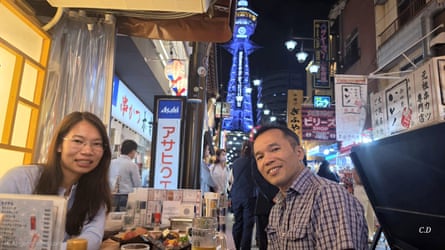
Tran Hiep spent his 51st birthday alone in a notorious detention centre in Vietnam’s Ho Chi Minh City after his sudden arrest last month.
The Melbourne-based Vietnamese-Australian democracy campaigner hasn’t been heard from since mid-September when Vietnamese authorities detained him for alleged terrorism and forging identity documents.
The alarm was first raised by his wife, Chloe Dang, when Hiep failed to board his flight from the Cambodian capital, Phnom Penh, on 18 September where he was meeting with human rights defenders.
For nearly a fortnight, Hiep had apparently vanished. Then the Vietnamese authorities confirmed he was in jail, awaiting trial.
More than three weeks later, Dang has been told by Australian authorities Hiep is being held in the B34 pre-trial detention centre in Ho Chi Minh City, known for alleged human rights abuses against political prisoners.
“I will not stop worrying until I hear from him or see him with my own eyes,” Dang said.
“Last week, he had to spend his birthday alone in detention. We always do everything together, so the thought of that is truly heartbreaking for me.”
Dang wants his immediate and unconditional release.
Not the only detainee
Hiep is the latest Australian human rights campaigner to be detained in Vietnam.
Vietnamese-born Australian, Chau Van Kham, was arrested in Vietnam in January 2019 and sentenced to 12 years’ imprisonment on “financing terrorism” charges over his membership of the pro-democracy group Viet Tan. He was released after four years in 2023.
Hiep, a freelance IT professional who founded the Australian Alliance to Combat Human Trafficking, is also accused of being a member of Viet Tan – which Vietnam describes as a terrorist group.
Human Rights Watch has previously described Viet Tan as “an opposition political party … which operates openly and lawfully in many countries including Australia, but which Hanoi arbitrarily labels ‘terrorist’”.
According to a Vietnamese government statement, Hiep was arrested entering Vietnam from the Cambodian border along with another human rights activist, Nguyen Duc Thuan, who is also Vietnamese and holds a Norwegian passport.
A third person, Thai Cong Truong Son, was also arrested. Cambodian authorities have since denied any involvement in the arrest or detainment of the three men, who, they say, were intercepted at the My Quy Tay border crossing.
The Department of Foreign Affairs and Trade is providing the family with consular assistance but won’t comment on his case due to privacy obligations.
The foreign affairs minister, Penny Wong, said she had made personal representations regarding Hiep’s case but would be “careful what I say publicly”.
“We know that different political regimes in the region have very different approaches to individual freedom and political freedom to that Australia takes,” Wong told ABC on Friday.
‘Worsening human rights situation’
Human rights advocates are concerned Australia’s silence in the public arena is the wrong approach while Hiep remains uncontactable, and his condition unknown.
Kyinzom Dhongdue, Amnesty International Australia’s strategy and efficacy manager, said the human rights group was “increasingly concerned about the worsening human rights situation in Vietnam”.
Dang, as well as Hiep’s lawyer Alison Battisson, Amnesty, Human Rights Watch, and other groups, believe Hiep was abducted by Vietnamese authorities while in Cambodia. If so, his arrest would be a violation of international law.
“This is an egregious case of transnational oppression in which an Australian citizen has been kidnapped from a third country – Cambodia – and forcibly taken to Vietnam,” Battisson claimed.
Both Vietnamese and Cambodian authorities deny this happened.
Dhongdue said the Australian government should demand an independent investigation, noting previous cases.
“I think the government really needs to speak out publicly, privately, at the highest level, because keeping it quiet doesn’t help,” Dhongdue said.
Kylie Moore-Gilbert was held in Iranian detention from September 2018 for 804 days until her eventual release in November 2020.
Moore-Gilbert said the Australian government’s decision not to make her detainment public until 2019 led to her being sentenced to 10 years’ jail for espionage in a secret trial.
She hoped it would not be the same for Hiep.
“I would really hope that they would learn the lessons from that experience with that detention and apply them in order to act more expeditiously in [Hiep’s] case,” Moore-Gilbert said.
“Keeping that media spotlight on him will hopefully protect him a bit from some of the worst excesses of that regime.
“We need to put our foot down as a country … we really need to send a strong signal to Vietnam that [his arrest is] unacceptable and that we will accept nothing less than his immediate freedom.”
Disclaimer : This story is auto aggregated by a computer programme and has not been created or edited by DOWNTHENEWS. Publisher: theguardian.com