
An associate of a notorious Islamic preacher linked to the Bondi shooters has called on followers to take up arms against Christians and Jews, putting the spotlight back on radical preachers after the major parties shelved attempts to rein them in.
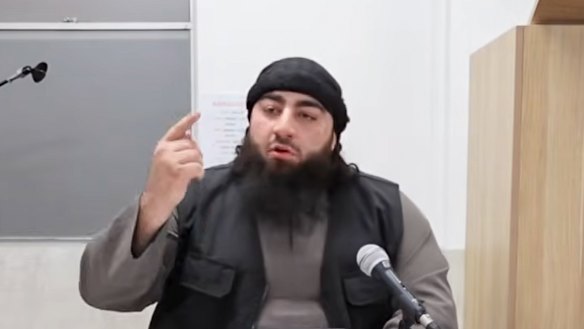
A young and increasingly popular preacher from Melbourne’s southeast who goes by Abu Ahmad said in a July sermon that adherents should not “take the Jews and the Christians for friends”.
“For the sake of Allah, it includes the obligation to declare enmity for his sake, opposition for the sake of Allah. It is to declare opposition: indeed, to take up arms against his enemies, to shun them and to stay far from them both in word and deed,” he said in a clip posted to his Al Bayyinah Islamic Centre’s social media feed.
“This proves that simple opposition of the spirit is not enough and that it must be complete by honouring of your commitment.”
The Al Bayyinah Islamic Centre was established in Springvale in 2024. It has regularly posted on Instagram with another account called Station of the Seekers, which has featured Islamic State sympathisers.
The Al Bayyina centre has also been supported by Sydney-based preacher Wisam Haddad, who is linked to the Al Madina Dawah Centre, a prayer hall in Sydney’s Bankstown.
Bondi shooter Naveed Akram reportedly attended the Al Madina centre and formed connections with Islamic State supporters through people he met there. Akram and his father, Sajid, are alleged to have killed 15 people at a Chanukah event at Bondi Beach.
The call to take up arms will renew focus on extremism 10 months after one of Australia’s worst alleged terror attacks and raise questions about why hate preachers can still call for violence against Jews and Christians from their unofficial pulpits.
Parliament descended into chaos in mid-January when Prime Minister Anthony Albanese tried to pass legislation prohibiting neo-Nazi and Islamist groups and criminalising the promotion of hatred via anti-vilification laws.
The Nationals feared cracking down on violent rhetoric risked inhibiting free speech and giving a future government power to target conservatives, while the Greens worried the move would curtail legitimate criticism of Israel’s bloody war in Gaza.
The lack of support for stronger hate speech laws meant Albanese sliced the bill in half, banning hate groups but dropping laws that would have given authorities more scope to target hate preachers and neo-Nazis who vilify based on race, gender or religion.
Without these extra powers, authorities have been privately grumbling about their inability to target these unofficial suburban firebrands.
The national security community remains concerned about the threat. Former spy boss Denis Richardson declared a fortnight ago that Australia should be able to have an open debate about fringe radicals in the Muslim community without demonising all Australian Muslims.
A few days later, ASIO boss Mike Burgess said the chance of a terror attack was more likely than the terror threat level – “probable” – suggested. Meanwhile, lawyer Josh Bornstein last month questioned why the royal commission into antisemitism did not spend more time probing Haddad and antisemitic neo-Nazis.
The AFP continues to target IS sympathisers. In mid-September, it arrested half a dozen men who had been sharing Islamic State propaganda. On Wednesday, it arrested a 65-year-old alleged member of a terrorist organisation who is accused of sharing thousands of extremist files and ISIS propaganda.
This masthead is not suggesting Abu Ahmad is under investigation or that he supports Islamic State. The Al Bayyinah centre was contacted for comment.
Ahmad gave his talk in mid-July. He said opposition for the sake of Allah was “to feel anger at the enemies of Allah and to struggle against them”. He also mentioned a book famous for promoting antisemitic conspiracy theories.
“If the aim of the enemies of Islam whether they are atheists or Jews or Christians or modernists or Zionists or communists is the emasculation of … Muslims, and the erosion of their unique character in order to make them the ass of the chosen people … then the urgency of this issue should become clear to every Muslim,” he said.
Haddad has previously urged his “Melbourne brothers” to show support for Al Bayyinah and attend its weekly players, which are displayed in slick social media videos on YouTube, Instagram and TikTok. In early 2025, Ahmad reportedly visited the Bankstown centre linked to Haddad and delivered a sermon that took aim at “infidel” Western powers that colonised the Middle East.
An ABC Four Corners investigation, aired in April last year, also reported connections between Abu Ahmed’s outfit and Haddad.
“Haddad rapidly expanded Al Madinah Dawah Centre, turbocharged his online influence, and re-energised a national pro-IS network, which now includes an affiliated prayer centre in Melbourne, Al Bayyinah Islamic Centre,” the ABC reported in April 2025.
Professor Josh Roose, a Deakin University professor who tracks extremism, said Haddad had effectively set up an “outpost” in Melbourne.
“If authorities don’t crack down on these centres as soon as they emerge, then we’re inviting, quite frankly, extremists, Salafists, jihadist Islam, into the suburbs,” Roose said.
“This is the problem with the hate speech laws as they are. Calling to take up arms is more radical than anything Hizb ut-Tahrir ever said, and they were banned.”
Roose said Abu Ahmad could defend any charge by arguing that his call to arms was colloquial or general, rather than a specific call to violence. He said there had been a rise in extremism and atomisation around the world in the social media age, evident in the growth of extreme misogyny and organised neo-Nazi activities in Australia.
Last month, Federal Court judge Ian Jackman called out the judiciary’s “dogmatism” on free speech that he said had given too much leeway for religious extremists to spread hate against Jews, urging a reconsideration of the implied freedom of political communication that gained recognition in the 1990s.
“It would not have occurred to Australians in the 1990s that other Australians would abuse their freedom of political communication to publicly intimidate and vilify Jews,” he said in a speech at the Samuel Griffiths Society, a conservative legal fraternity that has long opposed anti-vilification laws.
Start the day with a summary of the day’s most important and interesting stories, analysis and insights. Sign up for our Morning Edition newsletter.
 Paul Sakkal is Chief Political Correspondent. He previously covered Victorian politics and won a Walkley award and the 2025 Press Gallery Journalist of the Year. Contact him securely on Signal @paulsakkal.14.Connect via X or email.
From our partners
Disclaimer : This story is auto aggregated by a computer programme and has not been created or edited by DOWNTHENEWS. Publisher: www.smh.com.au