
Examine, a free weekly newsletter covering science with a sceptical, evidence-based eye, is sent every Tuesday. You’re reading an excerpt – sign up to get the whole newsletter in your inbox.
A world-first pill designed to protect soldiers, the public and cancer patients from radiation is just one of the innovations Australia could lose to other nations after the axing of a federal program which helped commercialise research.
The government recouped $800 million by cutting Australia’s Economic Accelerator (AEA) program in the budget, and instead diverted funds to public science agencies including CSIRO and the National Measurement Institute.
The science sector has welcomed the agency funding, but warned it comes at the cost of the program which addressed a key weak spot: Australia’s ability to capitalise on our discoveries instead of bleeding technology and talent overseas.
The AEA began as a $1.6 billion program launched in 2023 to translate Australian university research into real-world use, for economic and social good.
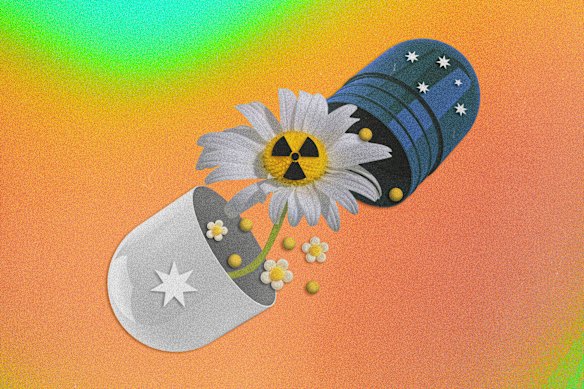
In 2024, the program gave $395,000 in seed funding to The Daisy Project, an effort to make a drug that can protect the body from radiation.
The Daisy Project’s leader, Professor Christopher Sweeney, spent months alongside his colleagues and industry partners applying for a further $3.2 million grant from AEA to firm up an Australian manufacturing route. But the project is now in limbo.
“We have developed a therapy which has the ability to protect civilians and military personnel from radiation exposure in a nuclear attack, as well as developing it as an anti-cancer agent,” says Sweeney, a professor of medicine at Adelaide University.
“We’re ready to actually make the drug at scale to put this into patients for clinical trials.”
The drug is made from the feverfew flower. Within the daisy-like bloom, scientists discovered a potent compound called parthenolide, which has anti-inflammatory and cancer-busting effects.
Sweeney and his colleagues created a derivative of the compound called DMAPT, which can be taken orally and is easily absorbed. In mouse studies, DMAPT shielded organs from the severe effects of radiation, including tissue fibrosis and reproductive damage.
The researchers aim to craft the compound into a pill that offers multi-organ protection for people exposed to high levels of radiation, such as soldiers and astronauts.
In the nearer-term, the drug could be given to cancer patients undergoing radiation therapy. In healthy cells, DMAPT triggers stress pathways to generate protective antioxidant proteins, bracing the body for the inflammation and DNA damage inflicted by radiation.
But in cancer, the compound has the opposite effect: DMAPT seems to shut down those same pathways in tumours, making cancerous cells more vulnerable to radiation.
The result could be a drug that weakens aggressive tumours while guarding the rest of the body against nasty side effects of cancer treatment.
The US Food and Drug Administration and the Biomedical Advanced Research and Development Authority (BARDA), the body which initiated America’s Operation Warp Speed for the invention of COVID-19 vaccines, have endorsed the drug’s development plan.
The aim is to make the drug in Australia and export it to the world. A Barossa Valley company that’s part of the project, Black Squid Distillery, invested in new equipment to extract the key compound from feverfew using ethanol.
Sydney pharmaceutical company Abinito would take the resulting product and manufacture it at scale into a therapeutic drug, using a new and patented formulation.
The researchers and industry partners laboured over their application to AEA to make the plan a reality, only to learn the entire fund had been axed ahead of the budget.
They want to keep the project in Australia, but must now consider moving it to the US.
“We were ready to launch if we got funded from the AEA,” Sweeney said. “There is a real chance we’ll actually have to take this offshore to other countries for manufacturing at a cheaper rate, potentially, and lose that sovereign capability.”
Applications such as Sweeney’s may not have been successful even if the AEA had maintained its funding, but what scientists are frustrated by is the mass cancellation of applications already written, submitted and vetted. Many groups, including Sweeney’s, had already been interviewed by AEA application panels.
“A lot of people are saying this was a massive waste of time … we could not remember such a case when the funding was cut at the stage when the grants were already submitted,” said Ilya Shadrivov, a physics professor at the Australian National University.
He had applied to the AEA to make a prototype of a new kind of battery which can translate excess renewable energy into hydrogen.
The saga raises the question of whether Australian science is better off after the budget.
The $387.4 million given to CSIRO and an increase to disbursement from the Medical Research Future Fund were desperately needed, said Ryan Winn, chief executive of peak body Science & Technology Australia.
But the loss of the AEA and other funding redirections and cuts, including a blow to environmental research programs, amounted to a loss of $1.5 billion in grants across the sector.
“This has been really a budget which gave with one hand and took from another. I think it’s fair to say this budget creates a leaner, and probably a bit meaner, science system,” Winn says.
“The Australian Economic Accelerator was purely about partnering between universities and industry, and actually creating the commercialisation and translation we know we desperately need,” he says, to compete with high-spending countries such as the US and Japan.
In just-released analysis, the Australian Academy of Science applauded measures including improving a tax incentive for businesses to invest more in R&D and implementing a National Resilience and Science Council, a recommendation of the recent Ambitious Australia report on the research system.
But the overall trajectory of national investment in research and development – which stands at 1.7 per cent of GDP, far below the OECD average of 2.7 per cent – has not manifestly improved.
“The measures announced signal genuine commitment to reforming Australia’s broken R&D system,” academy president Professor Chennupati Jagadish said.
“However, the $1.5 billion over the forward estimates for research and science agencies is funded by cuts to existing research programs, which does nothing to begin reversing the long-term decline in overall research investment.
“Australia’s science system needed a step-change; what it has received is a starting point.”
A government spokesperson said total investment in research and development was projected to reach about $15.1 billion for 2025–26, acknowledged the “significant effort” researchers had put into AEA applications and said the education department was providing universities with information on alternative programs.
The Examine newsletter explains and analyses science with a rigorous focus on the evidence. Sign up to get it each week.
 Angus Dalton is the science reporter for The Sydney Morning Herald.Connect via X or email.
From our partners
Disclaimer : This story is auto aggregated by a computer programme and has not been created or edited by DOWNTHENEWS. Publisher: www.smh.com.au