It is for birds? Is it for planes?
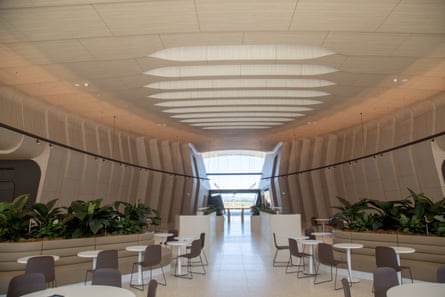
The sleek, rust-coloured saucer settles into the earth, mirroring the surrounding hills. It looks like an art gallery or a high-end conference centre – an architectural masterpiece designed to sit lightly on the land.
Until you see the shed behind it.
The sweeping lines are the gateway to a $600m poultry processing plant that will, at full capacity, process 3 million chickens a week.
Located in Tamworth, 300km north of Sydney, the new facility is owned by Baiada, one of Australia’s two largest chicken producers and the owner of household brand names Steggles and Lilydale Free Range.
At its height, two lines will process 15,000 birds an hour as chickens fly through state-of-the-art chilling systems and automated packing machines en route to supermarkets across the state. The new plant will support more than 1,000 jobs, with workers able to spend their lunch breaks at an on-site cafeteria, at a gym or in landscaped gardens.
Jeff Budd, deputy mayor of Tamworth regional council, has toured the facility, which opened last week. He says the unusual design creates a gem for the city and will attract the skilled workers and technicians needed to run kilometres’ worth of conveyor belts and systems.
“I think it’s massive for the entire region,” he said. “The Baiada company … certainly made it look that way. Once you’re inside that main building at the front, it’s like a five-star hotel.”
Australians are voracious chicken eaters, consuming an average of 55kg of chicken meat per person per year. Almost half of all meat eaten in Australia is chicken, and consumption has doubled in the past 30 years. More than 800 million chickens will be slaughtered this financial year to meet the demand.
Once fully operational, the Oakburn facility will account for almost 20% of that.
“We’re happy to see a commitment from a Sydney-based company to one of their regional hubs, to put in such a sophisticated [facility],” says Prof Stephen Walkden-Brown, the interim director of Poultry Hub Australia at the University of New England. “It’s a pretty big development, one of the most modern plants in the world.”
In a media release, Baiada said the company had “grown alongside” the Tamworth community for six decades, and the facility reflected the company’s commitment to the city.
“This is a long-term investment in Tamworth and the people who have supported Baiada for generations,” managing director Simon Camilleri says. “Our history in this region stretches back to the 1960s, when Charlie Baiada first established operations here, and this facility reflects our confidence in the future of Tamworth.”
But it did not answer questions about whether the new facility would also deliver improved animal welfare outcomes.
Jed Goodfellow, the director of policy and government relations at the Australian Alliance for Animals, said while the Baiada building may be state of the art, he believes “the welfare model behind it is anything but”.
Slowing the growth
A leading welfare issue, Goodfellow says, is the speed at which meat chickens grow.
“Chickens are still being selectively bred to grow at extraordinary speeds, with their bodies paying the price for ever greater efficiency,” he said. “Healthier, slower-growing breeds are now being used in many parts of the world, particularly Europe, with Norway, the Netherlands, and France producing higher welfare breeds at scale.”
“It may cost slightly more, but as their experience shows, the increase is not prohibitive, as European consumers increasingly opt for the healthier option.”
Melina Tensen, the senior scientific officer for farm animals at the RSPCA, said about 97% of chicken meat sold in Australia abides by the organisation’s welfare standards.
“It’s a pretty big deal to have most of industry achieving standards to go well above the legal minimum,” Tensen says. “Wherever animals are farmed for food – and they’re going to be farmed for food for a long time to come – we want to be in there making sure that animals are raised and handled and transported and slaughtered in ways we find acceptable.”
Welfare standards were updated this month to promote lower stocking density, variable light intensity in sheds – to allow chickens to choose between brighter and darker areas – and the phasing out of a slaughtering method called electrical water bath stunning. Those changes must be enacted by 1 January 2031 for businesses to keep their RSPCA certification.
At the same time, the RSPCA has released a new category of “enhanced” welfare standards, which are primarily focused on encouraging producers to rear slower-growing breeds. Most of Australia’s commercial chickens are two fast-growing breeds, the Ross 308 and the Cobb 500, which reach slaughter weight at between four and six weeks of age.
Tensen said the RSPCA would ultimately like to see chicken meat producers replace fast-growing breeds with ones associated with higher welfare standards, but consumers would have to help achieve that transition.
“The longer it takes to grow, the greater cost,” she said. “We definitely encourage consumers to be vocal about supporting this transition … because every dollar you spend is a message to the retailer.”
Disclaimer : This story is auto aggregated by a computer programme and has not been created or edited by DOWNTHENEWS. Publisher: theguardian.com