

How do you legitimise a sport which involves two men running at each other at high speed, seeking to cause as much damage as possible to the other party? Which health experts have repeatedly warned could be life-threatening – and in one example was life-ending?
For starters, you need a permit.
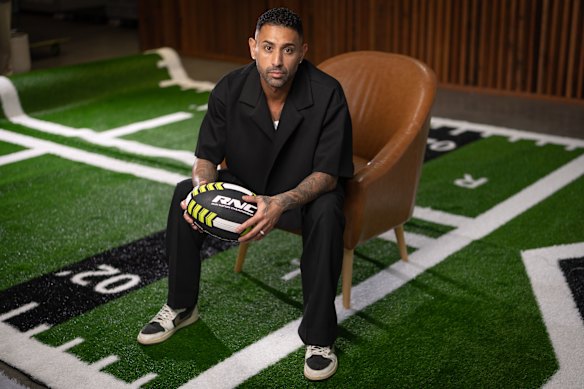
Inside a complex of small warehouses in the inner-city Sydney suburb of Alexandria sit the Run Nation Championship (RNC) headquarters. In one of the units, Tremaine Fernandez is preparing for the competition’s next event, on November 28 – which will take place only after a court temporarily prevented it being held.
Fernandez appeared in September as a witness in a case he brought against the state regulator for combat sport in the NSW Supreme Court, in a bid to overturn its decision to cancel the fourth edition of the competition. His case was unsuccessful.
But outside the court, Fernandez told reporters RNC wasn’t going anywhere, and instead vowed to work with the authority to gain a permit to hold the event. That has now been obtained, this masthead can reveal, and the Run Nation Championship is good to go.
“I think a lot of outsiders looking in get brought in by the hysteria and some of the headlines, which is ‘sport to be banned’ or ‘unsafe’,” Fernandez said. “The Supreme Court hearing was about regulation, not about safety.”
Fernandez, though, is not naive to the criticisms directed at RNC. Instead, he says, he shares many of the same concerns about unregulated, backyard versions of the sport, even though an event like it is what drew him into investing in the first place.
Fernandez did not create the concept of two men running at each other. The internet trend known as “run it straight” started off as a backyard game across Australia and New Zealand, with videos gaining viral popularity.
When Fernandez tried to acquire the rights to a backyard competition, its founders opposed his vision of turning it into a global sport.
“I wanted to institutionalise it,” he said. “Change up the rules completely, bring in the safety protocols that we’ve had since the start. Take it from a spectacle to a sport.”
As “run it straight” videos generated millions of views, critical comments started filling their comment sections, too.
The backlash increased after the death of a 19-year-old man, Ryan Sattherwaite, in New Zealand after he and his friends participated in the trend at a birthday party in a park.
“The death in New Zealand was horrible,” Fernandez said. “From the best of my knowledge, I think it happened at a party or something like that. But it was from these guys who are running the backyard versions at a viral level. I disagree with how those events were run. It’s the reason I couldn’t get into business with them.”
While Fernandez says he has enforced rigorous safety protocols since creating his own rule book in 2025, RNC hasn’t been without scares of its own.
At his second event, a collision resulted in both participants being knocked unconscious. Footage of the two men lying on the running track was clipped and posted on Instagram, where it generated 37.5 million views.
“We had a 20 per cent circa concussion rate,” Fernandez says of that event. “Too high. It was also a little bit sickening. I saw the footage and I said, ‘How many times could an athlete do this?’”
Fernandez said he consulted sports scientists who recommended shortening the distance each participant runs from to slow them at the point of collision.
Fernandez claims this change, combined with safety protocols enforced by RNC organisers from the outset, have made RNC the safest “run it”-style competition in the country. It’s also why he’s not concerned about the potential for future lawsuits brought by RNC athletes that could replicate those in other codes in Australia and overseas.
He says the organisation is actively seeking to introduce more ways to test brain health, including mouth guards trialled by World Rugby which light up when there is heavy contact with the head, and has one of the most conservative concussion protocols in Australian sport.
The return to play period after a concussion in RNC is 90 days (similar to professional boxing guidelines), compared to 11 days in the NRL and12 days in the AFL.
“Would I call it unsafe? I think every sport’s got risk, any contact sport has risk,” Fernandez said. “It’s how you handle it. What protocols do you have in place? And I think we are arguably the best in the country at doing it.
“I don’t think the NRL does a better job than us, I don’t think boxing does a better job than us – or the AFL. We are using technology that is used in Formula One and the NFL which guys here are just starting to use, and we’re using it from day one.”
At their last event, RNC3, of more than 80 individual runners, not a single athlete became concussed, Fernandez says. At a recent event in Queensland, he said there were no knockouts and one grade one concussion from illegal shoulder contact.
“These are now professional athletes,” Fernandez says. “You shouldn’t be trying this at home. This is something that is regulated, it’s in a controlled arena, there’s a referee, and they’ve been having a 12-week camp to get to this moment.”
On November 6, Fernandez received a permit from the Combat Sports Authority (CSA) to hold the RNC4 event.
His athletes and promoters will now be included on the CSA’s register, and subject to additional health checks including serology tests. CSA officials will also attend future events.
Although Fernandez is excited about RNC becoming a regulated sport (“we want to set the bar so high that these backyard guys can’t get into it”), he said the existing legislation that governs combat sports in NSW needs to change to accommodate new sports.
His view is shared by the NSW Office of Sport, which referred the legislation to a Parliamentary Inquiry. Its first hearings took place earlier this month.
“We’re working with the authority at the moment and they are being fantastic,” he said. “There’s a really great relationship being formed. However, it’s really clear to us that a lot has to change in its current framework to accommodate us.”
Collision sports, including RNC, will be considered alongside other emerging combat sports including face-slapping and bare-knuckle boxing. But Fernandez believes his competition is worlds away from the others.
“The rules in bare knuckle are to constantly deliver blows to the head and, even if you’re opponent looks unconscious, to keep going until the referee stops you,” he said. “We don’t have that in our sport. Our sport is built on trying to perfect a technique.”
News, results and expert analysis from the week in sport sent every Friday. Sign up for our Sport newsletter.
From our partners
Disclaimer : This story is auto aggregated by a computer programme and has not been created or edited by DOWNTHENEWS. Publisher: www.smh.com.au





