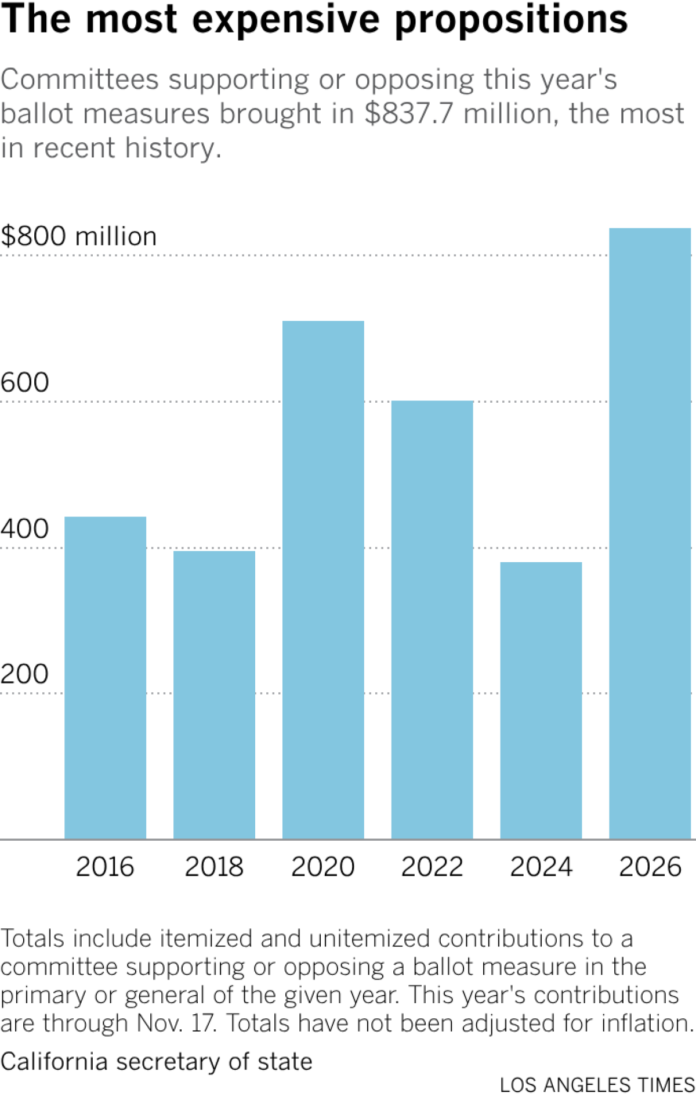
More than $1 billion was donated to 2026 California ballot measure campaigns, a figure that shatters spending totals on propositions in prior elections, according to a Times analysis of state fundraising records.
The outsized influence of money in the current initiative process erodes the goal of California leaders who created the system more than a century ago to give the state’s residents a direct voice in governance. Instead, it has turned into another channel for moneyed and powerful voices to craft laws that shape Californians’ day-to-day lives.
While the state has seen enormous spending in prior years, notably over a 2020 battle about whether ride-share and delivery drivers ought to be classified as employees or independent contractors, and sports-betting measures in 2022, no prior election eclipsed the money spent on this year’s ballot measures, without adjusting for inflation. The 2020 contest set the prior record.
Rick Hasen, a campaign-finance law professor at UCLA, said that while the level of 2026 spending is notable, it was driven by the issues on the ballot, notably the proposed billionaire tax.
“There was a lot of spending. There’s a lot at stake. California is a big state. There’s a lot of money at stake in a lot of these ballot measures,” he said. However, “I don’t think we can necessarily draw conclusions about overall spending on ballot measures in California based on this election, because that was a very specific, targeted ballot measure that was targeted against literally the wealthiest people in California, and so it provoked a big spending spree in response.”
More than $837 million was donated to campaigns supporting and opposing the 14 ballot measures on the Nov. 3 ballot, and nearly $179 million was spent on proposals that were withdrawn before the election, according to state campaign finance disclosures as of Nov. 17.
The vast majority of the money — more than a half-billion dollars — was spent opposing Proposition 40, an unsuccessful one-time 5% levy on billionaires’ assets crafted to offset federal healthcare spending cuts, and supporting two counter measures designed to nullify the tax.
Building a Better California, a billionaire-backed group opposed to the tax, argued that it would ravage California’s volatile budget, which already is overly dependent on state tax revenue from high earners. They spent at least $300 million on the three entwined efforts.
“Prop. 40 took direct aim at both California’s economic engine and its state budget, putting at risk the long-term revenue that funds education, healthcare, public safety, and all the other essential services Californians rely on,” said Abby Lunardini, spokesperson for the group. The proposed tax on billionaires’ assets “was objectively terrible policy and a lose-lose for California, and voters clearly agreed.”
Among the major donors to the committees opposing the billionaire tax were Google co-founder Sergey Brin, who donated more than $130 million, former Google leader Eric Schmidt and venture capitalist L. John Doerr, who each kicked in more than $40 million.
Brin and Doerr did not respond to a request for comment, while a representative for Schmidt said he was unavailable for comment.
The well-funded effort against the billionaire tax, which divided California Democrats and their allies, notably labor, was successful.
Proposition 40 failed, while the results were split over two initiatives crafted to undermine it. Voters rejected Proposition 41, which was framed as an effort to cut wasteful government spending and require audits of new special taxes. But they approved Proposition 42, which was presented as protection from state lawmakers taxing every Californians’ retirement funds, personal savings and home equity.
Though vastly outspent, one labor group contributed significant funds supporting the billionaire tax. Proposition 40 was proposed by the Service Employees International Union United Healthcare Workers West in response to legislation signed by President Trump last year that could result in millions of Californians losing Medi-Cal coverage, rural hospitals closing and other medical services being slashed. The union spent more than $32 million supporting the effort.
However, other unions either spent money opposing it or sat on the sidelines, reflecting a broader rift in the Democratic party and its allies about the proposal.
Labor interests were united in their support of a tangentially related ballot measure backing an existing tax on the state’s high earners, spending about $88 million supporting Proposition 3. The successful proposal made permanent a temporary levy that added 1% to 3% to the state income tax of single filers who earn more than $360,000, joint filers who make more than $721,000 and heads of household who earn more than $490,000. Voters passed the tax in 2012 and extended it in 2016, but it was set to expire in 2031.
Tia Orr, executive director of SEIU California, said that while the union prioritized making sure the existing wealth tax was made permanent, it didn’t anticipate spending a significant amount of money on Proposition 3 because of a lack of opposition. But polling showed support for the ballot measure dropping as voters saw messaging opposing the billionaire tax and anti-tax policies in general, resulting in SEIU and its labor allies spending $80 million to make sure Proposition 3, which largely funds public education, passed.
“A lot of ads on [the billionaire tax] just continued to force the numbers to go down, which created, I would say, some panic at the end,” Orr said. “No one assumed, and I mean, no one assumed, we were going to have to invest that much to keep that thing afloat.”
The union also spent money opposing Proposition 43, which would have raised the threshold for approving certain local tax initiatives from a simple majority to two-thirds of the vote, as well as Proposition 39, which would have required voters to present government-issued ID every time they cast a ballot.
“We were protecting our progress and defending core values like our democracy, advancing our goals,” Orr said. “The threats were loud and clear, especially when it gets to something like Proposition 39. Right, and we had to make sure that we invested considerable resources in defending our democracy.”
The powerful California Teachers Assn. spent nearly $70 million supporting Proposition 3, as well as opposing the voter ID proposal.
“Educators prioritized their support … to not only protect billions in vital funding for public schools, healthcare and other critical services, but to safeguard the hard-fought voting rights that are foundational to our Democracy,” said CTA President David Goldberg, adding that the union’s members knocked on the doors of nearly 400,000 voters to highlight these issues.
The California Democratic Party, which received significant financial support from the state teachers’ union, also spent heavily opposing Proposition 39.
Unlike the billionaire tax, there was a clear partisan split over the proposal, with nearly 6 in 10 likely voters opposing the effort and more than a third supporting it, split largely along party lines, in a late-October poll by UC Berkeley that was co-sponsored by the Los Angeles Times.
“California Democrats made defeating Proposition 39 a top priority because our voting rights, our democracy and our way of life were on the line,” said state party chairman Rusty Hicks. “We invested big, organized relentlessly and helped crush this Trump-backed attack on our elections by a staggering 21 points. This was proof positive that when California Democrats organize and fight, we win.”
Other November ballot measures that saw significant spending include Proposition 38, a successful effort to create an $8.4-million bond to fund immunology and immunotherapy research to fight disease.
Critics argue that the wording of the proposition ensured that more than $4 billion of the funding will be invested in the nonprofit California Institute for Immunology and Immunotherapy, which was cofounded by physician Gary Michelson. The billionaire contributed $68 million supporting the ballot measure.
Michelson’s representatives did not respond to a request for comment.
More than $73 million was donated to efforts supporting and opposing efforts to reform the California Environmental Quality Act, a landmark 1970 law that was once sacred in the state’s Democratic politics but has faced increased scrutiny because of the state’s massive shortage of affordable housing.
Proposition 45 would have shortened the timeline for review of some infrastructure and other projects, including housing, water, transportation and internet access, and winnowed the courts time to review CEQA lawsuits. It was overwhelmingly rejected by voters.
In 1911, California created the process for citizens to shape their state’s governance through the initiative process to effectively bypass the state’s elected officials and create their own laws. The move was part of an effort heralded by Gov. Hiram Johnson to give power to the people, part of a legislative effort that also created the ability to recall elected officials.
But political operatives argue that Johnson’s intent has been subverted by the modern political environment, where the only groups that can qualify proposals for the ballot given the significant signature requirements are well-funded interests. That’s why Californians routinely run into out-of-state workers being paid up to $15 for every signature they gather outside of a Trader Joe’s, Target or other storefronts to qualify a proposal for the ballot.
It’s no longer “a tool of the average citizen,” said Brandon Castillo, a veteran ballot measure strategist in Sacramento. “It’s the exact opposite of what Hiram Johnson intended — [giving citizens] the [ability] to push back against the Legislature.”
Castillo, who worked on three proposals on the November ballot, added that while voters want to get rid of systemic problems in Sacramento and trust themselves more than state leaders, there remains an intractable maxim.
“This has always been the case,” Castillo said. “You can’t take money out of politics. Particularly out of ballot measures.”
More to Read
Disclaimer : This story is auto aggregated by a computer programme and has not been created or edited by DOWNTHENEWS. Publisher: latimes.com