Book Review
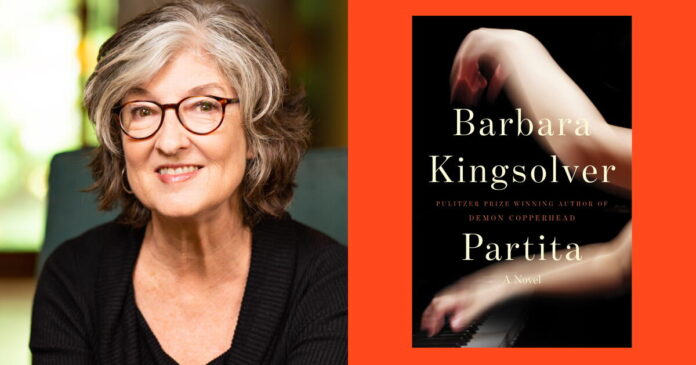
Partita
By Barbara Kingsolver
Harper: 352 pages, $32
If you buy books linked on our site, The Times may earn a commission from Bookshop.org, whose fees support independent bookstores.
Barbara Kingsolver writes the type of quips you want to scribble onto a Post-it note and revisit because you’re glad someone else said it better. A hallmark of the decorated novelist’s work is her flair for pithy sentences that illuminate the human experience, giving voice to our private longings and secret vulnerabilities.
Her 19th book, “Partita,” is classic Kingsolver.
The author’s grand and ambitious novels are written with warmth and a whimsical attunement to the human condition. She tackles broad ideas by personalizing them through singular characters, as seen in her Pulitzer Prize-winning “Demon Copperhead” (2022), an Appalachian reimagining of Dickens’ “David Copperfield”; “The Poisonwood Bible” (1998), her eerie family tale of abstruse colonial evangelism; and “The Lacuna” (2009), a political tale of art and silence. Her hyper-local studies of identity, misunderstanding and discovery shine in her debut novel, “The Bean Trees” (1988), its sequel, “Pigs in Heaven” (1993), and the oft-taught tale of loss and familial discovery, “Animal Dreams” (1990). Kingsolver’s fans appreciate her ability to play at vastly different scales.
“Partita” returns readers to the author’s focused and personal realm. It starts with a phone call that upends its protagonist’s world. Livia Cable has made a tidy life of her quiet, sensible marriage: teaching youth piano lessons in her native Tennessee, where she’s also trying to sort through her deceased mother’s belongings. Her college lover, Sigurd, calls out of nowhere and asks to see her. Their young romance ended predictably, and poorly. Sigurd’s phone call forces Livia to confront the stories she’s told herself about her identity in the decades since she split from the handsome activist with the “syncopated grin.” In different hands the ordinary premise might not work, but Kingsolver offers more: She gets into the spaces between these notes and dances around.
Narrated in chapters titled by musical movements, drifting between these two timelines, and accompanied by a playlist of classical hits that Livia knows by muscle memory, Partita slowly reveals what happened between the lovers and how Livia was wounded. Kingsolver complicates the truth of Livia’s backstory, revealing a brother who died by suicide when Livia was 11, a mother overtaken by paralyzing loss, and the two life-changing catastrophes — including an “ancient injury”— that permanently changed Livia’s destiny.
Perhaps more than any of her other novels, “Partita” is Kingsolver on Kingsolver. She cleverly explicates her own writing through her discussion of classical music. In her college days, Livia’s gift enlivens her nimble fingertips so that can take on the toughest of compositions. But she’s a philosophical musician, and in the days after she’s contacted by Sigurd, she considers her life for its parallels to the music she learned by body and spirit. That’s “why I love Bach,” she says: “because of balance. Not a flat-out symmetry of Question: Answer. That would be Mozart. Bach is more winsome, making his opening promise, then taking it out for a little walk around, which is called fortspinning, and then, finally, inevitably, delivering heart-in-hands the conclusion he had you longing for. You could count on it.”
This fortspinning is Kingsolver to a T; fans will recognize that she’s always writing toward this Bachian kind of tension, and that she excels at this same kind of weaving. As she’s said in many interviews, each of her books begins with a question, and Kingsolver’s novels often include a musical notion of refrain. She doesn’t give simple answers, taking greater satisfaction in exploration. The walking, the dancing, the complication is, of course, where she comes alive, and often her novels conclude in a comfortable — if not easy — resolution.
Much of Livia’s discomfort when Sigurd calls comes from confrontation with her flawed self-identity. Cowed by her mother’s cruelty, Livia never imagined herself fitting in at her Boston music school. She spent her teens fighting her mother’s limited view of gender and desire that results in her harsh punishment. There is “risk in [ambition],” Livia muses, “for a girl especially, among people who let you know there is no greater sin than parading yourself around. How easily pride can get chased into a burrow of humiliation.” Here is Kingsolver underscoring the audacity of creativity and expression: They require a measure of self-confidence at odds with outward humility or silencing oneself for the comfort of others. Kingsolver makes this a more complicated notion by gradually revealing Livia’s secrets as well as her mother’s, and the two characters’ interactions exist in a realm beyond a simple critique driven by rural sexism or small-mindedness.
“Partita” is a meditation on how a composition is different each time a musician plays it. It is different for the listener, too, as their personal experience, emotion and corporeal self rise to meet each note. We are “[l]iterally, moved. The tension pulls us forward into the unresolved strain and throws us back as we’re released… It’s a language we’re born knowing.”
In this vein the novel is a kind of rewriting, delving specifically into motifs of Kingsolver’s novel “Animal Dreams”: the uncommunicative parent/child relationship, letters from an absent sibling, faulty memory, the weight of inheritance, the slow unspooling of closely held secrets, the freedom of self-made ceremony, and the quirks of small-town community. Readers familiar with that book will find much to love. Yet nothing is a retread, because Kingsolver brings the full weight of her experience and her other work to the page in this entirely new story. It hits the same chords, but it is full of discovery and insight. She’s different, and we’re different too.
“It’s never the same music the second time through, and maybe that is the point.”Kingsolver takes joy in exploring these notes again, and it’s our pleasure to listen.
Partington is a school librarian in Elk Grove, Calif., and a board member of the National Book Critics Circle.
More to Read
Disclaimer : This story is auto aggregated by a computer programme and has not been created or edited by DOWNTHENEWS. Publisher: latimes.com