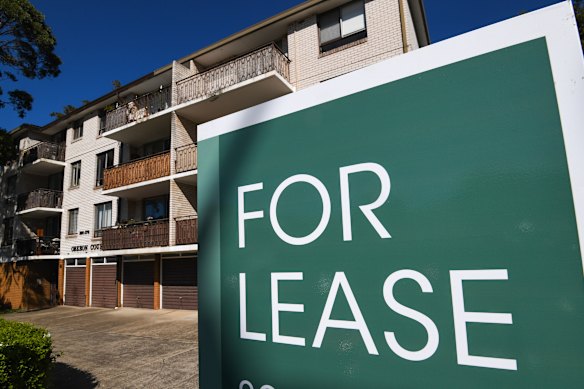

Barely half of Victorian rental properties meet minimum standards, new research shows, despite a Victorian government push to improve conditions for renters.
More than 11,000 rental housing audits – about 2 per cent of Victoria’s rental stock – were conducted by a private, third-party auditing and consulting business, Property Compliance Victoria, to help rental providers understand their obligations, before being analysed by a La Trobe University report, the first of its kind.
The audits took place between March 2021 and May 2024.
The report found only 54 per cent of landlords were compliant with 14 minimum standards set by the state government in 2021. The standards include the provision of a functional kitchen, energy-efficient heating in the main living area, lockable external doors and a mould-free, structurally sound and waterproofed home.
The standards with the highest compliance rates included working toilets (100 per cent), vermin-proof bins (99 per cent), and laundry facilities (98 per cent). In contrast, measures for mould and dampness (73 per cent) and bathrooms (79 per cent) had the lowest compliance rates.
Lead author Dr Anisur Rahman, a data analytics expert at La Trobe, said PCV initially contacted him to help sift through complex, raw data they had gathered during their audits.
What struck Rahman was the variation in compliance pass rates linked to the suburb’s socioeconomic status.
Disadvantaged suburbs showed higher failure rates in bathroom and electrical safety standards, while mould issues were widespread across socioeconomic groups, the report found.
“There are some suburbs where the performance is around 20 per cent, like in Thomastown and Lalor,” he said. “Mould and dampness in particular is very concerning, as it only a 73 per cent compliance rate. This interested me, as I wonder if it’s causing health-related issues.”
It comes as asking rents for Melbourne units are at a record high with a median of $600 a week, while house rents are at $590, just $5 below their record, according to Domain data.
But PCV sales director Craig Topp believes the story is more nuanced.
“We deal with property managers on a daily basis and see what they’re doing and how rental providers are behaving specific to minimum standards … but all we were seeing in the press was the negative stuff,” he said.
Topp cited confusion around how different standards are assessed as well as considering tenant behaviour with issues like mould.
“I asked La Trobe to tell me, of the properties that failed mould, which ones passed structural soundness (another standard), which ones passed ventilation, and which ones had a normal moisture meter read?” he said.
“If the room is structurally sound, if it’s well ventilated and if there’s no moisture in the structure of the building, then it shouldn’t be deemed a fail because the mould is going to have been caused by tenant living habits.”
Applying these criteria halved the number of mould-based failures, Topp said, and left most compliance failures simple to rectify.
“They’re not major fixes – it’s not as though these places that fail are falling down, festering with mould,” he said.
“It’s usually simple things like a new block-out blind in that bedroom, or a new lock on that back door.” The average cost of fix these issues was less than $700, Topp said.
Topp said once rental providers were given PCV’s report and had the issues explained to them, they resolved them in 27.5 days.
“So not only are rental providers willing to put their hands up and invest in getting a check done when they’re presented with a professional report and communicated to well, they actually take action and invest again to get the stuff done,” Topp said.
Tristan Sime has lived in his Maidstone house for 10 years, during which time little to nothing has been done to upgrade it. Despite this, his rent keeps going up, as his house is being compared to newer properties in the area.
“I took the place [because it] needed a lot of work, it was run down in a developing area,” he said.
“There has been an upswing since then … and I get compared to places which have split systems and are clean and well-maintained … while I live with a crack in the main door that’s never been addressed.”
Sime said new minimum standards in Victoria applied only to new renters, while long-term tenants were ignored.
“When it comes to any maintenance beyond the barest minimum, I have to go to VCAT,” he said.
“I’ve had four leaks in the last six months, and it took months to resolve, even though in Victoria, any leaking is considered an emergency. The owner won’t sign on off any repairs.”
Damien Patterson, director for policy, advocacy and engagement at Tenants Victoria, said while only 54 per cent of the properties in the report passed compliance, it was ultimately a good story.
“Every one of those landlords was actively checking that their property was meeting minimum standards and seeking to come into compliance – it’s the type of behaviour we seek to encourage,” he said.
Better enforcement of minimum standards was the second-biggest issue renters want fixed in the rental system, Patterson said, pointing to a Consumer Policy Research Centre (CPRC) 2025 report about the reality of renting. The first issue to fix was better regulation of rent increases.
He wasn’t surprised that mould and damp was the second-highest compliance failure.
“As Victoria enters into the cooler months, we get a lot of requests about information about what renters can do about mould in the property that they’re renting,” Patterson said, adding it was important for landlords to consider maintenance costs – and not just rental income – especially if they were purchasing cheaper property.
A Victorian government spokesperson said: “With the latest of our more than 150 rental reforms introduced to parliament this week, such as capping lease-break fees, Victoria is leading the nation on renters’ rights.”
Consumer Affairs Victoria’s renting taskforce has also focused on properties rented out that don’t meet minimum standards.
Property listings
From our partners
Disclaimer : This story is auto aggregated by a computer programme and has not been created or edited by DOWNTHENEWS. Publisher: www.smh.com.au