My grandmother had a string of Basra pearls that felt inseparable from her. When I picture her, I almost always see the strand at her neck, getting tangled up in the folds of her dupatta. As a child, I found the pearls curious because they did not look like the ones I saw on television or in jewellery advertisements. They were slightly misshapen, didn’t match, yet they had a gleam that would keep you looking.
I did not know then that they were heirloom Basra pearls from Hyderabad being worn by a woman far removed from her homeland. Years later, I would learn that this is how Basra pearls often survive now, through old family pieces and antique jewellery.
Their history stretches far beyond the family cupboard. In 1865, Maharaja Khande Rao Gaekwad of Baroda commissioned an object that sounds almost mythical now: a canopy embroidered with approximately 950,000 Basra pearls. Christie’s describes the surviving Baroda Pearl Canopy as one of two extant pieces from a five-part suite, purportedly intended for the tomb of Prophet Muhammad in Medina. Its pearls were worked with emeralds, sapphires, rubies and coloured glass beads in elaborate floral arabesques, creating one of the most extraordinary surviving examples of Indian royal craftsmanship.
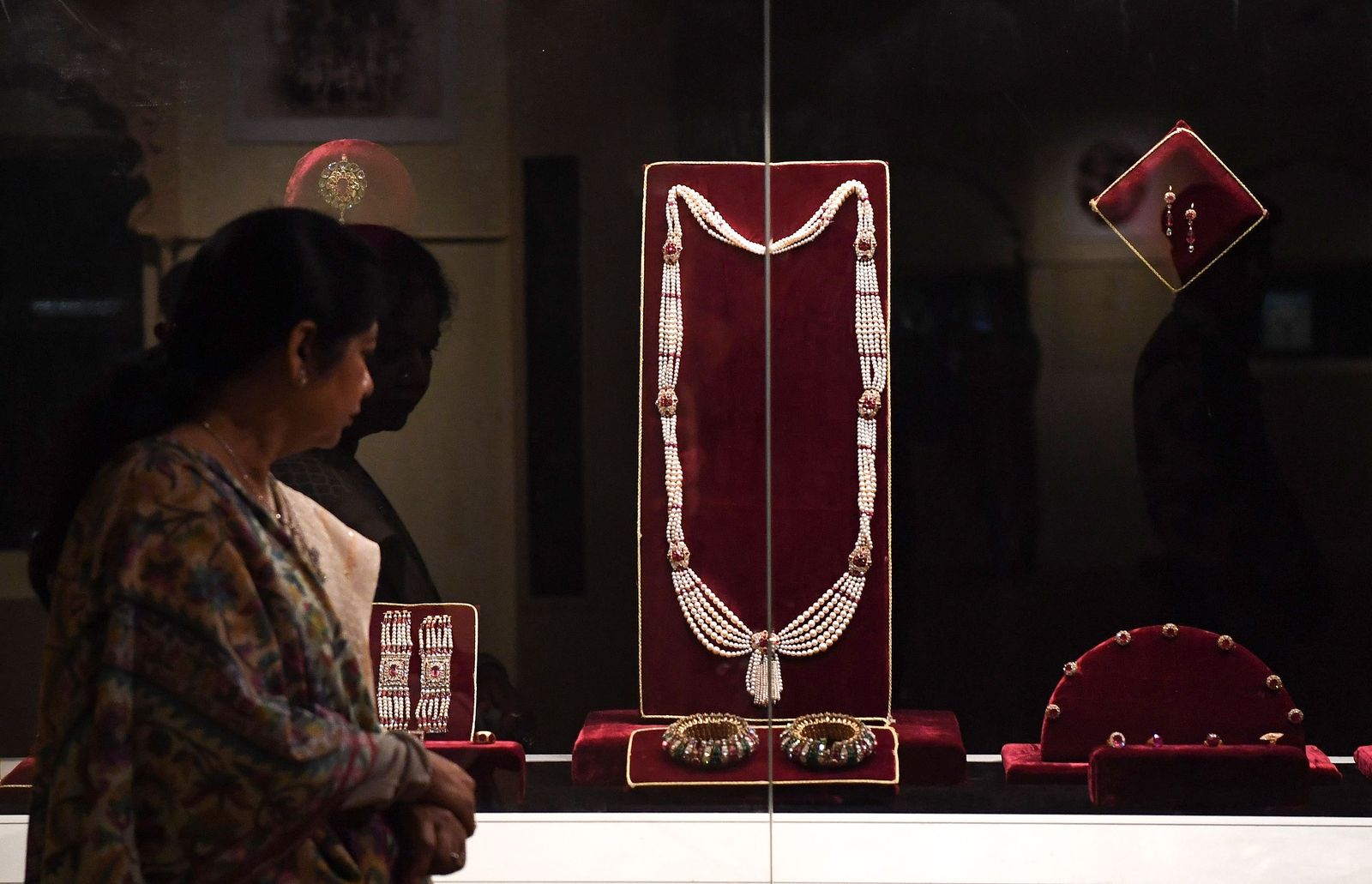
By the mid-19th century, the pearl trade between the Arabian Gulf and India was at its height, with some of the finest natural pearls sold through the Iraqi port city, Basra, to Indian merchants and royal patrons. In Hyderabad, they entered another jewellery tradition, appearing in Nizami satladas, including the much-cited seven-strand necklace of 465 pearls set with diamonds, rubies and emeralds. In Mahrashtrian traditions you will spot them on naths and tanmani necklaces.
So what exactly are Basra pearls, why are they so rare and how can collectors tell whether they are authentic? We asked the experts at Shree Raj Jewellers, Raniwala 1881 and Raj Mahtani Couture Jewels.
What are Basra pearls and how are they different from cultured pearls?
Unlike cultured pearls, which are produced through controlled cultivation, Basra pearls form naturally in oysters. That distinction changes how they look and how they are valued. One may curve slightly, another may catch the light faster, another may sit a little apart in tone. For collectors, these variations are proof that the pearl was formed naturally rather and not by human intervention.
Raj Mahtani of Raj Mahtani Couture Jewels says one of the biggest misconceptions is that “value and price comes from perfection.” With Basra pearls, he says, collectors and connoisseurs are drawn to “natural pearls with their organic and subtle glow, and artisanal quality.”
An Indian visitor looks at the jewellery displayed at the ‘Jewels of India: The Nizam’s Jewellery Collection’ exhibition at the National Museum in New Delhi on February 19, 2019. – One of the largest diamonds in the world, the Jacob diamond weighing 184.75 carats, along with 173 precious jewellery items from the collection of the Nizam of Hyderabad collection, are on display at the Indian National Museum from February 19 to May 5. (Photo by Prakash SINGH / AFP) (Photo credit should read PRAKASH SINGH/AFP via Getty Images)PRAKASH SINGH/Getty Images
Disclaimer : This story is auto aggregated by a computer programme and has not been created or edited by DOWNTHENEWS. Publisher: vogue.in