
One of the most dependable cliches of contemporary Spanish politics is that it never pays to bet against Pedro Sánchez. Time and time again – as leader of the Spanish Socialist Workers’ party (PSOE) and as prime minister – Sánchez has shown an almost preternatural ability to profit from adversity, and to confound expectations and wrongfoot his opponents.
But next month’s snap general election, called by Sánchez after rightwing and far-right parties voted down the housing reforms his coalition government had announced in response to angry protests, may suddenly not be the contest it once was.
Wednesday’s deadly rail collision, in which at least 69 people died, has, for the moment at least, subdued much of the vicious language and posturing that has come to characterise recent elections. The crash could sap Sánchez’s recently resurgent momentum and the issue of rail safety now threatens to overshadow his attempts to defend his record and remain in the Moncloa palace.
The poll the left had billed as a last chance to stop the conservative People’s party (PP) joining forces with the rightwing Vox party to roll back decades of social progress – and which the right had billed as an opportunity to end eight years of what it disdainfully calls sanchismo – will now take place in a country deep in shock and grief.
Not only has Spain’s extensive high-speed railway long been a source of national pride, it is also a transport network that millions of Spaniards depend on for work, holidays and family visits. This week’s crash, after another on the same line that killed 46 people in January, has left people angry, bewildered and worried.
Thursday’s headlines spoke for themselves. El Mundo’s front page lamented “Another massacre on the trains”; ABC’s noted “At least 68 dead nine months on”, while El País mourned the “Second high-speed catastrophe in less than a year.”
Even before Wednesday’s terrible events on the outskirts of Urda, Sánchez and his allies were facing a battle. As well as the housing protests, the prime minister has had to contend with a slew of corruption allegations surrounding his family and inner circle, while his government’s handling of the mass crossing into Spain’s north African territory of Ceuta over the summer had been fiercely criticised at home and abroad.
Pablo Simón, a political scientist at the Carlos III University of Madrid, stressed the delicacy of the moment, saying that people across Spain were still struggling to come to terms with what had happened this week.
“There are a lot of fronts [for the government] here, and I think this accident has a twofold impact,” he said. “First, it draws attention to the state of railway infrastructure, suggesting that the problem is structural, and pointing to a broader decline in public services in Spain, specifically regarding infrastructure.”
Simón said that Sánchez’s government, which has been in power since 2018, could not blame the state of things on its PP predecessor, which carried out austerity cuts. “That’s simply not credible,” he said.
“But there’s also a second issue: even before this, the government faced an uphill battle; it was already highly unlikely that they could secure the necessary support.”
Sánchez has said it is “unacceptable” for the country to experience two high-speed rail disasters in less than a year, and promised to strengthen safety measures “so that something like this never happens again”, but his opponents say that is simply not good enough.
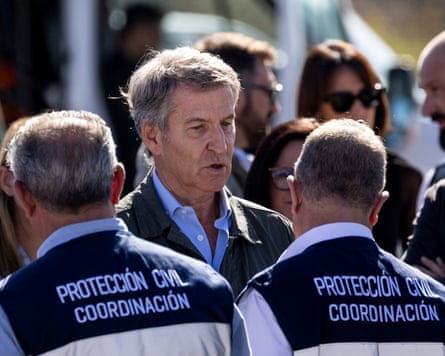
The PP leader, Alberto Núñez Feijóo, said on Thursday that any politician found to be responsible for the crash would be held to account, adding: “We can’t go on like this; this kind of management just can’t carry on.” According to the PP, Spaniards are not asking for “miracles; they’re just asking for a Spain where things work again”.
Vox, on the other hand, is going all out, accusing the government of “killing” the train crash victims and of systemic mismanagement and cronyism. It has also urged the supreme court to investigate Spain’s transport minister, Óscar Puente, on suspicion of manslaughter and causing bodily harm through gross negligence. Puente has rejected allegations of mismanagement, insisting that Spain’s railway system is “safe and reliable”.
Simón said the contrasting reactions of the PP and Vox reflected splits on the right, as both parties compete to put an end to Sánchez’s government: “The question becomes what tone should one adopt: a more institutional one, which is what the PP is currently attempting, or a tougher, more aggressive one, which is what Vox is doing?”
He also suggested the sombre national mood could make it very hard for Sánchez to rally as many as 1.2 million “politically dormant” but PSOE-leaning voters, on whom he had been counting. The electoral event the prime minister had hoped to portray as a Manichean clash between progressives and reactionaries, fought over issues of housing and equality, has morphed into something else.
“An election campaign relies on high spirits and a sense of optimism,” Simón said. “But how can that exist when the entire country is in mourning over this tragedy?”
Disclaimer : This story is auto aggregated by a computer programme and has not been created or edited by DOWNTHENEWS. Publisher: theguardian.com