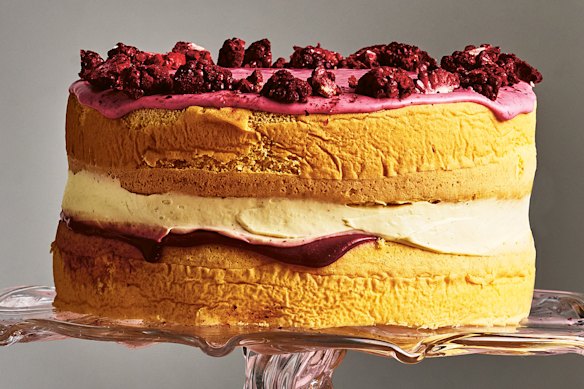
Made with “a fairy’s touch” and tips from a nun, this is the sponge that Natalie Paull loves the most.

When I meet Natalie Paull at her local North Melbourne cafe, she rattles off the three bakes currently occupying shelf space in her home fridge, including her favourite cheesecake − the one she clearly loves the most.
Since closing her dearly beloved Beatrix shopfront a few blocks away, the bestselling author has kept her beaters spinning, investing time in developing recipes and hobby baking, from tackling her “terrible” fear of choux pastry to perfecting pineapple jam for hummingbird cake (both bakes feature in her third cookbook, Sweet Heart).
She’s poured her heart into testing recipes for home bakers: “I think that my calling − or my purpose, my all-purpose − is to give people that confidence of opening a pack of flour, [and] feel they can tackle a cake for the first time, and have something lovely come out.”
‘To know that someone will go forward in life and be making one of my recipes, that is, that means, the world to me.’
Natalie Paull
The original All-purpose sponge cake from her debut cookbook Beatrix Bakes is a fan favourite (“people say, I didn’t ever think I could make a sponge, and then I made yours, and now I make it all the time), but the following improved-upon recipe is “the one she loves the most”.
The resulting “cottony” cake is inspired by childhood memories of the “perfect” sponge, sandwiched with whipped cream and topped with thick passionfruit icing, that would make regular appearances at her best friend Lesley’s house, itself adapted from a nun’s recipe, which called for sifting the flours nine times, and whipping the eggs for nine minutes.
The best recipes from Australia’s leading chefs straight to your inbox.
Paull’s recipe doesn’t quite go that far, but there are plenty of signature tips and “Trix”. She generously shares some extras with Good Food, over a piccolo chased with a filter coffee.
Despite a recent rise in baking pop-ups, don’t expect a Beatrix bake sale or John Farnham-style comeback tour. “When you gently close the door, it’s probably best just to respect that it stays closed.”
But the next best thing is her recipes, and their enduring legacy.
“To know that someone will go forward in life and be making one of my recipes, that is, that means, the world to me.
“I loved what I did at the shop, I loved what I was making for people, and people were so in love with what we did there, but it’s also really beautiful to be in [their home] kitchens, that there was a recipe that goes on the table, every birthday or celebration − that’s amazing.”
Just like that “nun’s sponge” made by her best friend’s mum, of which she’d eat two or three slices apiece.
Here are Paull’s sponge-making secrets, starting with her No.1 tip.
The essential ingredient
Cornflour, but not the one that’s made from corn (or maize). Paull insists on using wheaten cornflour, an “old timey, CWA” ingredient made from, you guessed it, wheat.
While Paull says standard maize-based cornflour is fine for custards, wheaten cornflour is always the best cornflour to use for dry applications, and helps the sponge rise.
She stocks up in country or independent supermarkets (look for Fielders or home brands) and keeps some spare in the fridge for longevity.
Cracking egg myths
- Size doesn’t matter. Because Paull specifies separate combined weights for yolks and whites, the size of your eggs isn’t an issue. Paull suggests buying jumbo eggs (900g) at markets, which are often better value.
- Neither does freshness: “Fresh eggs give you less volume, but a more stable foam. Older eggs give you more volume, but less stable. So by the time you fold it in your flour and other things, you’ll pretty much end up with the same amount.”
Peachy keen
Custard powder is an addition to the OG recipe, a “tiny little nod to the [Australian] tradition” that adds a “nice peachy tone” to the cake, especially if the yolks aren’t very vibrant.
Fairy dust
Sifting the dry ingredients multiple times is not about aerating the flour; rather, it’s to incorporate the cornflour and plain flour, which “don’t make friends very easily”.
“If you [only] sift it once, when the cake’s baked, you’ll see a heavier layer, and then a lighter layer on top.”
‘I think we’re so worried about being fast, that we forget to be gentle. I like to slow everyone down.’
Natalie Paull
While the nun’s recipe called for nine sifting shifts, the Beatrix recipe below is technically six, if you count the final “fairy blanket” sifted directly onto the egg foam.
Sticking with the enchanted theme, this floury blanket should be folded in with a “fairy’s touch”.
“I think we’re so worried about being fast, that we forget to be gentle. I like to slow everyone down.
“When you’re folding, you’re very gentle and the movement, but it’s very intentional. You’re not just being fluffy with it.”
Fold in with a metal whisk; Paull finds the sturdy tines are more effective at cutting through the dry ingredients than a spatula.
Put it on ice before you slice
It’s not just the flours that need to get to know each other. Paull recommends filling the sponge, wrapping and chilling it in the fridge a day in advance, so the cream can meet the sponge surface.
“Because you’ve exposed the crumb [by shaving the tops], the crumb extracts a bit of moisture from the cream. It holds together a bit better, so you don’t get so much of that squidging out the sides [when slicing].”
Glaze the cake straight from the fridge before serving. “Ideally, the cake is room temperature, but the cream is cold. If I had to be really pedantic, cut a piece of sponge [straight from the fridge], let it sit for five minutes. Eat it.”
Top ‘n’ fill
Beatrix’s cakehouse (aka cake cabinet) was always stocked with a seasonal sponge that changed weekly.
“We would match a curd to the icing. Sometimes we would do a lime curd inside and a raspberry glaze on top, which was delicious; we would do Seville [orange] curd with an orange glaze on top − that’d be the most beautiful curd. We’d dice up fresh strawberries, put them in pomegranate molasses or vincotto, a bit of sugar, and let them macerate and put them in, so it’s a real strawberry sponge.”
Paull says blackberry jam is a fine substitute for the blackberry and lime curd (see recipe).
“If you’re buying [jam], put a little squeeze of lemon into it, or a little bit of vanilla, just to zhuzh it up a little bit. Even if you’re buying a bottled lemon curd, I would put some fresh zest into it, to give it that little thing that it loses from being jarred.”
Or you can simply sandwich it with whipped cream and dust the top with icing sugar − cream is Paull’s sponge non-negotiable, and never to be skimped on.
A treat for the chef
“[At Beatrix] the whole benches will be covered with sponges being filled, 20 sponges, all open, cream going round, curd going round, or jam. The cakers would take the tops off, and then they’d put any excess cream and curd inside them, or jam, and roll them up into little tiny sponge rolls for us to eat a snack. It was the best treat ever.”
The Beatrix Bakes featherlight sponge cake
There is little in this world more sensorially pleasing than biting down into layers of pillowy light cake, on the cusp of too much cream, and a thick, sweet, fruit-forward glaze. There is also little in the baking world more confounding than a sponge cake recipe. This signature bake from my little shop started as a hybrid of the best and most foolproof features from myriad sponge recipes – a firm meringue foundation, hot milk and butter at the end for feather-lightness, and always wheaten cornflour. This sponge cake recipe is the proud, glazed beauty you may have sunk your teeth into on Queensberry Street.
INGREDIENTS
Sponge layers
- cooking oil spray
- 210g egg whites, plus 120g egg yolks, from approx. 6–7 eggs
- ¼ tsp cream of tartar
- 170g caster sugar
- 70g soft plain flour (8–9% protein), plus extra regular plain flour (10% protein) to dust the tins
- 70g wheaten cornflour
- 20g custard powder or extra cornflour
- ½ tsp (3g) baking powder
- ⅛ tsp (1g) fine sea salt
- 15g unsalted butter
- 50g/ml full-fat milk
- 1 tsp (5g) vanilla bean paste
Filling
- 360g/ml whipping cream (35% fat)
- 1 tsp (5g) vanilla bean paste
- ½ batch Blackberry & lime curd (see recipe below)
Sour cream glaze
- 50g frozen blackberries
- 200g icing sugar mixture
- 60g full-fat sour cream, plus extra as needed
To finish
- freeze-dried fruits (optional)
METHOD
- Prepare your equipment Preheat the oven to 170C fan-forced. Tin prep is everything for this sponge. Lightly spray two 20cm round, 5cm deep cake tins with cooking oil spray and line the bases only with a snug circle of baking paper. Spray the paper base lightly again. Sprinkle the insides of the tins with a little extra flour and tap out the excess. This helps the batter grip the sides as it rises. Spray only the bases one last time and very, very lightly.
- Make the sponge batter Put the egg whites and cream of tartar in the bowl of an electric stand mixer with the whisk attachment (or use hand-beaters). Whip on just below high speed for 3–4 minutes until the whites change from foamy to a stiff and creamy white. Once glossy, gradually add the sugar, a tablespoon at a time, over 3 minutes, to make a shiny and very stiff meringue. While the whites whip, sift the flours, custard powder, baking powder and salt five times and leave the sieve on top for later (see Top Trix 1, below).
Place the butter, milk and vanilla in a bowl or saucepan ready to heat (microwave or stovetop). When it comes time to add these to the batter, they should be very warm.
As soon as all the sugar has been incorporated, tap the meringue off the whisk into a wide bowl. Scrape in the rest of the meringue. Fold the yolks in until the mix is marbled apricot coloured. Sift half the flour mix over the foam, then fold with gentle intent with a balloon whisk until it is almost incorporated. Heat the butter/milk now while you sift over the remaining flour, folding until completely incorporated and beginning to stiffen. (See Top Trix 2, below)
Working very quickly now, pour the warm butter, milk and vanilla mix gently around the edge of the bowl and fold in with the balloon whisk, using gentle but decisive folding strokes until the batter is well mixed but still fluffy. - Bake! Divide the fluffy batter between the prepared tins – approx. 300g/ml each – and quickly smooth the tops. Bake for 16–18 minutes until the sponge tops are a light golden colour and springy to the touch. Remove the cakes from the oven and lightly spray the tops of the cake with cooking oil. Flip them gently out onto the rack and remove the tin, then carefully peel back the paper. (If they steam in the tin, they will toughen.) Leave to cool completely for 40 minutes. Do not flip topside up until cool. When cool, flip the sponge cakes top-side up and don’t worry if some of the top crust comes off. Shave the tops off both the sponges with a sharp serrated knife.
- Make the filling Whip the cream and vanilla until billowy soft but starting to hold its form.
- Fill the sponge Smooth the blackberry curd over the cut side of the base cake. Pile the cream on top and place the second layer trimmed side down to sandwich. Push down gently to coax the cream to slightly squish out the sides. Swipe around the sides to neaten up the cream. Wrap a collar of plastic wrap around the sides of the cake and then a piece on top lightly. Chill for a minimum of 3 hours or overnight. (See Top Trix 3, below.)
- Glaze the cake Zap the frozen blackberries until most of the juice has evaporated. Add to a wide bowl along with the icing sugar and sour cream. Hand-whisk hard – it will take a moment to get a paste happening. From here, add teaspoons of sour cream as needed until the glaze is a thick paste with a ‘lazy ooze’ consistency after moving your whisk through. It must be spreadable yet not runny. If it is super runny, add more icing sugar – it will be sweeter but at least it will set. Unwrap the cake. Pour almost all the glaze (hold back approx. 1 tablespoon) into the centre and push towards the edges, taking care not to tear any of the crust as you smooth. Sprinkle on the crushed freeze-dried fruits, if desired.
- Keep and store Refrigerate for up to 2 days. Wrap a collar of plastic wrap around the circumference of the cake. Press plastic wrap up to any cut sides if you have taken a slice. Can be frozen for up to 3 months, but the cream can behave badly and weep (the liquid separates) when thawed.
Top Trix
- Sifting isn’t to add air to a batter. Sifting is blending. Flour and cornflour and custard powder don’t mix well unless sifted together multiple times. If you skip this mixing, the flours incorporate into the batter at different rates, and you get a lumpy batter.
- Fold well before adding the milk/butter. You want to start feeling a taut resistance when folding and see the volume start to drop a smidge. These are your two cues to add the milk. If you add before that, the egg is not fully protected by its flour jacket and will deflate.
- During this chill period, the sponge draws in the cream’s moisture, both firming the cream (so, it doesn’t squish out when you cut) and moistening the sponge. The layers fuse, so your sponge layers have structural togetherness.
Blackberry & lime curd
My mea culpa for the narrow fruity prejudices I have held for too long that berries are for jams and citrus is for curds. Once I stopped pigeonholing the potential of berries, I can honestly, hand on heart declare this rich, tangy, maroon slick of berry butter a godsend for every tart, cake, scone and pavlova it meets.
INGREDIENTS
- 125g fresh blackberries
- 1 large lime (choose one that yields when squeezed, to confirm juiciness)
- 80g caster sugar
- 60g unsalted butter, squidgy soft (22C)
- 60g egg yolks, from approx. 3 eggs
- ¼ tsp (2g) citric acid
METHOD
- Set up a double boiler over a low heat to simmer.
- Whiz the blackberries in a food processor, then strain, pushing the pulp vigorously through a fine non-reactive sieve into a bowl. Weigh the puree – you need 110g/ml. If underweight, top up with extra pureed blackberries or lime juice. Discard the seeds.
- Add the lime zest and juice the lime. Add all the zest and 20g/ml of the juice to the blackberry puree. Add the remaining ingredients to the blackberry/lime juice and hand-whisk well until just combined.
- Cook the curd Place the bowl over the double boiler. Hand-whisk often but not constantly. Scrape the side of the bowl down each time you whisk – the mix at the side will cook faster, so you want to incorporate that regularly. Cook and temp check the curd to 82C – always whisk the mix before testing. The curd will look thick and gloopy and your whisk will leave raised marks in the mix when lifted out.
- Chill Remove the bowl from the double boiler and leave aside to cool, whisking occasionally while it cools so a thick skin doesn’t form on top. Scrape the curd into a jar or tub, press a small piece of plastic wrap on the surface (preventing a skin forming) and chill for 2–3 hours (minimum 1 hour). Pop the lid on when it has fully chilled so no sweat forms. (Sweat development accelerates the formation of mould.)
- Keep and store Refrigerate for up to 7 days, or freeze for up to 3 months – thaw in the fridge.
Makes about 220g curd
Adaptrix
Can I use frozen blackberries? Yes, but thawed frozen fruit can yield less juice so start with extra fruit – approximately 180g.
Thaw at room temperature or express-thaw in the microwave. Whiz and strain the juice as per step 2.
Frozen raspberries Conversely, frozen rasps yield more juice than their fresh friends. Use 150g frozen raspberries (thaw at room temperature or in the microwave). The curd will turn a subtle crimson.
This is an edited extract from Sweet Heart by Natalie Paull, photography by Rochelle Eagle. Murdoch Books RRP $49.99.
From our partners
Disclaimer : This story is auto aggregated by a computer programme and has not been created or edited by DOWNTHENEWS. Publisher: www.smh.com.au