
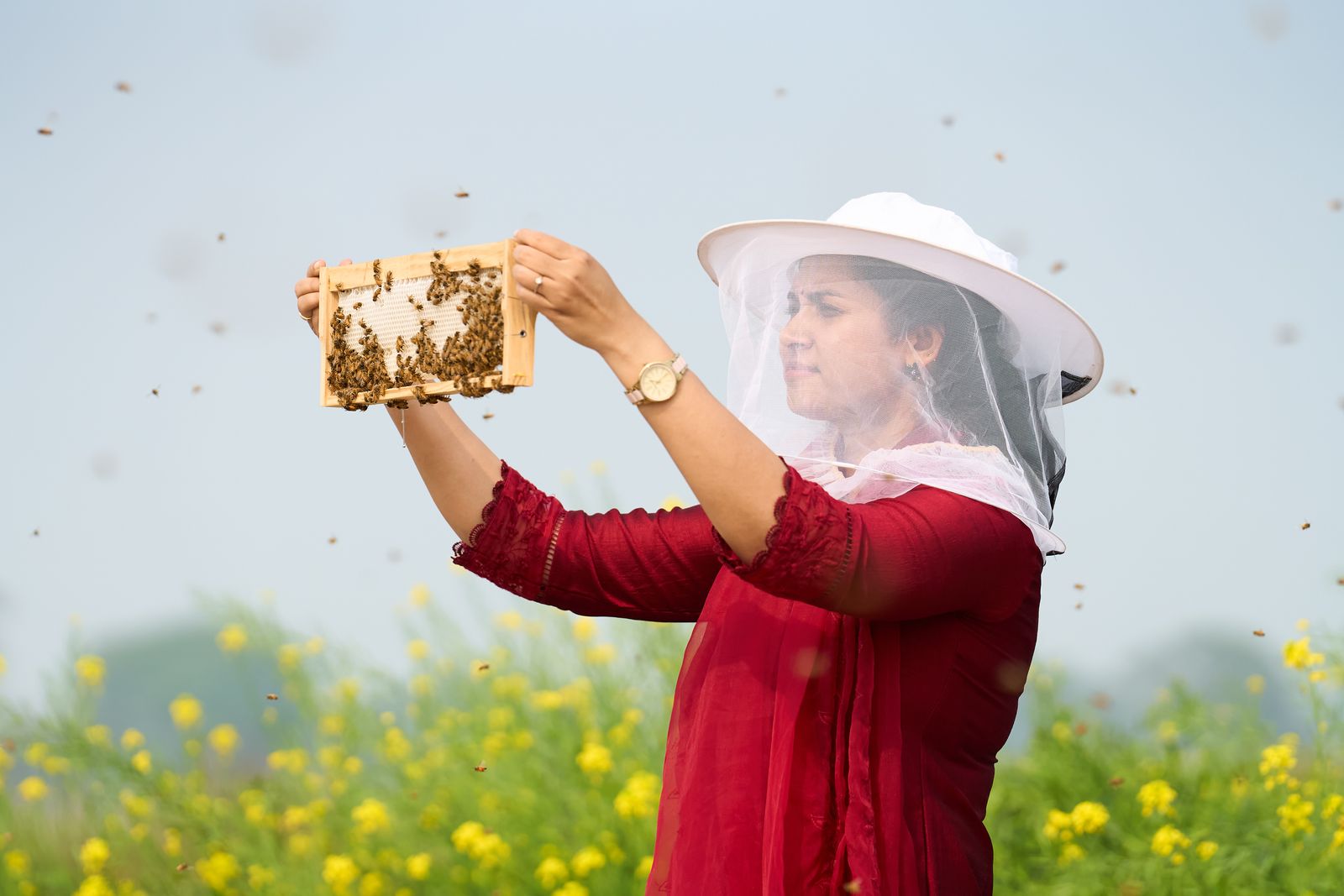
In India’s vast agricultural landscape, the beekeeper has traditionally been imagined as a man: face veiled, smoker in hand, hauling heavy boxes through mustard fields under a punishing sun. Bees, after all, are still widely associated with risk, sting and brute endurance. Which is precisely why Monika Shukla is an anomaly.
At 37, the IIT Kharagpur silver medallist and former Goldman Sachs analyst is building what she calls a “pollination economy”: a sprawling network of rural women beekeepers across India who are earning independent incomes while helping restore biodiversity and agricultural resilience. Earlier this year, her work was recognised by the Cartier Women’s Initiative, a global platform celebrating women-led impact businesses. But spend a few minutes speaking to Shukla, and it becomes clear that the award, while significant, feels almost secondary to the larger mission buzzing beneath it all.
“We don’t see bees as extractive tools for honey,” she says. “We see them as climate workers.” It’s an unexpectedly poetic framework for a business born out of hard economics. Shukla grew up in Bhilai, Chhattisgarh, in what she describes as a lower-middle-class household where education was viewed as the surest route to stability. Her father worked at the Bhilai Steel Plant; success meant becoming an engineer or a doctor. She dreamt of the latter but ultimately studied electrical and instrumentation engineering instead, before landing the kind of career many Indians are taught to aspire to: Goldman Sachs in Bengaluru, then New York.
But somewhere between spreadsheets and investment banking, something shifted. A stint at the Young India Fellowship exposed her to social entrepreneurship and the possibility that profit, ecology and social change need not exist in separate worlds. It was there that she met Varun Kashyap, a batchmate with whom she has now spent more than a decade building ventures in the social impact space. Together with Vaibhav Trimukhe—a Tata Institute of Social Sciences alumnus who previously worked in the goat value chain—they would eventually co-found Humble Bee.
Disclaimer : This story is auto aggregated by a computer programme and has not been created or edited by DOWNTHENEWS. Publisher: vogue.in



