Rigoletto ★★★★
Sydney Opera House, July 21
It is the “curse” – la maledizione – that drives the drama of Verdi’s Rigoletto. We hear it in the overture’s first portentous notes and in Rigoletto’s despairing cry at the close. Rigoletto believes it ultimately derives from his ugliness, the hunchback that condemns him to a life of humiliation and corrosive bitterness, making him over-protective of the one thing of beauty in his life, his daughter, Gilda.
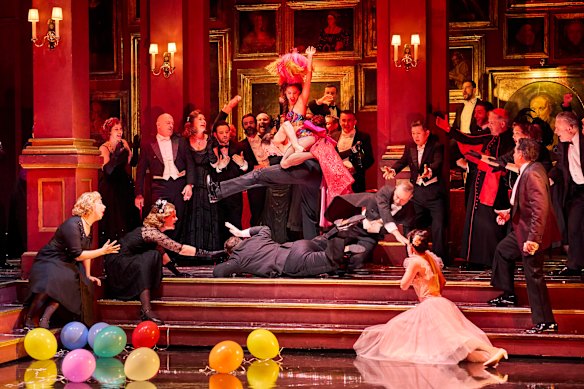
This classic production by the late Elijah Moshinsky transfers that ugliness to the world at large, in particular, the Duke of Mantua’s court, the centrepiece of designer Michael Yeargan’s rotating set. Creating a surprising sense of depth and space on the Joan Sutherland Theatre’s limited stage, it juxtaposes a palace of glittering debauchery, the false sanctuary of Rigoletto’s home and the seedy tavern of the final tragedy, all connected by murderous dark alleyways.
For this revival, Dalibor Jenis sings the title role with a voice of strength and depth, grained with worry and fierce in self-loathing. He is impressive throughout, but never more so than in the crucial reconciliation scene with the seduced Gilda in Act 2 where impotent frustration over his fate mixes with fragile tenderness.
This was also Gemma Nha’s finest moment as Gilda. Here she displayed a wide emotional and tonal range, beginning Tutte le feste al tempio with winning quietness, before rising to thrilling passion. Earlier she had sung Caro Nome in Act 1 with a bright penetrating sound and a tight vibrato that crazed the tonal surface.
Her dramatic persona moved lightly between pertness, filial loyalty and youthful yearning. Kang Wang as the Duke also emphasised lightness rather than power, his attractive tenor sound and strong command of the upper range creating an autocrat of insouciant suaveness rather than overbearing menace.
La donna e mobile had buoyant clarity. Such a nice young man! With an effectively threatening edge to his low notes, David Parkin was an aptly brutal Sparafucile (literally “shoot gun” – you get the idea). As his seducing sister, Maddalena, Sian Sharp sang with colour and strength, injecting an important element of human warmth into the sound.
Gennadi Dubinsky, as Monterone the wronged father, was imposing though slightly less searing in delivering the plot’s actual curse in Act 1 than in his portentous and incisive power in shackles in Act 2.
The Opera Australia Chorus seemed to enjoy their depravity, and sang with an energised, full sound, the male members delivering conspiratorial whispered precision in the kidnap scene and a quite passable soft-shoe shuffle.
Under conductor Sesto Quatrini, the Opera Australia Orchestra highlighted the shudders and flashes of Verdi’s highly original orchestration with discreet balance. Simon Meadows (Marullo), Virgilio Marino (Borsa), Jonathan Alley (Ceprano), Dominica Matthews (a haughtily, ungracious Giovanna), Jennifer Black (Countess Ceprano) and Katherine Wiles (Page) adeptly filled out a cast in which nobody acts particularly admirably.
This production is a gem of Opera Australia’s repertoire though it doesn’t seek to problematise male possessiveness, which is the story’s real curse.
Javier Perianes in Recital ★★★★½
Sydney Opera House, July 20
For the first half, Javier Perianes sat at the piano in reflective rumination as though playing to himself, as he wove together, in an unbroken line of musical thought, pieces by Chopin and Perianes’ compatriot, Manuel de Falla, whose sesquicentenary the concert honoured.
Both composers wrote feelingly of their native country, but refined their authentic voice in Paris. In De Falla’s Nocturno (1896), Perianes blended imitative lines, suggestive of an intimate duet, with smooth tristesse and glowing sound, each phrase cadencing with a characteristic rhythm, like a rhyming song.
Showing remarkable control of line, filigree and shaded nuance, his performance of Chopin’s Nocturne, Op. 27 No. 2 in D flat (1836) was among the most memorable of a memorable night. A group of Mazurkas initiated more active rhythms, although the tone retained quiet radiance. De Falla’s Mazurka (1899) combined melodies of immaculately smooth mournfulness with more vigorous passages in the central section, while in Chopin’s Mazurka Op. 7 No. 2 Perianes lingered on phrases with increasing regret, fading to a whispered hush at the close.
De Falla’s Serenata Andaluza was coloured with sparkling light alternating between dreamy and lively passages. Perianes framed a beautiful, fleetingly glittering, performance of Chopin’s Waltz, Op. 34 No. 2 (1831) with a haunting tenor melody played with his characteristically rich honeyed tone.
De Fallas’ Cancion (1900) was remarkable for its delicacy and controlled changes of sound leading, to the lulling, finely ornamented arabesques of Chopin’s Berceuse, Op. 57 (1843-44). Perianes played all of these pieces with great freedom of tempo, drawing out phrases or hurrying them forward as though to explore their expressive essence.
The second half moved to more extrovert music, beginning boldly with De Falla’s Four Spanish Pieces, one of the earlier fruits of his Paris sojourn. The first of these, Aragonesa, rippled with vitality, while the second Cubana, was infused with expressive rubato led always by the melody.
Montesa was quiet and gently luminous with fleeting energy in the upper reaches of the piano, while the lusty cries that begin the final piece, Andaluza, rang with bell-like clamour. Perianes finished with selections from Albeniz’s Iberia, each piece a miniature tone-poem meandering through soulful melody, watery decoration, spiky energy and brilliant colour. This is music that can sound amiably directionless but with a player of Perianes’ tonal imagination and control it becomes a journey to which one could listen indefinitely.
Rigoletto ★★★★
Sydney Opera House, July 21
It is the “curse” – la maledizione – that drives the drama of Verdi’s Rigoletto. We hear it in the overture’s first portentous notes and in Rigoletto’s despairing cry at the close. Rigoletto believes it ultimately derives from his ugliness, the hunchback that condemns him to a life of humiliation and corrosive bitterness, making him over-protective of the one thing of beauty in his life, his daughter, Gilda.
This classic production by the late Elijah Moshinsky transfers that ugliness to the world at large, in particular, the Duke of Mantua’s court, the centrepiece of designer Michael Yeargan’s rotating set. Creating a surprising sense of depth and space on the Joan Sutherland Theatre’s limited stage, it juxtaposes a palace of glittering debauchery, the false sanctuary of Rigoletto’s home and the seedy tavern of the final tragedy, all connected by murderous dark alleyways.
For this revival, Dalibor Jenis sings the title role with a voice of strength and depth, grained with worry and fierce in self-loathing. He is impressive throughout, but never more so than in the crucial reconciliation scene with the seduced Gilda in Act 2 where impotent frustration over his fate mixes with fragile tenderness.
This was also Gemma Nha’s finest moment as Gilda. Here she displayed a wide emotional and tonal range, beginning Tutte le feste al tempio with winning quietness, before rising to thrilling passion. Earlier she had sung Caro Nome in Act 1 with a bright penetrating sound and a tight vibrato that crazed the tonal surface.
Beethoven’s Emperor Concerto ★★★★½
Sydney Symphony Orchestra, Sydney Opera House, July 22
The works on this program were written over roughly a 20-year span, yet, in their expansive vision and power, changed the course of musical history. Conductor Simone Young and the Sydney Symphony Orchestra played the slow opening of Beethoven’s Symphony No. 1 in C, Op. 21 with majestic breadth, synchronising the plucked strings and wind chords to create a pointed moment of impulsive awakening.
The first movement was judiciously disciplined in tempo and carefully accented, so the effect was energetic without being brusque. Young included the repeats in both first and second movements and, in the latter, allowed an unhurried gracefulness to unfold, tinged with Beethoven’s wry self-mocking that he could be so well-behaved.
The Menuetto was well-articulated and the finale suavely fleet, the players picking up cues of rapidly rising figures with deft wit.
Following this, pianist Javier Perianes played Beethoven’s Piano Concerto No. 2 in B flat, Op. 19 (actually the first written with its origins dating back to the 1780s) with unassuming elegance and light imagination as though adopting the same deferential modesty Beethoven had shown when admitting to a publisher that, although not his best, it could be engraved without disgrace.
Disclaimer : This story is auto aggregated by a computer programme and has not been created or edited by DOWNTHENEWS. Publisher: www.smh.com.au