
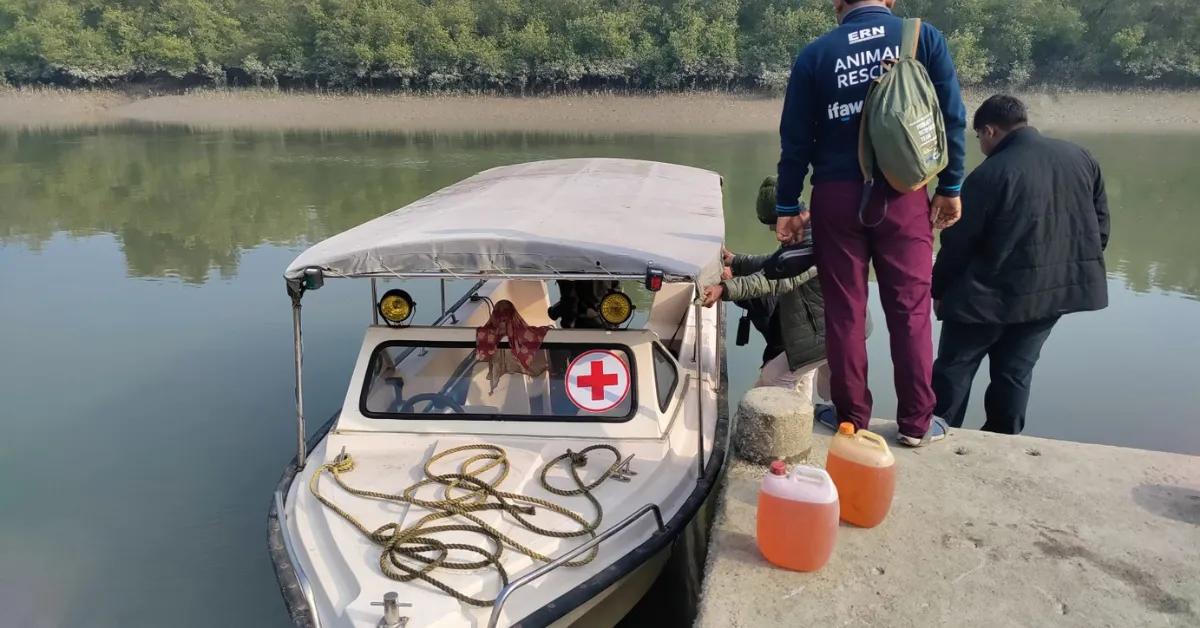
Three men sit shoulder to shoulder inside a narrow wooden patrol boat as it moves through a winding creek in the Sundarbans.
Sheets of monsoon rain blur the mangroves behind them as they patrol one of the many waterways that separate villages from the Sundarbans tiger habitat.
Speaking to The Better Indiafrom the middle of the creek during one such patrol, the men keep scanning both banks on the sides. On one side of the creek lies a cluster of homes protected by nylon fencing. And across the water begins the tiger’s world.
The distance between them is barely a few dozen metres. Actually so small that, during low tide, it appears almost walkable.
“Nodir opare bagh, epare amra, thakte toh hobei ekshathe” (The tiger lives on that side of the river. We live on this side. We have to coexist),” says Pintu Mondal, a member of the Primary Response Team (PRT) of the Wildlife Trust of India(WTI), speaking to The Better India as the boat continues its patrol through the rain.
He watches the opposite bank and smiles.
In the Sundarbans, that coexistence is practically a daily operation.
But a decade or two ago, if a tiger entered a village, the first reaction would have been how not to get killed, or how to kill the tiger before it killed someone else.
A landscape where rivers decide everything
The Sundarbans Delta stretches across nearly 10,000 sq km of India and Bangladesh, making it one of the world’s largest contiguous mangrove ecosystems and one of the highest-priority Tiger Conservation Units globally.
Around 40 percent of the delta lies in India, while the remaining mangroves are in Bangladesh.
The landscape is threaded together by hundreds of rivers, creeks, and estuaries formed by the Ganges, Brahmaputra, and Meghna river systems.
This is also home to the largest single population of Royal Bengal tigers.
On the Indian side alone, the 2022 All India Tiger Estimation recorded an estimated 101 tigers with a density of 4.27 tigers per 100 sq km.
But these are not the tigers most people imagine.
They are smaller than their mainland counterparts, with adult males typically weighing between 97 and 115 kilograms.
Generations of living in saline marshes have shaped them into powerful swimmers capable of crossing tidal rivers with ease. Their coats often appear darker and glossier.
So, what makes a tiger rescue in the Sundarbans so different from almost every other rescue operation?
“For us, these rivers are roads. For the tigers too, these are roads.”, Pintu Mondal answers.
And that changes everything.
In the world’s largest mangrove forest, the only mangrove habitat of the Royal Bengal tiger, there are no forest tracks to follow, no dry ground to chase across. Here, a tiger can swim across a creek with the tide and find itself in the middle of a village.
To understand what really happens next, The Better India sat down with the people behind these rescues, reconstructing — minute by minute — what it takes to guide a tiger safely back home.
Minute 1: Someone spots the pugmarks
The first sign may be fresh pugmarks outside a cowshed. Dogs barking before sunrise.
Someone returning from the field spots movement near a bamboo grove.
Word spreads. The village informs the Forest Department.
The police are alerted.
Members of the Primary Response Team (PRT), trained local volunteers supported through Wildlife Trust of India (WTI), and other such organisations begin moving towards the location.
At this point, everyone knows the first objective, which is simply to guide the tiger back into the forest.
Minute 30: The exits are planned before anyone moves
The Sundarbans cannot be treated like a mainland forest. Every creek, embankment, and mudflat changes with the tide.
“If the tiger has entered from the river, we don’t close that side,” Samrat Paul, Field Officer for WTI’s Sundarban Tiger Project, explains.
“If we push it from the village, it should have an option to swim back.”
Instead, teams begin covering possible escape routes leading deeper into human settlements while intentionally leaving the forest-facing direction open.”
/filters:format(webp)/english-betterindia/media/media_files/2026/07/24/tiger-3-2026-07-24-23-07-56.png)
In the Sundarbans, tranquilisation is rare,” says Samrat.
“The terrain itself makes every decision more complicated, so the rescue is designed around the tiger’s instinct to retreat.”
Minute 60 (in rare cases): The village becomes part of the rescue
Many imagine wildlife rescues as specialists arriving with cages and dart guns. In reality, the first attempt involves no chemicals, just coordinated pressure.
The first objective is always to give the tiger a chance to leave on its own,” explains Samrat, who assists the West Bengal Forest Department and the WTI’s Rapid Response Teams to safely capture and guide stray tigers back into the depths of the Sundarban Tiger Reserve (STR).
Villagers and trained responders position themselves at safe distances while the Forest Department coordinates the operation. Drums are beaten in a steady pattern in synchrony to create a wall of sound that gradually nudges the tiger away from human habitation.
Firecrackers, locally known as potka, burst, and after dark, powerful lights are switched on.
“The idea isn’t to terrify the animal,” Paul says. “It’s to make the village feel unfamiliar and uncomfortable, while keeping the route back to the forest open. A tiger naturally prefers the security of dense cover, so if it has a safe exit, it will choose to return.”
These non-lethal methods are the first line of response recommended by wildlife experts because they encourage the tiger to leave on its own, reducing the need for capture and lowering the risk for both people and the animal.
Most rescues end here.
The tiger slips back into the mangroves.
Minute 120: When the tiger refuses to leave
Sometimes, it doesn’t. It hides inside thick vegetation, or settles in a paddy field, or moves further inland.
Only then do response teams prepare for the next phase: Nets.
The nets used are unlike fishing nets. They are heavy-gauge barriers, often layered twice or three times, designed to gently funnel the tiger towards a safe enclosure or transport crate.
If even that fails, the Forest Department may deploy a steel-reinforced cage fitted with an automatic closing mechanism.
A live bait, usually a goat, may be used under carefully monitored conditions.
Even at this point, the aim remains temporary containment before the tiger is released back into suitable habitat.
Chemical immobilisation is considered only in exceptional situations.
Why does a tiger enter a village?
Why a tiger crosses into a village isn’t always easy to explain. “There isn’t enough scientific evidence to point to one single reason for tiger straying in the Sundarbans,” says Samrat.
“People often assume it’s because the animal is hungry, but we can’t conclusively say that. It could be territorial movement, pressure from another dominant tiger, or even movement during the breeding season. Every incident is different.”
Sometimes, he says, the landscape itself is responsible. “From the opposite bank, a tiger doesn’t necessarily see a village. The riverbanks are lined with mangroves and trees, so what looks like a settlement to us may simply appear as another stretch of forest to the tiger. It swims across, thinking it is entering more habitat, and only after crossing does it encounter houses, livestock, and people.”
Unlike elephants, which move in herds guided by older matriarchs who pass on knowledge of safe routes, “A tiger is solitary. It doesn’t have that kind of inherited road map. It isn’t following another tiger that already knows the landscape.”
There have been rare exceptions. Samrat Paul recalls a radio-collared tiger from around 2008–09 that repeatedly returned to the same area near Pakhiralay despite being relocated. “It kept coming back to the same landscape,” he says. “Eventually, after repeated straying incidents, the decision was taken to translocate it to a zoo. But those are exceptional cases.”
The rescue that lasted a week
Not every rescue ends within hours.
Pintu Mondal remembers one operation in the Kultali landscape that stretched across seven days. The tiger kept shifting through mangrove patches and muddy fields.
As daylight faded, teams turned to drones to look for signs of movement above the dense vegetation.
“At night, drones helped us scan areas that would have been impossible to search on foot,” Mondal explains. “Meanwhile, our boats kept changing position with the tides because the waterways here are constantly changing. You have to work with the landscape, not against it.”
Despite days of tracking, the tiger never entered the cage.
And that, Mondal says, was not a failure.
“In the end, it found its own way back to the forest. That is always the best outcome. If a tiger returns on its own, it means there is less stress for the animal and much less risk for everyone involved.”
He says that such outcomes are more common than people realise.
“In 2025, around the Kultali block alone, we recorded 37 incidents of tigers straying into villages. Only two eventually had to be captured. In almost every other case, the tigers went back on their own.”
Then he points to what has changed the most over the years.
“We couldn’t have managed those rescues without the villagers. Today, they cooperate with us, they inform us quickly, and they help us keep people away from the animal instead of chasing it.”
/filters:format(webp)/english-betterindia/media/media_files/2026/07/24/tiger-1-2026-07-24-23-04-37.png)
One of the biggest reasons rescue operations look different today is the network of Primary Response Teams (PRTs), better known locally as Baghbondhu or “Friends of the Tiger”. Unlike outside rescue personnel, these volunteers belong to the very villages where these conflicts happen.
“The idea behind Baghbondhu is a local feeling,” Samrat Paul explains. “Organisations like ours can support the landscape, but we won’t always be there. The people who live here are the ones who will respond first. So we wanted to build a system where the community itself knows what to do when a tiger enters a village.”
For the Baghbondhus, the role goes far beyond emergency response. They help maintain fencing, assist the Govt Forest Department during rescues, respond to calls involving snakes and other wildlife, and spend much of the year speaking to fellow villagers about how to react calmly when animals stray.
“When the message comes from someone within your own community, people trust it more. They are our own people, naturally when someone from your own village explains what to do, people listen,” Paul says.
A rescue remembered for the wrong reasons
Basudev Mondal, a 34-year-old Primary Response Team member on the boat, now opens up to The Better India. He still remembers a rescue from his teenage years. There were no trained community teams then, so he has witnessed that change firsthand.
“Back then, we didn’t have organised rescue nets or a proper system for handling these situations,” he recalls. “For us, a tiger only meant one thing: danger. The first thought was never how to save it. It was how to save ourselves.”
“In fact, we grew up hearing one phrase all the time, ‘Baghe khabe‘, which is literally (the tiger will eat you),” he says. “Parents would say it whenever children wandered too far from home. ‘Don’t go there, ‘baghe khabe.‘ It became part of our childhood. The tiger was something we feared from the time we were little
That day, a male tiger had strayed nearly six kilometres into their village before taking shelter in paddy fields.
“As soon as people heard there was a tiger, crowds gathered from all directions,” he says. “Everyone wanted to see it, but in doing so they surrounded the animal. Instead of leaving it an escape route, people unknowingly blocked every side.”
The Forest Department eventually reached the spot and prepared to tranquilise the tiger.
“But the tiger was frightened,” he says. “The moment the dart was fired, it charged towards the veterinarian, and both of them rolled and fell into the river.”
The chaos only escalated.
“The tiger managed to get out and ran into a nearby house. It crawled under a bed because it was exhausted and had nowhere else to go,” Basudev Mondal recalls.
Eventually, forest staff managed to wrap the tiger in nets before placing it inside a transport cage.
“But by then the damage had already been done,” he says. “People had beaten it with sticks. Some even pulled out their whiskers. The tiger later died.”
/filters:format(webp)/english-betterindia/media/media_files/2026/07/24/tiger-4-2026-07-24-23-10-02.png)
For Basudev Mondal, that rescue marks how much attitudes have shifted over the years.
“Back then, we didn’t know why tigers were important,” he says. “People acted out of fear because they didn’t understand the animal.”
Today, he says, the response in many villages is almost unrecognisable.
“Now, if someone spots a tiger, the first instinct is to inform the Forest Department or the Primary Response Team. Even when villagers find a snake or a turtle, they call us instead of trying to kill it.”
Better rescue = fewer tiger attack deaths?
It is important to distinguish between rescue operations and tiger attacks. Rescue operations come into play only when a tiger strays into a human settlement; they are distinct from the many human-tiger encounters that occur inside or along forest habitats during livelihoods such as fishing, crab collection, and honey harvesting.
This reconstruction offers a glimpse into how a rescue operation unfolds when a tiger enters a village. But across the Sundarbans, many documented and undoubtedly undocumented human-tiger encounters continue to end in tragedy.
So, rescue is only one part of reducing conflict. Preventing tigers from entering villages remains equally important.
Kultali remains among the blocks most affected by human-tiger interactions in the Indian Sundarbans.
Data compiled by the Association for Protection of Democratic Rights (APDR), an organisation working with the families of those killed or attacked by tigers in the Sundarbans reportedly recorded at least 10 human-tiger encounters this year until May, resulting in eight deaths and two injuries.
For the teams who patrol these creeks, they are careful not to suggest that rescue operations can prevent every human-tiger encounter. Conflicts and fatal attacks can still occur in a landscape where people live inside or along the tiger habitat.
What a rescue operation can do is prevent a tiger that has already strayed into a village from becoming the centre of another tragedy. By calming crowds, creating a safe escape route and coordinating with the Forest Department, the teams work to reduce the risk to both people and the animal.
All pictures and videos by : Wildlife Trust Of India
Disclaimer : This story is auto aggregated by a computer programme and has not been created or edited by DOWNTHENEWS. Publisher: thebetterindia.com







