
Updated ,first published
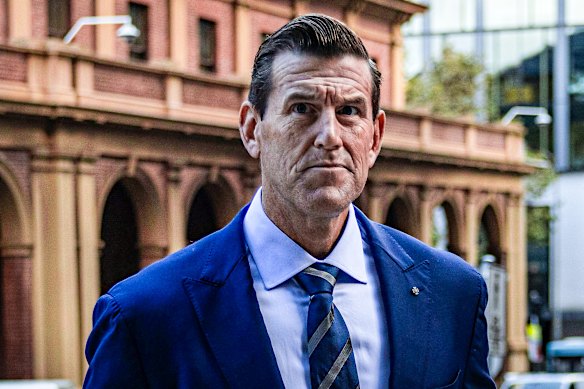
Ben Roberts-Smith’s barrister has told a court the former elite soldier is not a flight risk as he seeks bail after being charged with war crimes over the alleged murders of five unarmed detainees in Afghanistan.
A hearing is under way in Sydney’s Downing Centre Local Court where the former Special Air Service corporal is applying for bail.
Roberts-Smith, dressed in prison greens, appeared via audiovisual link from Silverwater’s Metropolitan Remand and Reception Centre on Friday.
His barrister, Slade Howell, told the Local Court that his client’s defamation proceedings, which resulted in findings on the balance of probabilities that he committed war crimes in Afghanistan, were “not criminal proceedings”.
The defamation case was “decided on a body of evidence that is likely to be nothing like the body of evidence in this case”, Howell said.
“By the time all the evidence is disclosed or otherwise produced, we say a very different picture may emerge as so the strength of this case.
“The court should be conscious of this because there are many unknowns at this stage.”
Howell conceded that if Roberts-Smith was convicted of one or more of the offences he would receive a prison sentence.
Roberts-Smith’s father, former judge Len Roberts-Smith, was offering a “substantial surety with a deposit”. The prospect that the former elite soldier was a flight risk was “fanciful”, Howell said.
Roberts-Smith applied for funding from the Afghanistan Inquiry Legal Assistance Scheme to cover his criminal defence, but has not yet received approval.
The legal assistance scheme is administered by the Commonwealth Attorney-General’s Department. It provides financial assistance for reasonable legal representation and related costs, such as administration costs and travel, to eligible members or former members of the Defence Force.
Roberts-Smith was arrested at Sydney Airport last Tuesday after a joint investigation between the Office of the Special Investigator (OSI) and the Australian Federal Police (AFP).
Those eligible for funding from the scheme include current or former ADF members “charged with a crime in relation to matters that are the subject of the AFP or OSI Afghanistan investigation”.
Caps apply to the amount that may be recovered under the scheme. According to the most recent rates available publicly, dated September 2021, the maximum rate for a senior solicitor including a partner is $550 an hour up to a maximum daily rate of $3000 for six hours.
“Work undertaken by a firm of solicitors must be undertaken at the lowest appropriate level in the firm and billed accordingly,” an assessment of costs document says.
Roberts-Smith was charged last week with five counts of the Commonwealth offence of war crime – murder over the alleged killing of five unarmed detainees while he was on deployment in Afghanistan between 2009 and 2012. The offences must be tried before a jury, and carry a maximum penalty of life imprisonment.
Three of the five counts involve an allegation of aiding, abetting, counselling or procuring the offence of war crime – murder. In addition, he is charged with one count of war crime – murder, and one count of joint commission of war crime – murder.
Under the offence, the alleged perpetrator must cause the death of a person who was “neither taking an active part in the hostilities nor are members of an organised armed group”, when they knew or were reckless about the circumstances establishing that the person was not engaged in hostilities.
The alleged perpetrator’s conduct must also take place “in the context of … an armed conflict that is not an international armed conflict”.
The offence does not apply if “the death of the person or persons occurs in the course of, or as a result of, an attack on a military objective” and the alleged perpetrator did not expect the attack would result in the “the incidental death of, or injury to, civilians that would have been excessive in relation to the concrete and direct military advantage anticipated”.
It must also be “reasonable in all the circumstances” for the alleged perpetrator not to have had that expectation.
Start the day with a summary of the day’s most important and interesting stories, analysis and insights. Sign up for our Morning Edition newsletter.
From our partners
Disclaimer : This story is auto aggregated by a computer programme and has not been created or edited by DOWNTHENEWS. Publisher: www.smh.com.au