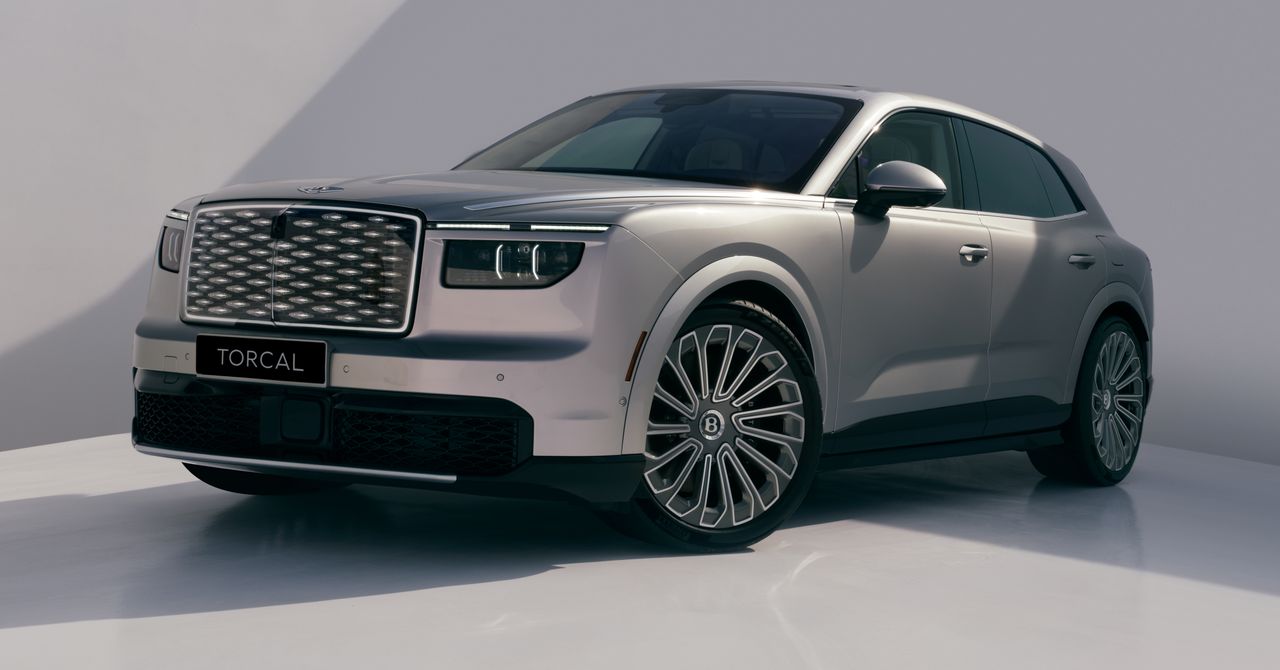
Bentley has taken the covers off its first-ever fully electric car, the Torcal, making it the automaker’s fourth model line, joining the Continental GT, the Flying Spur sedan, and the Bentayga SUV. The luxury brand is confident about the launch, too, with Bentley chairman and CEO Frank-Steffen Walliser saying he believes “this is one of the best Bentleys ever.”
When WIRED first reported on the car in July, we said the EV would have more than 300 miles of range. Well, turns out it has considerably more: up to 375 miles (on the WLTP cycle, maybe 330 miles on EPA), and can charge from 10 to 80 percent in just 16 minutes at 400 kilowatts.
Prodigious performance from a motor on each axle sees the five-seat Torcal—smaller than the Bentayga and so perhaps more of an urban SUV—get 888 metric horsepower (PS) and 1,350 Newton-meters (Nm) of torque in the sporting S models, resulting in 0 to 60 mph in as little as 2.9 seconds and a top speed of 162 mph. The “core” model drops to 821 PS and 1,194 Nm, with standstill to 60 mph in 3.4 seconds, and a max of 155 mph.
However, luxury brands get worried about their existing client bases when they switch to electric vehicles—look to Ferrari as a prime example—so it’s no surprise that Bentley is keen to point out how this new model embodies the finest elements of the brand, just like every other high-end marque does going into electrification. “The Torcal is a Bentley first and foremost,” says the launch literature. “In every aspect of its design, technology, craftsmanship, materials, and sustainability, it is a template for future Bentleys, regardless of powertrain.”
The reason for leaning into brand heritage is obvious on dealership lots. The first-ever EV Bentley will roll off the production line into a decidedly twitchy luxury auto market where Lamborghini shelved its Lanzador electric GT—with CEO Stephan Winkelmann stating demand among its buyers was “going almost to zero, if not to zero”—and Mercedes-Benz selling just 1,450 of its electric G Wagen in Europe through April 2025. Rolls-Royce Spectre sales are down nearly by half, with the brand hoping that a model refresh will turn things around.
And make no mistake that the Torcal is aiming for the luxury dollar. At $218,000 or £173,300 for the base model, and $258,200 or £199,300 for the First Edition S, this EV is priced higher than the Range Rover Electric, which has a similar range and starts in the US at $138,000. But a fairer comparison to the Torcal would be the Range Rover Electric Autobiography model, which clocks in at $208,000. Keep that in mind, and it’s easy to see that Bentley is trying to take market share from JLR with its new SUV: spend an extra $10,000, people, and you can drive off in an electric Bentley instead of a Range Rover.
At 4,983 mm long (161 mm shorter than a Bentayga) and 2,016 mm in width, the Torcal is not far off the size of the Range Rover Electric, but the most drastic difference is in height. The Range Rover Electric towers over the Torcal by nearly 20 centimeters. Also, while Bentley insists the Torcal has off-road chops, it’s probably safe to say the Range Rover Electric will have it pipped there.
Where Bentley wants the Torcal to pull ahead is in the luxury refinements. Despite being smaller than its stablemate, the Torcal is a powerful, purposeful-looking SUV, with a switchable glass sunroof and newly designed light clusters, which are particularly evident at the rear. Unlike the Bentayga, the Torcal roofline drops down at the back for better aero efficiency.
At the front, undoubtedly the most striking visual element of the car is the new Torcal grille: Ventilation to a traditional radiator no longer needed, the upright front is now a solid wall of illuminated acrylic “crystals” that light up as you approach, and on a night in a rearview mirror on a freeway or mountain road will be deliberately unsubtle, and a far cry from quiet luxury.
Inside, Bentley continues to ram home the high-end message. All-round power doors open up to reveal a mixture of OLED screens and physical switchgear. The central display curves pleasingly downward, reminiscent of the new Cayenne, but there is deliberately no separate passenger screen option.
Bentley brought in Fox Brothers to engineer a wool tough enough to be used to panel some of the interior, which is apparently a world first. An attractive new wood finish developed for the Torcal is formed from 1,000 layers of walnut off-cuts and recycled paper pressed together, then sliced to less than a millimeter thick. The Torcal has new massage and power-folding seats, and an optional Naim 1,780-watt sound system with 28 speakers including seat shakers and headrest speakers, as well as Dolby Atmos 7.1.
What’s impressive is the digital trickery Bentley has employed in both audio and visual manners—mirroring the crystal switchgear, Bentley has created animations on the screens that show light passing through cut glass. After trying to do this completely with computer animation, it was decided the effect was not real enough as the model could not account for minute imperfections in the glass which subtly effect the light patterns cast. So Bentley had to film these animations using real crystal instead. The effect of the central console and instrument panel is striking.
Disclaimer : This story is auto aggregated by a computer programme and has not been created or edited by DOWNTHENEWS. Publisher: wired.com