Leaves are a problem of addition by subtraction: Just a couple of mature trees can drop enough debris that you need to remove, and in the process, consume hours of your weekends. Mowing leaves into mulch is a compelling option, but you’ll still need to wrangle them off driveways, walkways, flower beds, and patios. Gas blowers have long been the standard, but rising noise bans, finicky engines that are hard to start, and battery advances are cutting into their appeal.
If you’re on the fence about a leaf blower, know that owning one of any kind will reduce the amount of raking you do, but rarely eliminate it. For small yards, or if you (or your neighbor) have just one medium-sized deciduous tree, a rake and a tarp may be all you need. On the other hand, if you live in an arboretum, the long runtime of a gas backpack blower may be worth the maintenance headaches—unless you’re willing to invest heavily in multiple batteries.
I’ve tested the newest crop of battery-powered blowers on everything from heavy fabric leaves to gravel, mulch, and even knocking over a concrete paver. Today’s models deliver serious clearing power without the gas-can hassle, though runtime is always the primary trade-off. Here’s everything you need to know about battery-powered blowers.


Love WIRED? Add us as a preferred source on Google to see more of us.
Best Overall
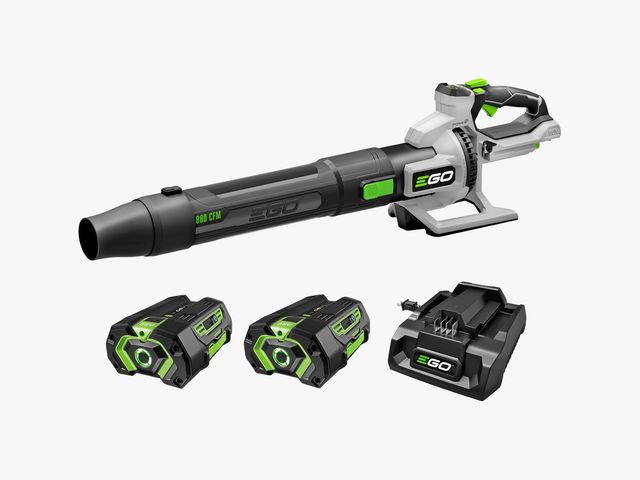
When factoring in overall performance along with the quality and diversity of Ego’s outdoor tool ecosystem, this blower is the best option for most users. In testing, it delivered gaslike power, easily knocking over a 5-pound brick paver on high speed where lesser machines required turbo mode, and it cleared the test patch of leaves without issue, without relying on turbo. Even with all that power, it was the second-quietest machine on turbo, registering about 89.7 decibels at an arm’s-length distance of 30 inches—though Ego still suggests hearing protection.
A bright, 1.75-inch LCD serves as the tool’s dashboard and is easy to read even in direct sunlight, though some details, like confirmation that a battery is installed, add clutter without much information. The electronic cruise control is intuitive: squeeze the variable-speed trigger to your desired speed, press the speed lock button, then release the trigger. The blower maintains that pace until you press the speed lock button again.
Ergonomically, the blower’s relatively narrow frame keeps the tool comfortable and tight to your body during operation, and the unit naturally pitches the nozzle towards the floor. A plastic grid covering the air intake and battery location helps prevent stray leaves from clogging the vents. The included fan nozzle widens the airflow for clearing hardscapes, though on a lawn, it can scatter leaves rather than help corral them. The tool sits securely on a wide base so it doesn’t tip very easily, and has a stubby, 4.5-inch-long nozzle beneath the blower tube that works for drying a car or a grill.
Ego’s was nearly the most expensive blower we tested, and its 56-volt battery powers a capable range of outdoor power equipment, from lawn mowers to string trimmers and chainsaws, making it a good choice for outfitting your garage or shed. The manufacturer has also branched into lifestyle gear, including portable power stations that run on its tool batteries, fans, wet-dry vacuums, and even a fun-looking mini bike. The downside of this leaf blower is runtime, which Ego attempts to offset by packaging the kit with two 4 amp-hour batteries. It had the shortest runtime of the tested models, a direct trade-off for its high performance. The thinking is that you can charge one battery while using the other, which may work for most users since few people blow continuously for 11 minutes.
| Specs | |
|---|---|
| Power | 56-volt battery with 4 Ah (kit comes with two batteries) |
| Claimed CFM | 880 on turbo; 700 on high |
| Claimed MPH | 200 on turbo |
| Battery | Just over 11 minutes on high, 52 minutes to recharge |
| Weight | 10 pounds, 12.8 ounces |
| Noise | Up to 89.7 decibels |
| Warranty | 5 years on the tool, 3 years on the battery |
| Does It Come as a Bare Tool (No Battery)? | Yes, model LB8800 |
| Other Battery Capacities Available | 2.5, 5, 6, 7.5, 8, 10, and 12 Ah |
Best Budget
The Skil checks two important boxes for a battery-powered leaf blower: It was the least expensive model we tested and tied for the longest runtime, at just over 33 minutes on high. Skil, a sister company to Ego, couldn’t match our top pick’s power—it would only knock over the brick on turbo and took a bit longer to push a brick-topped tarp—but it’s capable for most common leaf-blowing jobs. It was also the quietest blower in our test, registering 78.6 decibels on high, though Skil still recommends hearing protection.
The trigger system is as simple as it gets: Pull the variable-speed trigger, or rotate the dial with your thumb to set cruise control for longer sessions. Like most blowers, a separate button engages boost mode. The air intake is covered on all four sides by a black plastic grid that didn’t clog with leaves during testing, though if one gets sucked in it should be easy to pull off. This compact blower measures just under 36 inches long and is one of the few models that can stand upright when the battery is attached, which could help with storage.
Like the Ego, it has a short tube built into the housing, which is handy when you need high-volume airflow in a tight space. The secondary handle, while not very useful for clearing the lawn, makes the tool easier to rotate, position, and hold at awkward angles for jobs like clearing gutters, directing airflow around a vehicle for pushing water or snow, or clearing a workbench.
The Skil’s impressive runtime is partly due to the 6-amp-hour battery it comes with, though the blower is also available with a slightly less capable 4-amp-hour battery for about $20 less. That 40-volt battery can power a range of core lawn and garden tools, including mowers, trimmers, and chainsaws, and the system has earned a solid reputation for performance and runtime. Skil doesn’t yet have much in the lifestyle department—it does have a handy inverter which helps get more use out of the battery between weekends, but doesn’t offer the range of battery amp-hours Ego does.
| Specs | |
|---|---|
| Power | 40-volt battery with 6 Ah |
| Claimed CFM | 650 on turbo, TBD on high |
| Claimed MPH | 170 on turbo, TBD on high |
| Battery | Just over 33 minutes on high, 130 minutes to recharge |
| Weight | 10 pounds, 12.8 ounces |
| Noise | Up to 91.1 decibels |
| Warranty | 5 years on the tool, 2 years on the battery |
| Does It Come as a Bare Tool (No Battery)? | No |
| Other Battery Capacities Available | 2, 2.5, 4, and 5 Ah |
Best Mix of Power and Runtime
At the intersection of power and endurance, the Husqvarna 350iB feels as capable as the Ego but offers roughly three times the runtime. This well-designed, capable tool costs as much as our winner, but delivers somewhat less value: It comes with only one battery, powers a smaller lineup of tools, and carries a three-year warranty instead of Ego’s five. In testing, it cleared our test patch of leaves with ease and, in turbo mode, knocked over the paver. It’s also relatively quiet at both high and turbo speeds, and recharges quickly in just under an hour and a half.
The 350iB’s high power is plenty strong for all but the most stubborn jobs. The tool is well-balanced, keeping the tube pitched slightly downward when walking. Thoughtful design details include punchy springs that help eject the battery, rubbery feet to protect the surface you set it on, and a second nozzle with a stiff plastic scraper that helps dislodge wet, matted leaves from a patio. The controls rely on graphics rather than words, but the buttons are intuitive to decipher.
If you’re new to outdoor power equipment and expect to build a system out to cover the basics, Husqvarna is a good choice to handle core lawn and garden tasks like lawn mowing, string trimming, and cutting wood with a chainsaw. The system doesn’t offer the variety of lifestyle tools that Ego or Ryobi do, however, and Husqvarna’s tools tend to cost more than comparable models. But for homeowners who prioritize power and runtime, the 350iB makes a strong case for the Husqvarna system. The higher price and shorter warranty are the main trade-offs.
| Specs | |
|---|---|
| Power | 36-volt battery with 7.7 Ah |
| Claimed CFM | 800 on turbo; 555 on high |
| Claimed MPH | 200 on turbo; 140 on high |
| Battery | Just over 33 minutes on high, 80 minutes to recharge |
| Weight | 10 pounds, 3.2 ounces |
| Noise | up to 90.5 decibels |
| Warranty | 3 years on the tool, 3 years on the battery |
| Does It Come as a Bare Tool (No Battery)? | Yes, model 970 56 99-03 |
| Other Battery Capacities Available | 4, 5, 6, 9, 10, 15 Ah |
Best System
The Ryobi has an excellent mix of power and balance, plus a rubbery nozzle tip that makes it easy to pry debris off the ground. But price-wise, it sits between better-performing models and our favorite budget pick. The blower’s power and ease of use are hampered by a scant 12-minute runtime, despite having the largest amp-hour battery in the test. That short runtime, combined with the long recharge time, makes it less practical for larger cleanup jobs, unless you have a second battery.
The Ryobi measured under 85 decibels on high. The rear intake is lined with foam that helps tame the noise. There’s no boost or turbo button here, so you pick between two cruise control settings for max power or max runtime, or squeeze the variable speed trigger. It’s a capable blower, but its biggest advantage is the 40-volt system behind it: Ryobi offers one of the widest ranges of tools that use the same battery, making the platform, rather than any single tool’s performance, its strongest selling point.
Like nearly every outdoor power equipment manufacturer, Ryobi uses the same battery across a range of push mowers, string trimmers, and chainsaws. But the company also offers useful niche tools, including a leaf vacuum mulcher, handheld power washer, and log splitter. The same battery can power heavier-duty equipment, too, including a two-stage snow blower, rear-tine tiller, and auger. For someone planning to build out a broad outdoor power equipment collection, that range is a significant advantage.
| Specs | |
|---|---|
| Power | 40-volt battery with 8 amp hours |
| Claimed CFM | 800 on max power; 740 on max runtime |
| Claimed MPH | 200 on max power; 165 on max runtime |
| Battery | Just over 12 minutes on high, 1 hour and 40 minutes to recharge |
| Weight | 10 pounds, 12.8 ounces |
| Noise | Up to 84.1 decibels |
| Warranty | 5 years on the tool, 3 years on the battery |
| Does It Come as a Bare Tool (No Battery)? | Yes, model RY40HPLB01B |
| Other Battery Capacities Available | 2, 4, 6, 12 Ah |
Others Tested
Greenworks 80V Electric Leaf Blower for $190: This was a powerful blower with about 15 minutes of runtime on high, which was longer than our favorite model. It also stayed well below 90 decibels, even in turbo mode. The blower is very narrow and comfortable to hold, and has a 4-year warranty on the battery, which was the longest in our test. Sometimes the tool is on sale for less than $200 as a kit, which is a good value for the power, and a recharge time of about 40 minutes. On sale, it’s about the same as our budget pick, which felt as powerful and had a longer runtime.
FAQs
Disclaimer : This story is auto aggregated by a computer programme and has not been created or edited by DOWNTHENEWS. Publisher: wired.com