
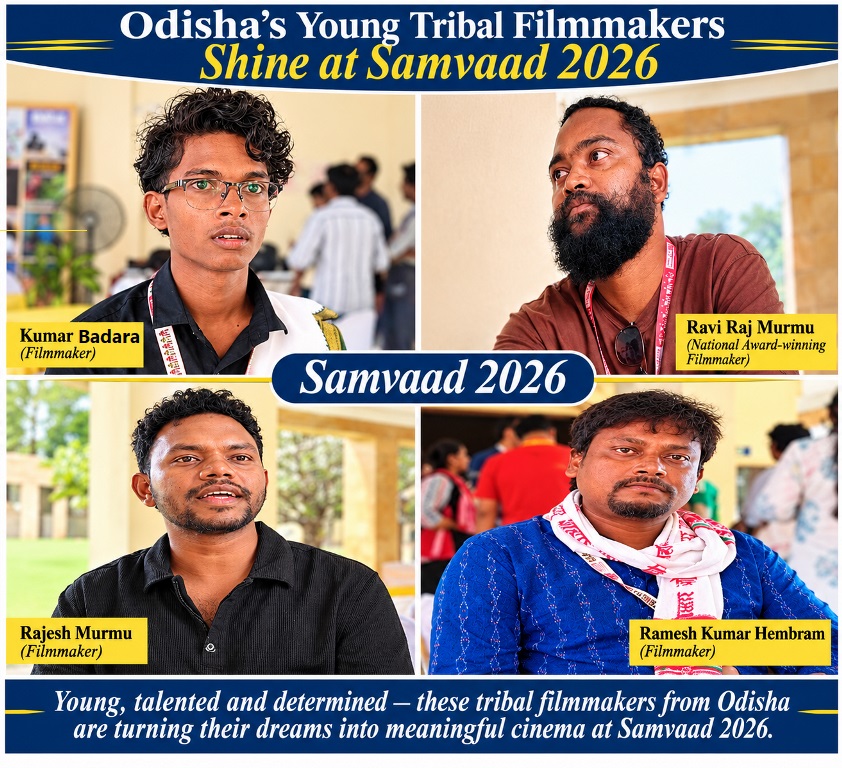
Jamshedpur/Bhubaneswar: He does not own an expensive smartphone or have access to sophisticated filmmaking equipment. But 20-year-old Kumar Badara, a tribal youth from Gobarghati village near Odisha’s industrial hub of Kalinganagar in Jajpur district, has something that matters more – an abundance of imagination and the determination to translate his ideas into cinema.
Armed with an ordinary, non-branded mobile phone bought from a local market, Badara has made a 20-minute film, ‘Bariye Hura,’ in the Ho language. His modest filmmaking venture has now found recognition at the film festival organised as part of Tata Steel Foundation’s (TSF) annual cultural and tribal exchange event, Samvaad 2026, in Jamshedpur.
His film was screened alongside several other productions at the event, which began on November 15 and has brought together more than 70 filmmakers, providing a platform for emerging tribal storytellers to showcase their creativity and engage with fellow filmmakers.
The film revolves around four close male friends whose lives take sharply different turns. Two of them fall victim to child marriage, pushing them into difficult circumstances, while the other two pursue their ambitions and strive to build successful lives. Eventually, the latter come forward to help their childhood friends overcome the challenges they face.
Through this narrative, Badara seeks to highlight the social consequences of child marriage and the importance of education, individual aspirations and making informed life choices.
“The title Bariye Hura translates into ‘two paths’ in English. Through the film, I have tried to portray the contrasting lives of young people who are pushed into child marriage and those who pursue their dreams and marry only after attaining the legally prescribed age. I have also attempted to capture the contradictions within our society, where some children are forced into early marriage while others elope after falling in love and subsequently face difficulties,” Badara explains.
What makes his achievement particularly remarkable is that he managed to produce the film without incurring any financial expenditure. The characters were played by his own friends from the village, turning the project into a collective creative effort driven largely by enthusiasm and conviction rather than resources.
Badara is not alone in making his presence felt at Samvaad 2026.
Rajesh Murmu, another young filmmaker from the Santal community, has earned the opportunity to showcase his 20-minute film, The Price. Similarly, Ramesh Kumar Hembram’s 12-minute Odia film, Atithya, has been selected for screening at the festival.
Coming from economically disadvantaged backgrounds and communities that often remain underrepresented in mainstream cinema, these young filmmakers see Samvaad as much more than a film-screening platform. For them, it is an opportunity to learn, exchange ideas, understand filmmaking techniques and, above all, gain the confidence to tell their own stories.
The presence of national award-winning filmmaker Ravi Raj Murmu of Jharkhand has added further significance to the gathering. Murmu won the National Film Award for Best Debut Non-Feature Film of a Director at the 72nd National Film Awards for his Santhali-language short film Angen.
For the young participants, the opportunity to interact with accomplished filmmakers and watch their own creations being screened before an audience has been an encouraging experience.
“We do not normally get such opportunities to showcase our talent. Participating in this event has considerably boosted our confidence. We now believe that we, too, can take our films to national and international platforms,” says Badara, a sentiment echoed by Rajesh Murmu and Ramesh Kumar Hembram.
Their journeys underline how access to technology, however modest, combined with creativity and determination, can open new avenues of expression for young people from marginalised communities.
At Samvaad 2026, these emerging filmmakers are demonstrating that compelling cinema does not necessarily require expensive cameras, elaborate production arrangements or big budgets. Sometimes, all it takes is a story waiting to be told, a mobile phone and the courage to tell it.
Disclaimer : This story is auto aggregated by a computer programme and has not been created or edited by DOWNTHENEWS. Publisher: deccanchronicle.com








