The way we build homes has changed significantly.
They have grown larger. Buildings have grown taller. Amenities have multiplied. Technology has entered almost every corner of residential life. We have become very good at building homes that are secure, efficient and convenient.
But has the way we live changed as a result?
A family may have a larger home today, yet spend less time outdoors. A community may have hundreds of residents, yet neighbours may remain strangers. A development may have landscaped gardens, yet nature may still feel like something placed around the buildings rather than something that shapes everyday life.
When someone buys a home, the questions are familiar. How large is it? Where is it located? What amenities does it offer? How well is it built?
But what if those questions aren’t enough?
Where does the water that reaches the home come from? What happens to it after it is used? Where does the food on the table come from? Can a child walk somewhere without needing a car?
And perhaps the most important question: does the place change the way people live?
A home is only one part of where we live
Long before cities became what they are today, human settlements formed around certain basic relationships.
Water gave communities a reason to stay. Soil gave them food. Agriculture created livelihoods. Streets connected people not only to places but also to one another. Nature was not an amenity. It was part of the system that made life possible.
Modern cities have separated many of these relationships.
Water arrives through a pipe. Food arrives from somewhere else. Waste disappears. Energy comes from a grid. Nature is often confined to parks, balconies and landscaped edges. The systems keep working, but our relationship with them has become invisible.
Perhaps this is one reason people are increasingly seeking a different way of life. As urban life grows faster, denser, and more disconnected, they may not be looking to return to the past. They may simply want to feel connected again to water, soil, food, trees, open spaces, and one another.
This is where architecture goes beyond creating beautiful buildings.
Architecture can shape whether people walk or drive, whether a courtyard becomes a natural gathering place or stays unused, and whether a street serves only as a passage between buildings or becomes part of community life.
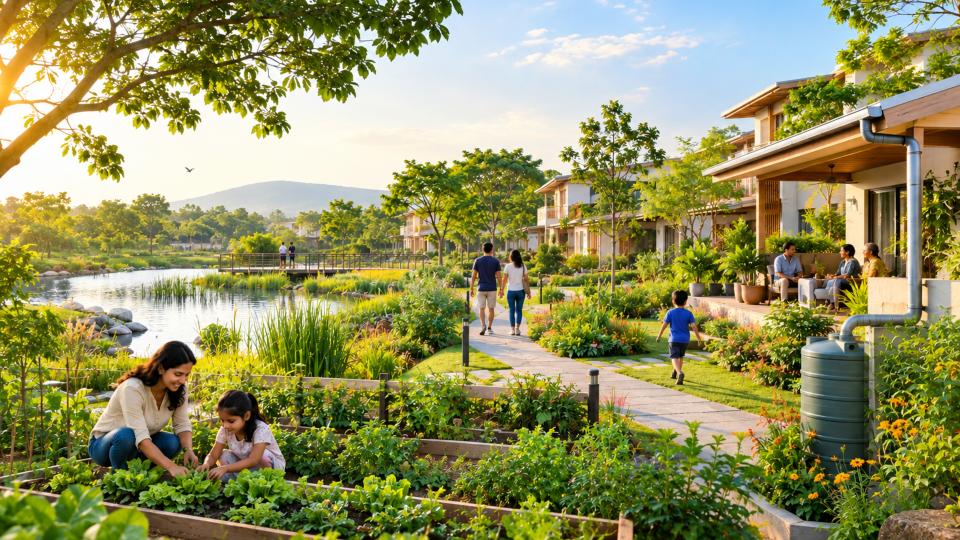
A shaded pathway can make walking comfortable. A veranda can provide a place to sit outside. A kitchen garden can help a child understand where food comes from. A shared space can turn an unfamiliar face into a neighbour.
These may appear to be small decisions on a drawing. Over time, they can influence the character of an entire community.
What happens when the land becomes part of the design?
For a long time, development has often begun with the assumption that the land is a blank canvas. We measure it, divide it, draw roads, position buildings, and then add landscape.
But a site is never really blank.
It already has contours. It has trees. It has water flows. It has soil. It has sunlight and shade. It has a history of how people, plants and other living systems have interacted with it.
What if these were not constraints to work around, but information to design with?
You can see what this way of thinking makes possible in places like Chevella, Hyderabad, where the landscape, homes, and everyday life come together with care that feels both intentional and deeply rooted in the place.
That changes the architect’s role.
The question is no longer simply: where should the building go?
It becomes: What is this land already telling us?
Perhaps the road should follow the land’s natural contours rather than cut across them. An existing tree could determine where a home is placed, rather than being removed to make room. Water could be allowed to collect, flow and replenish the land wherever the landscape naturally permits.
We should expect more from the idea of home
The idea of an Eco Habitat is not about rejecting modern living.
It asks whether modern living can be more complete.
We do not have to choose between the conveniences of a city and the connections that traditional settlements understood so well. The opportunity lies in bringing some of those relationships back into contemporary life.
Water can be conserved and reused. Food can be grown closer to where people live.
Nature can become part of everyday experience rather than an afterthought. The streets can encourage walking and interaction. Architecture can respond to climate, landscape and human behaviour. Communities can be designed to give people reasons to participate.
What will we leave behind?
Every generation builds something.
Buildings rise. Roads expand. New neighbourhoods take shape. Skylines change.
But another kind of legacy is less visible.
The quality of the soil.
The water that remains.
The trees that survive.
The biodiversity that returns.
The livelihoods that are created.
The relationships that develop between neighbours.
And the understanding a child carries of where food comes from, how water is conserved and why the natural world matters.
Perhaps, then, the question for the next generation of architects and developers is not simply how to build better homes.
It is how to create places where better lives can unfold.
Because a home is not just the four walls we return to every evening.
It is the water we depend on, the food we eat, the streets we walk, the trees we live among, the people we meet and the landscape we leave behind. The buildings we create may define a city for a generation.
Authored article by Mr Nagesh Kumar Battula, Founder & CEO at Organo Eco Habitats
Disclaimer : This story is auto aggregated by a computer programme and has not been created or edited by DOWNTHENEWS. Publisher: deccanchronicle.com