
In recent years, Abu Dhabi-based Space42 has emerged as one of the region’s most prominent names in space technology and AI, with its achievements helping to establish the UAE as a respected player in the space industry.
Sitting at the intersection of satellite communications, Earth observation and AI capabilities, Space42 uses space-based infrastructure to deliver connectivity and turn satellite imagery into actionable intelligence.
Now, the company is looking to take that model beyond its home market, committing $1.7 billion to new projects.
To date, government contracts have formed the backbone of Space42’s revenue, but it is now looking to expand its customer base, both domestically and internationally, over the next few years.
Currently, 90% of Space42’s revenue is generated in the UAE, with the remaining 10% coming from international markets. Government clients account for approximately 80% of revenue, while commercial customers contribute the remaining 20%.
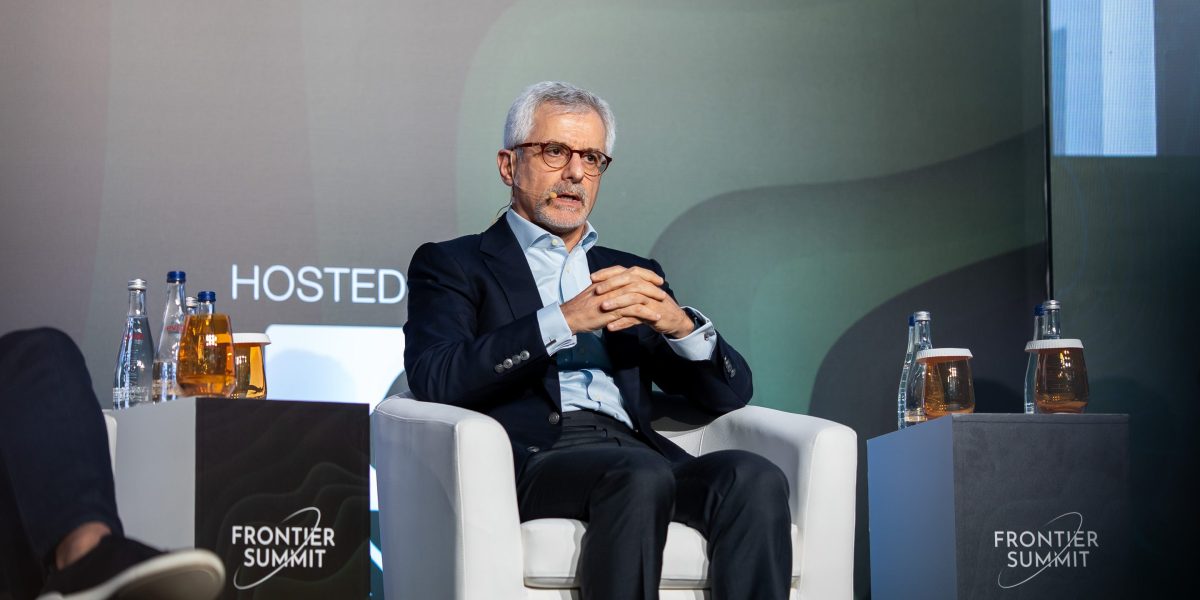
“Over a five-year runway, we expect those ratios to move toward a 70/30 split on both fronts,” Karim Sabbagh, managing director of Space42, tells me on the sidelines of the Frontier Summit held in Abu Dhabi this week.
The company’s $1.7 billion capital deployment commitment forms part of a broader strategy to double Space42’s revenue to $600 million by 2030.
The company generated $260 million in revenue in the first half of 2026, up 15% year-on-year, while netting $18 million in profit.
However, Sabbagh says the company may increase its $1.7 billion capital deployment plan. “If anything, we may make the plan more ambitious,” he says, adding that any decision would be announced at the company’s annual investor day next month.
Beyond organic investment, Sabbagh says Space42, is open to acquisitions that would add specific capabilities. Space42 is backed by Abu Dhabi’s sovereign fund Mubadala, which has $385 billion in assets under management, as well as International Holding Company, a diversified investment conglomerate and Abu Dhabi’s largest listed firm.
“I think there are going to be opportunities for very complementary capabilities, particularly in geospatial intelligence,” he says.
Acquisition targets could include companies that have developed specialized analytical models and established customer bases in areas such as agriculture and critical infrastructure. Such businesses can help transform raw observations into practical insights, from comparing conditions over time to assessing how a situation might evolve.
Last month, Space42 signed a binding agreement with U.S. communications company Viasat to establish Equatys, a shared platform designed to connect smartphones and other devices directly to satellites.
Viasat will be committing $400 million in equity to the venture, while Space42 is committing $600 million, which it sees as central to its ambition to diversify its geographic reach.
Traditional mobile satellite services have often relied on specialized equipment, including satellite phones. Direct-to-device technology could therefore expand the addressable market considerably.
The platform is expected to launch by 2029, and will initially comprise fewer than 200 satellites, with plans to expand the constellation to 2,800.
According to Sabbagh, Equatys will be able to leverage 400 relationships with mobile network operators across the world.
“The business model is unique because it’s a shared infrastructure in space, which will then allow existing sovereign direct-to-device satellite networks to integrate with our system,” says Sabbagh.
Rather than requiring every country or operator to develop and maintain their own satellite network, the model would allow participants to integrate their systems with a broader infrastructure.
A European, Canadian, or Indonesian direct-to-device network, for instance, could potentially connect to the Equatys infrastructure when operating within its intended territory. The shared network could then help extend connectivity when that national system operates beyond its own area of interest.
The aim is to make better use of satellite capacity that might otherwise sit idle when a system is outside its primary coverage area.
Sabbagh predicts this could transform the space industry from having less than 10 million users of mobile satellite services to being able to reach billions of users.
“We want to truly democratize space-based voice and data services to make them accessible at a price point that’s comparable to the services offered by alternatives delivered through terrestrial platforms,” he added.
Satellite connectivity currently commands a premium because of its relatively high cost, limiting its accessibility for some users.
There is, however, a transition period to navigate. Space42 expects new services to require time to build subscriber bases, establish commercial packages, and secure adoption, with Sabbagh estimating this could take one to three years.
Space42’s other major differentiator, according to Sabbagh, is its attempt to bring satellite communications, Earth observation, and AI-enabled analysis together within a single business.
As satellites generate growing volumes of data, the challenge is increasingly how quickly that information can be processed and translated into useful intelligence.
AI plays a central role in aggregating observations, identifying objects, comparing changes over time and supporting analysts as they investigate specific questions. Applications could range from assessing the impact of an earthquake by comparing imagery before and after an event to monitoring changes in infrastructure or identifying developments in a sensitive area.
The technology is particularly important when working with synthetic aperture radar, otherwise known as SAR.
Unlike conventional optical imaging, which depends on reflected sunlight and can be constrained by darkness and cloud cover, SAR uses radar signals and their reflections to construct images of the Earth’s surface. This enables observations in conditions where optical imagery may be limited.
“Many situational awareness requirements arise at night. An optical lens, for example, cannot capture images from 400 kilometres away in the dark,” says Sabbagh.
“Or let’s say that it’s raining, or there’s cloud cover or fumes. SAR doesn’t care about any of this. The radar signal will go in, the reflection will come out, and you’ll be able to derive your intelligence.”
Future success will require Space42 to turn its technological capabilities, capital commitments and international partnerships into commercially viable services that can compete across markets at scale and at a sustainable cost.
Disclaimer : This story is auto aggregated by a computer programme and has not been created or edited by DOWNTHENEWS. Publisher: fortune.com




