
A new exhibition explores the allure of the jewellery brand celebrities love to wear.
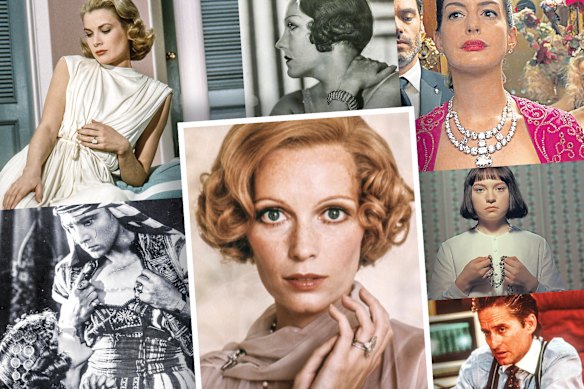
When Italian-born film star Rudolph Valentino appeared as an Arab sheik in his final film 100 years ago, his turban, darkened skin and desert-friendly robes were not the most incongruous part of the picture. That honour went to the very contemporary, very Western-looking Cartier Tank watch adorning his wrist.
It was not the first example of product placement on screen – the Lumiere brothers got there 30 years earlier with some blatant plugs for Sunlight soap in their early silent films. Nor was the Tank’s appearance intentionally promotional: the feted matinée idol simply refused to remove it during filming, and such was his star status that the watch stayed put. But it was the beginning of a beautiful marketing bond between the luxury jewellery brand and the silver screen.
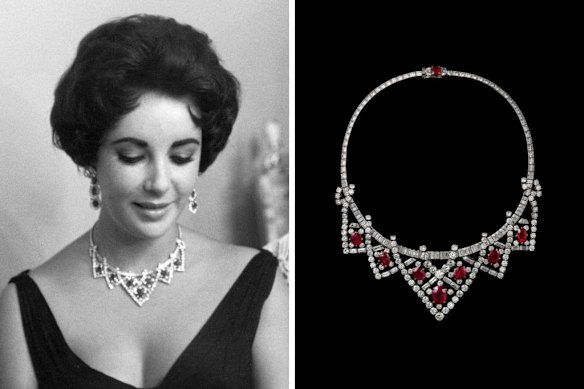
Even before The Son of the Sheik premiered in July 1926, Cartier’s celebrity-adjacent status had already been cemented on the much-admired necks and wrists of royals, aristocrats and other trendsetters. But the bond that began with Valentino flourished in the years that followed: there was Gloria Swanson wearing her favourite Cartier bangles in Sunset Boulevard and Perfect Understanding, Grace Kelly buffing her real-life 10.48-carat diamond engagement ring in High Society, Liz Taylor rocking a glorious 1951 ruby and diamond necklace from her third husband, Mike Todd, and Timothee Chalamet wearing a specially designed, candy-coloured necklace during his promotional tour for Wonka. Even the small screen got the Cartier dazzle when Meghann Fahy wore a yellow gold Tank watch in season two of The White Lotus.
Cartier’s connection to film reached its apotheosis in the 2018 heist movie Ocean’s Eight, in which Sandra Bullock’s Debbie Ocean hatches an elaborate plot to steal the $US150 million “Toussaint necklace”, describing it as “spectacular, blingy, big old Liz Taylor jewels”. The film version was modelled on a necklace made in 1931 for the maharaja of Nawanagar and speaks to the transformative power of jewellery, lighting up Anne Hathaway’s face the minute it is placed on her elegant, creamy-white neck.
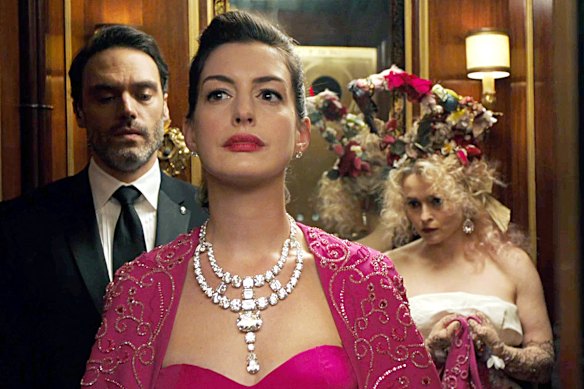
The necklace worn by Hathaway is among the items that bear testament to this jewel-encrusted film history in the NGV’s Winter Masterpieces exhibition Cartier. This showcase of design, craftsmanship and celebrity adornment is an expanded iteration of the wildly successful exhibition that had visitors jostling for a glimpse of all that glitter at London’s Victoria and Albert Museum last year. It examines how the company founded by Louis-François Cartier in 1847 thrived in the early 1900s as his grandsons, Louis, Pierre and Jacques, forged an enduring reputation for luxury and cutting-edge craftsmanship.
As V&A curator Helen Molesworth, a jewellery scholar and author, puts it: “When we think of Cartier, we think of glamour and romance and beauty.”
Of the three brothers, Pierre was the one most closely involved with cultivating Cartier’s celebrity connections. One of his favourite clients was our own Dame Nellie Melba, a fan of the brand’s “Garland” style, with its decorative, lace-like creations featuring bows and floral emblems. At the height of her fame, when Melba had her own dressing room at the Royal Opera House in London’s Covent Garden, Pierre would send his assistant along bearing jewels fit for a diva.
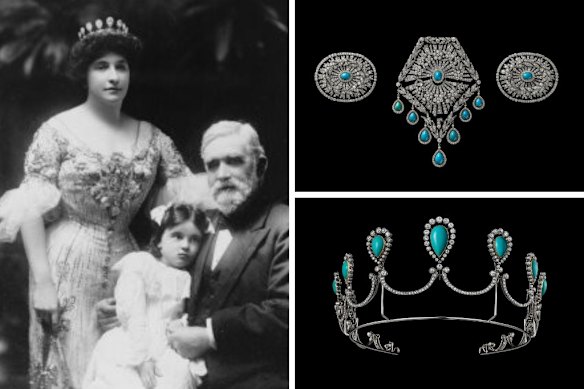
In one of the exhibition displays, we see her wearing a devant de-corsage (less elegantly known as a “stomacher”) in a photograph with her father and niece taken in Melbourne in 1903. The Melba addition to the London show also includes her necklaces, brooches and a handbag, along with a signed photograph that Pierre kept in his living room.
Other famous collectors featured in Cartier include Princess Margaret, the Duke and Duchess of Windsor, socialite Daisy Fellowes and Woolworth heiress Barbara Hutton. Among the brand’s more contemporary wearers, Rihanna gets a glittering look-in in the form of a choker and tiara worn for an extraordinary 2016 cover shoot for W magazine.
Of course, the connection between cinema and gemstones goes much deeper than questions of who wore what, to the essential interplay of light and dark that brings both into being. While film flickers to life out of the darkness of the cinematic space, gems emerge from deep beneath the earth’s surface. “You start a piece of jewellery with somebody digging deep in the earth to pull out those sapphires and diamonds,” says Molesworth, still marvelling at the process after more than 25 years of exposure.
Among the stones on show in Melbourne, visitors might see sapphires dug from alluvial deposits in Sri Lanka, emeralds plucked from the Andes in Columbia, and black opals from deep in the earth at Lightning Ridge in NSW.
Such earthly origins are cleverly conjured in the exhibition in the form of colour-coded rooms created by Dutch designer Sabine Marcelis and her architect partner, Paul Cournet. Miranda Wallace, the NGV’s senior curator, international exhibition projects, is particularly excited about one room that features a large garnet-red box lit from above by a Barrisol ceiling. Inside sit the most precious stones of all: diamonds, rubies, emeralds and sapphires.
“Part of their inspiration was thinking about Coober Pedy,” says Wallace, referring to the opal-mining town in South Australia. “One of their team had visited and had this idea of living underground and also thinking about these things [being] from the earth.” This deeply dramatic space speaks to both the source and splendour of gemstones, as though light and colour had transformed the earth’s interior into an oversized jewellery box. Its impact is nothing if not cinematic.
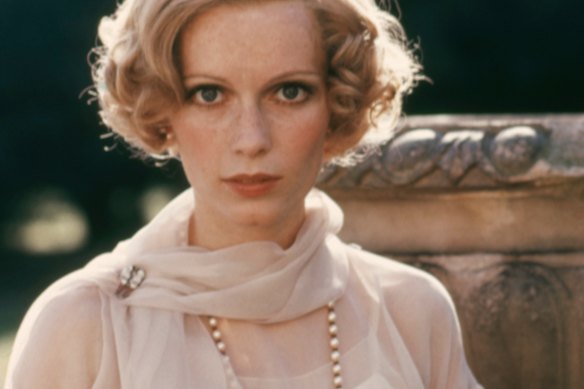
In another room, film clips will showcase the Cartier presence in movies including Wall Street (1987), Dial M for Murder (1955), Maria (2024) and The Great Gatsby (1974). In the latter, an ethereal-looking Mia Farrow, as Daisy Buchanan, teams floaty frocks and gossamer headwear with a diamond necklace and earrings; a lovebirds brooch perched teasingly on her shoulder hints at the flightiness that will seal Gatsby’s fate.

In Wall Street, Gordon Gekko’s greed-is-good ethos has Michael Douglas pairing pinstriped suits, braces and a power pout with Cartier’s Santos watch; sales of the timekeeper took off following the film’s release.
The film clips highlight the role of such pieces in helping to craft a character using more than just words. In a discussion filmed last year as part of Cartier’s Art Dialogues series, Academy-award-winning costume designer Sandy Powell reflects on the power of jewellery to help convey character. “If I’m doing a character who has bad taste, you do everything, the whole lot, mismatch,” she says. Powell, who once made jewellery out of cardboard, glitter and Quality Street wrappers for Derek Jarman’s low-budget 1986 film Caravaggio, says fakes are often favoured by filmmakers.
“If I was to use a huge necklace that was real, quite often it wouldn’t be practical because the sparkle is so great,” she says. “You’re likely to have the cinematographer say, ‘Can you spray that down because it’s actually too much’… if I used real sparkle everywhere, it ends up looking so blingy that it looks fake.” Coincidentally, Powell worked on the upcoming film My Duchess, in which Joan Collins plays Cartier devotee Wallis Simpson in her final days, still clinging to the title of Duchess of Windsor and still clutching her beloved jewels.
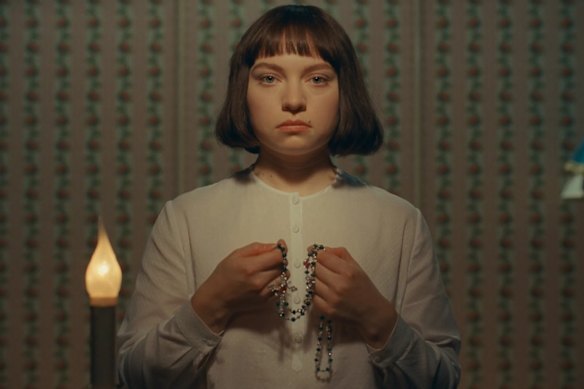
Miranda Wallace says that in curating film clips for the show’s cinema section, she wanted to show “not only people like Liz Taylor and Gloria Swanson and their jewels”, but also more contemporary on-screen examples, such as the emerald, ruby and diamond rosary beads from Wes Anderson’s 2025 film The Phoenician Scheme. In a crucial scene, the daughter of a wealthy businessman symbolically discards the frugal life of a Catholic nun by swapping her standard-issue rosary beads for the bright, shiny, jewel-encrusted replacement he offers.
“It plays quite an important role,” says Wallace. “It was inspired by a couple of pieces in the Cartier collection. They drew on that 19th century period of Cartier that predates our show, but it comes in at the end and it’s quite a historic-looking piece with a crucifix so it looks much more Catholic.
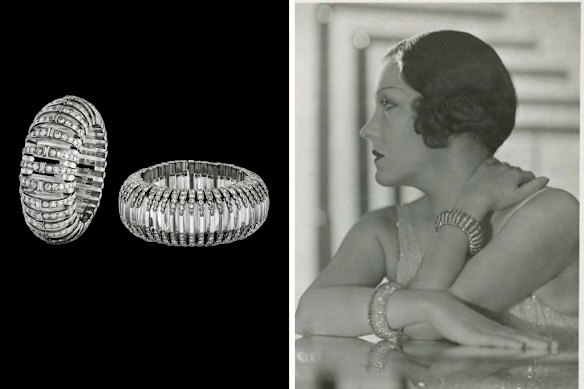
“[Cartier] do love their connection to film and being part of that. Gloria Swanson bought those rock crystal and diamond bangles for herself in the ’30s, and she just kept wearing them. She’s Norma Desmond in Sunset Boulevard in the ’50s and she’s still wearing them … She just loved them, obviously.”
Some of Cartier’s most extraordinary commissions came from legendary Mexican beauty María Félix, a star of Latin American cinema with a taste for exotic adornment and what she called “big jewellery”. The exhibition includes her intricately crafted snake necklace made in 1968 from diamonds, emeralds and gold set on a hinged structure that allows it to be wrapped around the neck.
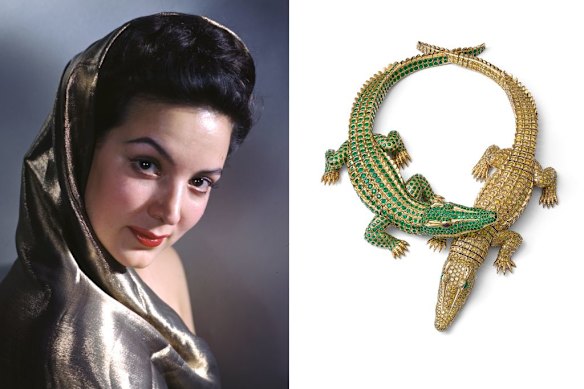
Legend has it that seven years later, Félix walked into Cartier’s Paris store carrying a baby crocodile and asked that they create a life-sized replica. The result, also included in the NGV show, is a double crocodile necklace crafted from emeralds, diamonds, rubies and gold. The two reptiles are joined at the tail and curled into an embrace, one emerald-crested head resting on the other’s back; they can be separated to form two brooches.
Félix was not the only Cartier client with a taste for vaguely menacing adornment. The brand’s signature panther prowled across everything from brooches and watches to a 1928 vanity case and was a favourite of the Duchess of Windsor, one of Cartier’s most avid collectors. “The duchess loved her wild cats,” says Wallace. “There was a bit of a zeitgeist moment for wild cats early on in the 20th century. Josephine Baker was famous for having a cheetah on a diamond lead, and a bit of the wild association was taken up.”
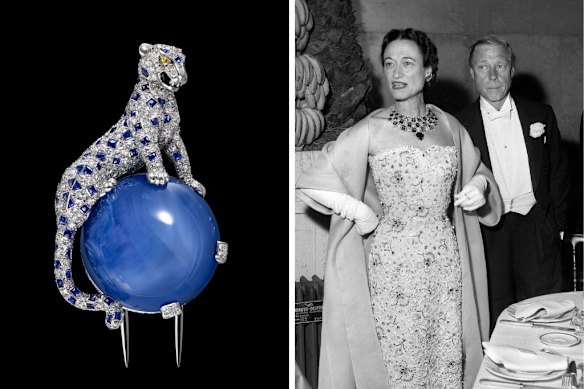
Molesworth says the duchess’ diamond and sapphire panther brooch, featuring the wild cat perched on a large cabochon sapphire, “is one of the most famous Cartier jewels”.
“For me, it combines all the things that make up a fabulous jewel – you’ve got a great gem, you’ve got an iconic style of jewellery design … and you’ve got the history of the Duchess of Windsor. This is a jewel that is part of a story of a king abdicating for a woman he loves. It’s a constitutional crisis, it’s a love story, and she was a hugely divisive figure, so to have a big wild cat representing her collection – elegant, feminine, powerful, terrifying – very strong, stand-alone, I mean I get goosebumps even talking about it. There are so many elements where you see the person in the jewels and the jewels in the person. And her collection, I think, does that exactly.”
The story – and the goosebumps it inspires – fit neatly into what Molesworth calls her “absolute mission to help people understand how much jewellery tells us about us”.
Through jewellery, she says, “we learn about mining and trade routes, chemistry and physics and geography, craftsmanship and design, romance, fashion – people fight over these things, wars happened. We’ve got jewels in there that have changed the history of design.”
We might not all get to drape ourselves in diamonds, rubies and pearls, but for most of us, there’s a piece of jewellery that helps to tell our story, evoking memories and emotions with every wear. Vows are made with an exchange of rings, brooches are passed through generations and treasured photographs are clipped inside heart-shaped lockets. Subtle or eye-catching, luxurious or everyday, these time-honoured symbols of sentiment and self-expression are all priceless in their own way.
Cartier is at NGV International, June 12-October 4; films including The Phoenician Scheme, The Great Gatsby, High Society and Wall Street will screen on selected Friday nights. Lindy Percival travelled to London as a guest of the NGV.
Disclaimer : This story is auto aggregated by a computer programme and has not been created or edited by DOWNTHENEWS. Publisher: www.smh.com.au


