
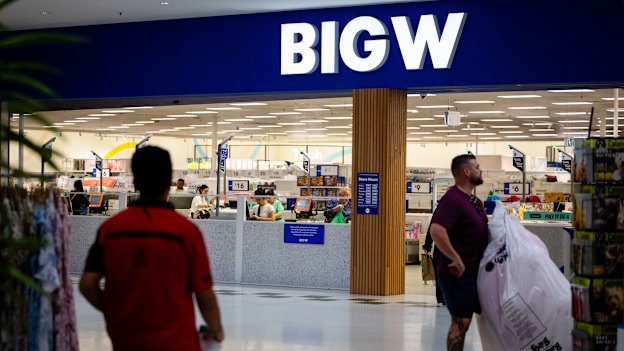
Mother-of-two Jun Bei Liu visited Kmart just last week. Her trip to Kmart Chatswood Chase yielded new lunch boxes for the kids, organisational baskets and decorative trays, to go with some recently purchased Anko vases. Her 13-year-old son and his friend also paid a visit to the Sydney store. “They bought a pair of slides,” she said. “It’s the first time they’ve ever been to the shops by themselves.”
By contrast, her last visit to Big W was about seven years ago. She remembers the department store in Macquarie Centre as having a messy apparel section, harsh lighting with a “warehouse feel”, a limited homewares section, and is not in a hurry to revisit.
“If I have to travel far and wide to find this store when it’s not convenient, and it doesn’t provide all the categories I need, why should I go there?”
Big W’s sticky narrative as Australia’s runner-up discount chain is unfortunately yet inevitably defined by how it is dwarfed by its more impressive, domineering rival Kmart, which for more than a decade has cemented its crown as the nation’s preferred discount department store.
Today, Big W’s national footprint (178 stores) is about half the size of Kmart’s (more than 300), after 30 store closures were announced in 2019. While Kmart consistently produces more than $1 billion in profits, Big W’s have been in a downward slide for several years, and sank to minus $33 million in the 2025 financial year.
Some wonder what parent company Woolworths intends to do with it. In early 2025, the supermarket group’s chief executive, Amanda Bardwell, reignited speculation that a sale or exit of Big W might be on the cards after announcing a strategic review of the “shape of its business portfolio”.
Management are eager to impart that a corner has been turned. Big W swung back into the black in the latest financial year, turning a $64 million profit thanks to less heavy discounting, stronger clothing sales and a thriving marketplace business.
“We’re still early days in our transformation,” said Big W managing director Dan Hake.
“We’ve had an important milestone this financial year, which was to prove out that we can step up our game in product. We can be absolutely competitive on price, and we can be lean and consistent enough in our operations that we can still make a profit at the end of the year. That’s just step one.”

The turnaround strategy is simple: keep shelf prices low, put better-quality products on the shelf, and get more efficient.
Big W’s traditional areas of strength (“the purpose of Big W is to make a real difference for families,” said Hake) have been primarily in its kids’ offering, a books department so formidable that local book store operators complain it undercuts their market share, and toy aisles full of Barbies, Lego sets, Pokémon cards and Bluey merch.
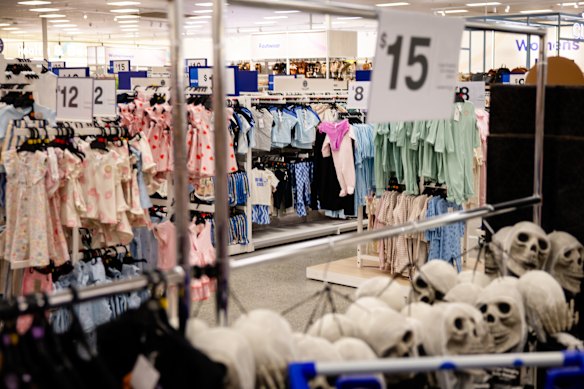
Much investment has been poured into clothing, health and beauty, and homewares departments. Change rooms at newly renovated stores are painted in colourful pastels and large enough to fit prams. “We know that families spend on their kids first,” said Hake. “But we also want mum to have a great experience.”
Store layouts are being reconfigured and trialled. Big W’s Plumpton store, 45 kilometres west of Sydney CBD, is among a handful of newly renovated stores with semi-enclosed sections for beauty and tech that are as much about driving people to explore what’s on the shelf as it is about stemming theft.
In apparel, some price points are in the single digits (children’s tees for $3). A budget version of the popular barrel leg-style jeans sells for $30. About 80 per cent of the womenswear range is now under $20.
“We’re not famous for it yet, but I think there’s great value,” said Hake. “We will get the growth, and we will become more front of mind for customers.”

Big W’s inescapable challenge is that it is stuck playing catch-up to Kmart, which has turned its in-house brand Anko into a standalone brand. But Big W cannot replicate Kmart’s strategy of turning private label products into 85 per cent of sales; it must juggle the dual task of growing exclusive-label lines without cannabilising its role as a “house of brands”.
Kmart has organised its business around a tight supply chain that takes globally trending designs, bulk-ordering from Asian manufacturers in huge quantities, and selling them in Australia en masse. Its homewares and furniture department is so successful it has spawned an IKEA-like spin-off, K Home.
Shoppers on a budget, who have more price comparison tools today than ever, are choosing where to spend with ruthlessness. “If you’ve got a product and that product is even 10¢ cheaper at the competitor next door, that’s where they’re going to shop it. If quality is just a little bit off, and you’re trying to get away with saving costs in the wrong places, your customer is going to shop that product elsewhere,” said Hake.
“These sound like little things, but to do it effectively at scale across the entire store, across all these different categories, it’s a big ask, right? You need to be absolutely on the ball.”
It has demanded a broader cultural change across the organisation and a sharper focus on one united vision (“we are a price fighter on behalf of our customers”). More product designers and category managers have been brought in-house. “It’s a game of simplicity, stock flow, and just getting the basics right,” said Hake.
Where is Big W going?
Big W’s position as runner-up goes deeper than mere numbers. Through Anko, Kmart’s offer to customers is unambiguous: designer-inspired products at budget prices. A loyal army of evangelists, in Facebook groups like Kmart Mums Australia or Kmart Home Decor & Hacks Australia, swap DIY hacks, styling tips and stock alerts with each other.
“Kmart had a big hand in eliminating the bargain stigma, making it cool to shop there,” said RMIT University associate professor of marketing Dr Marian Makkar, pointing to “late night Kmart runs” becoming a social activity for teens and young adults.
Positioned as a “luxe-for-less” retailer, Kmart has gained cachet with Gen Z by delivering on style and aesthetic without the barrier of a high price tag, removing buyer’s remorse and increasing basket sizes, says Macquarie Business School marketing professor Jana Bowden.
“That brand love for Kmart is the X factor,” said Bowden. “It’s what makes it different from its competitors. Kmart doesn’t just sell homewares and clothing. It sells a value consciousness, identity and a cultural moment.”
It’s not clear how much time Hake has to execute Big W’s big turnaround. Rumours about the chain’s future have simmered for years. In August 2025, Bardwell announced Big W’s technology systems would be separated from Woolworths, a move often interpreted as preparing a business for potential demerging.
Liu is lead portfolio manager of Ten Cap, which handles funds exceeding $1.6 billion and is invested in Kmart’s parent company, Wesfarmers, but not Woolworths. She wonders if the market is big enough to accommodate many discount chains. Canadian giant Dollarama, which bought The Reject Shop early last year and is rebranding stores, runs a successful private label model that could threaten Kmart.
“I really don’t know what that brand stands for, Big W,” Liu said. While a turnaround costs time and money, “how patient is Woolworths?” she asked. “You have to give it at least three years. I’m just not sure if Woolworths is that committed for [Big W] to turn around.”

Hake is here to do his job. “The policy the team and I have is: let’s not get distracted by what’s in the news or what the rumours might be,” he said.
“Let’s keep building this amazing brand, and let’s create a profitable business that’s returning money to shareholders. That’s the focus.”
The Business Briefing newsletter delivers major stories, exclusive coverage and expert opinion. Sign up to get it every weekday morning.
Disclaimer : This story is auto aggregated by a computer programme and has not been created or edited by DOWNTHENEWS. Publisher: www.smh.com.au



