“Give Me the Ball!” the ESPN’s 30 for 30 documentary chronicling Billie Jean King, emphasizes the sports legend’s love of competition by showcasing just how much she sacrificed for it.
King, who won 39 Grand Slam titles and a record 20 Wimbledon titles, dealt with multiple personal struggles surrounding her identity and sexuality as she used her status as a world No. 1 player to blaze the trail for equal pay for women in tennis.
Advertisement
Advertisement
Advertisement
“My whole life, I’ve been trying to be No. 1 in the world,” King says in the opening sequence of the documentary, which centers on her defeat of Bobby Riggs in the 1973 “Battle of the Sexes” match.
“When I was very young, I just loved sports. I loved playing. I loved winning,” before teeing up the documentary’s title. “It didn’t matter if it was a football, a tennis ball, a softball, a baseball — give me the ball.”
After discovering tennis through free lessons in her native Southern California, King said she quickly learned the history of the sport and began to idolize Althea Gibson; one of the first Black athletes to cross the color line of international tennis and first Black player to win a Grand Slam event.
1 / 50
Billie Jean King’s tennis career and her lasting impact
Billie Jean King’s career helped shape the women’s game, from her success on the court to her lasting impact beyond it.
See the moments that trace King’s path through a championship career and advocacy for equality in sports.
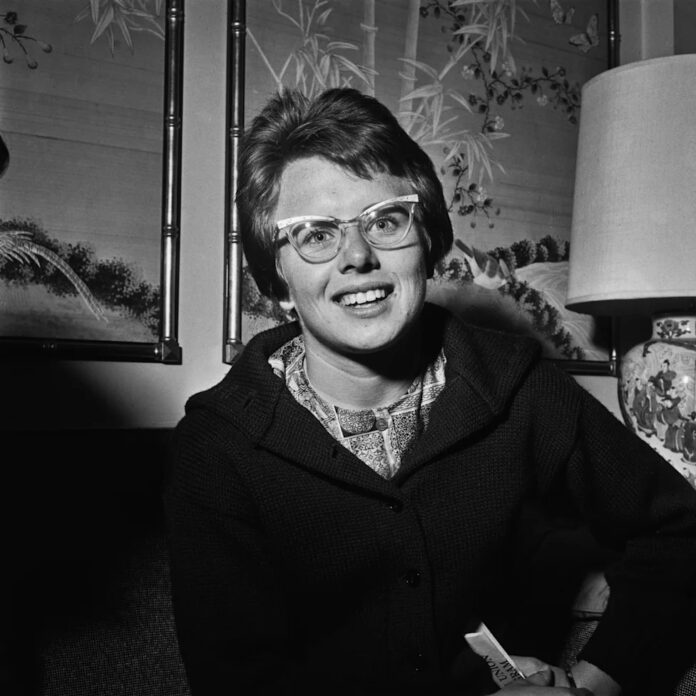
Above, Tennis player Billie Jean King, June 26th 1962.
(Edward Wing, Getty Images)
2 / 50
Billie Jean King’s tennis career and her lasting impact
American tennis player Billie Jean Moffitt (later King) in action during a semi final in the women’s singles championship at Wimbledon, 2nd July 1964.
(Dennis Oulds, Getty Images)
3 / 50
Billie Jean King’s tennis career and her lasting impact
American tennis player Billie Jean King (Billie Jean Moffitt) in action against Elizabeth Starkie of Great Britain in the second round of the Women’s Singles tournament at the Wimbledon Lawn Tennis Championships at the All England Lawn Tennis Club in Wimbledon, London on 24th June 1965.
(Terry Fincher, Getty Images)
4 / 50
Billie Jean King’s tennis career and her lasting impact
American tennis player Billie Jean King holds the winner’s trophy after the Final of the Women’s Singles tournament at Wimbledon, All England Lawn Tennis Club, London, July 1966.
(Central Press, Getty Images)
5 / 50
Billie Jean King’s tennis career and her lasting impact
American tennis player Billie Jean King during the Wimbledon championships in London, UK, 2nd July 1966.
(Evening Standard, Getty Images)
6 / 50
Billie Jean King’s tennis career and her lasting impact
Tennis player Billie Jean King of the United States in action at the Women’s Singles Final, Wimbledon, 8th July 1967. King went on to beat Ann Jones of Great Britain 6-3, 6-4.
(Reg Burkett, Getty Images)
7 / 50
Billie Jean King’s tennis career and her lasting impact
Press photographers gather around as Billie Jean King of the United States holds the Venus Rosewater Dish aloft after defeating Ann Jones of Great Britain in their Women’s Singles Final match on Centre Court at the Wimbledon Lawn Tennis Championship on 7th July 1967 at the All England Lawn Tennis and Croquet Club in Wimbledon, London, England. Billie Jean King won the match and championship 6 – 3, 6 – 4.
(Douglas Miller, Getty Images)
8 / 50
Billie Jean King’s tennis career and her lasting impact
Billie Jean King of the United States during the Women’s Singles Final match against Judy Tegart Dalton of Australia at the Wimbledon Lawn Tennis championships on 5th July 1968, at the All England Lawn Tennis and Croquet Club in Wimbledon in London, England.
(Don Morley, Getty Images)
9 / 50
Billie Jean King’s tennis career and her lasting impact
American tennis star Billie Jean King (Billie Jean Moffitt) (centre) sitting at a pavement cafe with tennis partner Carole Caldwell (left).
(Victor Drees, Getty Images)
10 / 50
Billie Jean King’s tennis career and her lasting impact
Billie Jean King stands on the court during a match at Wimbledon in England.
(Tony Duffy, Getty Images)
11 / 50
Billie Jean King’s tennis career and her lasting impact
Billie Jean King serves the ball during a match at Wimbledon in England.
(Tony Duffy, Getty Images)
12 / 50
Billie Jean King’s tennis career and her lasting impact
Billie Jean King of the United States during the Women’s Singles Final match against Margaret Court at the Wimbledon Lawn Tennis championships on 3 July 1970, at the All England Lawn Tennis and Croquet Club in Wimbledon in London, England.
(Don Morley, Getty Images)
13 / 50
Billie Jean King’s tennis career and her lasting impact
A jubilant Billie Jean King of the USA holds up the women’s singles trophy at Wimbledon after winning it for the fourth time, beating Evonne Goolagong.
(Evening Standard, Getty Images)
14 / 50
Billie Jean King’s tennis career and her lasting impact
American tennis player Billie Jean King with her trophies at Wimbledon after the Championships, UK, 8th July 1973. She is holding the trophy for the Women’s Singles, with the Women’s Doubles and Mixed Doubles trophies on the table in front of her. She thus completed the coveted ‘Triple Crown’.
(Harry Dempster, Getty Images)
15 / 50
Billie Jean King’s tennis career and her lasting impact
Billie Jean King during 1974 Family Circle Cup Tournament at Hilton Head.
(Manny Rubio, US PRESSWIRE)
16 / 50
Billie Jean King’s tennis career and her lasting impact
Billie Jean King during 1974 Family Circle Cup Tournament at Hilton Head.
(Manny Rubio, US PRESSWIRE)
17 / 50
Billie Jean King’s tennis career and her lasting impact
Billie Jean King of the United States during the Women’s Singles Quarterfinall match against Martina Navratilova at the Wimbledon Lawn Tennis Championship on 2 July 1980, at the All England Lawn Tennis and Croquet Club in Wimbledon in London, England.
(Tony Duffy, Getty Images)
18 / 50
Billie Jean King’s tennis career and her lasting impact
Billie Jean King of the USA in action during the Lawn Tennis Championships at Wimbledon in London July 1982.
(Bob Martin, Getty Images)
19 / 50
Billie Jean King’s tennis career and her lasting impact
Billie Jean King of the USA holds the trophy aloft after the Lawn Tennis Championships at Wimbledon in London. King won the Women’s Singles event.
(Allsport UK, Getty Images)
20 / 50
Billie Jean King’s tennis career and her lasting impact
Tennis great Billie Jean King waves as she accepts the 1999 Arthur Ashe Courage Award at the 1999 ESPN network’s ESPY Awards show at New York’s Radio City Music Hall, February 15. King was honored for her lifelong work towards the advancement of women in sports.
(Mike Segar)
21 / 50
Billie Jean King’s tennis career and her lasting impact
US captain Billie Jean King is congratulated by team members after Monica Seles defeated Justine Henin of Belgium in the Fed Cup semi-finals, 22 November 2000, at the Mandalay Bay resort in Las Vegas. Seles won 7-6 (7/1), 6-2.
(MIKE FIALA, AFP via Getty Images)
22 / 50
Billie Jean King’s tennis career and her lasting impact
US Senator Hillary Clinton (L) watches tennis hall of famer Billie Jean King acknowledge the crowd as they watch the match of Serena Williams of the US and Anca Barna of Germany during their first round matches at the 2001 US Open at Flushing Meadows, New York, 27 August 2001.
(HENNY ABRAMS, AFP via Getty Images)
23 / 50
Billie Jean King’s tennis career and her lasting impact
Women’s Sports Foundation founder Billie Jean King speaks during a ceremony at the Waldorf-Astoria Hotel in New York, NY.
(Al Bello, Getty Images)
24 / 50
Billie Jean King’s tennis career and her lasting impact
Billie Jean King, coach of the US Fed Cup team, encourages Monica Seles in her match against Austria’s Barbara Schwartz in Charlotte, NC, 27 April 2002. Schwartz defeated Seles in straight sets 7-6 (9-7), 6-2 to give Austria a 2-0 Fed Cup lead.
(NELL REDMOND, AFP via Getty Images)
25 / 50
Billie Jean King’s tennis career and her lasting impact
Tennis Hall of Famer Billie Jean King attends a press conference for the Women’s Sports Foundation annual salute to women athletes in 2004 on October 18, 2004, in New York City. Founded in 1974 by King, the Women’s Sports Foundation is a national charitable educational organization seeking to advance the lives of girls and women through sports and physical activity.
(Peter Kramer, Getty Images)
26 / 50
Billie Jean King’s tennis career and her lasting impact
Serena Williams, Billie Jean King and Venus Williams pose at the net before the women’s final match of the US Open at the USTA National Tennis Center in Flushing, New York. Venus defeats Serena 6-2, 6-4.
(Jamie Squire, Getty Images)
27 / 50
Billie Jean King’s tennis career and her lasting impact
Tennis legend Billie Jean King and USTA President Franklin Johnson pose next to a plaque during the opening ceremony for the US Open at the USTA Billie Jean King National Tennis Center in Flushing Meadows Corona Park on August 28, 2006, in the Flushing neighborhood of the Queens borough of New York.
(Clive Brunskill, Getty Images)
28 / 50
Billie Jean King’s tennis career and her lasting impact
Musician Elton John and honoree Billie Jean King share a laugh on stage at “An Enduring Vision” the fifth annual benefit for The Elton John AIDS Foundation at The Waldorf-Astoria October 3, 2006, in New York City.
(Evan Agostini, Getty Images)
29 / 50
Billie Jean King’s tennis career and her lasting impact
Tennis player Billie Jean King poses with her World Athlete Award in the media room backstage at the 3rd Annual Women’s World Awards at Hammerstein Ballroom October 14, 2006, in New York City.
(Bryan Bedder, Getty Images)
30 / 50
Billie Jean King’s tennis career and her lasting impact
Former Tennis player Billie Jean King and US figure skater Michelle Kwan pose for a photo during the Women’s Sports Foundation’s 28th Annual Salute to Women in Sports at the Waldorf-Astoria Hotel on October 15, 2007, in New York City.
(Stephen Lovekin, Getty Images)
31 / 50
Billie Jean King’s tennis career and her lasting impact
Billie Jean King watches children take part in her tennis mentoring clinic during the Sony Ericsson Championships at the Khalifa Tennis Complex on November 8, 2008, in Dohar, Qatar.
(Clive Brunskill, Getty Images)
32 / 50
Billie Jean King’s tennis career and her lasting impact
Venus Williams of the U.S. holds her trophy next to tennis great Billie Jean King after defeating Vera Zvonareva of Russia in the WTA Tour Championships final tennis match in Doha November 9, 2008.
(Steve Crisp, REUTERS)
33 / 50
Billie Jean King’s tennis career and her lasting impact
Serena Williams (R) holds the Billie Jean King cup presented by Billie Jean King (C) after she beat her sister Venus, holding the consolation trophy, to win the BNP Paribas Showdown tennis match at Madison Square Garden in New York March 2, 2009.
(Ray Stubblebine, REUTERS)
34 / 50
Billie Jean King’s tennis career and her lasting impact
Tennis player Billie Jean King walks onstage during the 30th Annual Salute To Women In Sports Awards at The Waldorf Astoria on October 13, 2009, in New York City.
(Stephen Lovekin)
35 / 50
Billie Jean King’s tennis career and her lasting impact
U.S. President Barack Obama (R) presents the Medal of Freedom to tennis champion Billie Jean King during a ceremony in the East Room of the White House August 12, 2009, in Washington, DC. Obama presented the medal, the highest civilian honor in the United States, to 16 recipients during the ceremony.
(Chip Somodevilla, Getty Images)
36 / 50
Billie Jean King’s tennis career and her lasting impact
Britain’s Queen Elizabeth greets Billie Jean King as she attends the Wimbledon Lawn Tennis Championships at the All England Lawn Tennis and Croquet Club in London June 24, 2010. It is the first visit by Queen Elizabeth to the Championships in 33 years.
(POOL New, REUTERS)
37 / 50
Billie Jean King’s tennis career and her lasting impact
Tennis legend Billie Jean King receives her Birthday cake during her 70th Birthday Party organized by the Women’s Sports Foundation at the Museum of Art and Design on November 6, 2013, in New York City.
(Brad Barket)
38 / 50
Billie Jean King’s tennis career and her lasting impact
Billie Jean King speaks onstage during the Women’s Sports Foundation’s 35th Annual Salute to Women In Sports awards, a celebration and a fundraiser to ensure more girls and women have access to sports at Cipriani Wall Street on October 15, 2014, in New York City.
(Michael Loccisano, Getty Images)
39 / 50
Billie Jean King’s tennis career and her lasting impact
Billie Jean King presents back-to-back World Gymnastics Champion Simone Biles with the Sportswoman of the Year Award (individual) during the Women’s Sports Foundation’s 35th Annual Salute to Women In Sports awards, a celebration and a fundraiser to ensure more girls and women have access to sports, at Cipriani Wall Street on October 15, 2014, in New York City.
(Mike Coppola, Getty Images)
40 / 50
Billie Jean King’s tennis career and her lasting impact
Serena Williams of USA shares a joke with Billie Jean King after her win over Simona Halep of Romania in the final during day seven of the BNP Paribas WTA Finals tennis at the Singapore Sports Hub on October 26, 2014, in Singapore.
(Julian Finney, Getty Images)
41 / 50
Billie Jean King’s tennis career and her lasting impact
Billie Jean King poses for a photo backstage at the 2015 Glamour Women Of The Year Awards at Carnegie Hall on November 9, 2015, in New York City.
(Dimitrios Kambouris)
42 / 50
Billie Jean King’s tennis career and her lasting impact
Billie Jean King attends the 2018 New York City Pride March on June 24, 2018, in New York City.
(Steven Ferdman, Getty Images)
43 / 50
Billie Jean King’s tennis career and her lasting impact
YYayuk Basuki, Alicia Molik, Lindsey Davenport, Jennifer Capriati, Chris Evert, Billie Jean King, Martina Navratilova, Monica Seles, Kim Clijsters, Iva Majoli, and Tamarine Tanasugarn take a selfie during day 4 of the BNP Paribas WTA Finals Singapore presented by SC Global at Gardens by the Bay on October 24, 2018, in Singapore.
(Clive Brunskill, Getty Images)
44 / 50
Billie Jean King’s tennis career and her lasting impact
Women’s Sports Foundation Founder Billie Jean King presents Billie Jean King Leadership Award to recipient Dawn Staley on stage during The Women’s Sports Foundation’s 2022 Annual Salute To Women In Sports Gala at Pier Sixty at Chelsea Piers on October 12, 2022, in New York City.
(John Lamparski, Getty Images)
45 / 50
Billie Jean King’s tennis career and her lasting impact
Billie Jean King attends the WTA 50th Anniversary Gala at The Ziegfeld Ballroom on August 25, 2023, in New York City.
(Matthew Stockman, Getty Images)
46 / 50
Billie Jean King’s tennis career and her lasting impact
Billie Jean King lights the Empire State Building in honor of the Women’s Sports Foundation’s 50th Anniversary at The Empire State Building on May 02, 2024, in New York City.
(Eugene Gologursky, Getty Images)
47 / 50
Billie Jean King’s tennis career and her lasting impact
Billie Jean King speaks onstage during the 2024 New York #LWTSUMMIT on September 19, 2024, in New York City.
(Bonnie Biess, Getty Images)
48 / 50
Billie Jean King’s tennis career and her lasting impact
Billie Jean King poses for a portrait ahead of the Billie Jean King Cup by Gainbridge Finals 2025 at Shenzhen Bay Sports Centre Arena on September 15, 2025, in Shenzhen, China.
(Zhe Ji, Getty Images)
49 / 50
Billie Jean King’s tennis career and her lasting impact
Billie Jean King attends her Hollywood Walk of Fame Star Ceremony on April 07, 2025, in Hollywood, California.
(Kevin Winter, Getty Images)
50 / 50
Billie Jean King’s tennis career and her lasting impact
Billie Jean King of the PWHL speaks with the media prior to a PWHL game at Madison Square Garden on April 04, 2026, in New York City.
(Bruce Bennett, Getty Images)
Decades later, King broke her own barrier as she became the first prominent active professional female athlete to publicly come out as gay, but not without great turmoil.
Advertisement
Advertisement
Advertisement
“How did I survive?” King reflected in the film while describing 1973 as the most pivotal year in women’s tennis but one of the most difficult times in her life.
“(I was) trying to be No. 1, trying to help women’s sports, trying to get the players together, trying to make a living, trying to get equal prize money, trying to get a sponsor, trying to get a divorce, trying to make everybody happy, trying to figure out who I am – the sexuality part — trying to avoid it, trying to do damage control, trying to change society,” King said. “Oh yeah, I gotta play tennis, too.”
Billie Jean King documentary examines abortion, affair
In 1971, King opted to have an abortion, a choice publicized against her will by her then-husband Larry King.
Advertisement
Advertisement
Advertisement
She said her husband encouraged her to get off birth control for health reasons and assured her she wouldn’t get pregnant. At the time, her husband’s signature was required to be granted the abortion.
King was later asked about the abortion during a “60 Minutes” interview even though she’d asked for it not to be mentioned — which led to emotional fallout with her mother, who King had not told about her choice.
“It wasn’t good,” King said. “It was very difficult.”
The documentary introduced King’s former husband as a “feminist” with whom she fell in love during college. The couple detailed how they grew apart as King’s career continued to take off and his desire for a family intensified.
Advertisement
Advertisement
Advertisement
“It wasn’t right for Larry and I to stay married because I didn’t know what I was doing. Hadn’t figured out who I was. And he shouldn’t be suffering through that either,” King said. “I kept pleading with him to divorce me and he wouldn’t.”
As King struggled with her feelings, the couple pivoted to an open relationship and she said she developed an eating disorder.
“I was averaging four hours of sleep a night. There was a huge amount of turmoil,” King said. “So I’d just eat. I’d binge. I could eat like, you have no idea.”
King said she only had this problem during breaks from tournaments and counted calories when it came time to win.
Advertisement
Advertisement
Advertisement
“I could eat a gallon of ice cream and 10 candy bars, no problem. But I’d be comatose and then go to sleep. And you don’t feel, which is great. The food helped make me numb,” King said.
“It was about my sexuality, it wasn’t about anything else.”
The documentary also details King meeting Marilyn Barnett, a hairdresser turned personal assistant who had a romantic relationship with tennis star and publicly outed her in a 1981 lawsuit after King attempted to cut ties.
“I fell in love with her. She fell in love with me. But things were very different than they are now,” King said. “If you were gay or bisexual or whatever, nobody talked about it. You had to keep it quiet. Especially people in the public eye.”
Advertisement
Advertisement
Advertisement
Both Barnett and Larry King were on the sidelines during the “Battle of the Sexes.”
Despite King’s career reaching unparalleled heights with endorsements and TV appearances after the victory over Bobby Riggs in that iconic match, she was struggling personally. The documentary outlines her trying to get a divorce from Larry King and get away from Barnett, who was living in one of the couple’s shared properties and demanding financial support.
Tennis legend Billie Jean King speaks during her hand and footprint ceremony at the TCL Chinese Theatre in Hollywood.
A newspaper headline featured in the documentary said King was being “sued for galimony.” Instead of being blackmailed, King — who had already involved with now-wife Ilana Kloss — admitted publicly to having an affair with Barnett in 1981.
Advertisement
Advertisement
Advertisement
King said she “lost every endorsement overnight,” which prevented her from enjoying her life with Kloss and retiring.
“It was kind of scary to be in love with the most visible woman in the world and yet have to hide,” Kloss said in the documentary.
King got a divorce in 1987 and found joy in coaching but gained a lot of weight due to her eating disorder, which led her to pursue therapy and officially move on with Kloss.
The couple was married in 2018. The documentary features footage of their wedding, including a toast with artist Elton John, who recounts his close friendship with King in the film.
Advertisement
Advertisement
Advertisement
Larry King, who died in May, remarried and had two children. Kloss and King are godparents.
“Tennis saved me in a lot of ways. I learned to be resilient,” King said. “But tennis also caused me to wait quite a few years of my life that I couldn’t be my authentic self. You need time to figure that out, but if you’re holding on to a secret, you don’t even have a chance to really find out.”