
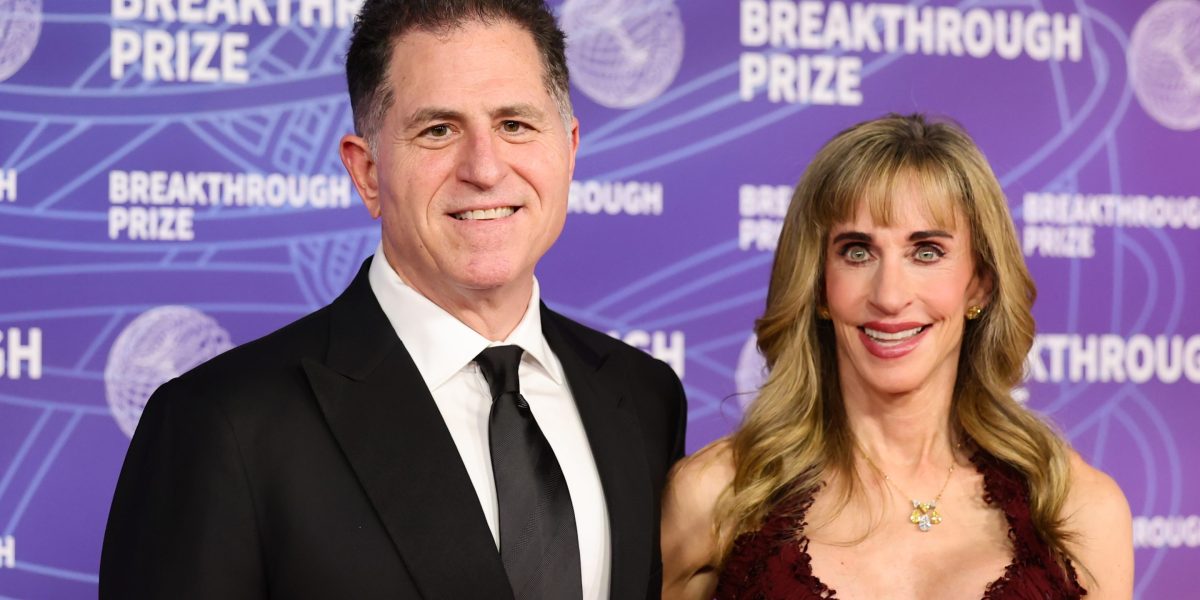
Michael Dell is having one of his biggest philanthropic years yet, having announced a major gift to his alma mater on the heels of a $6.25 billion pledge to seed “Trump Accounts.”
The Dell Technologies founder and his wife, Susan Dell, announced Tuesday a $750 million gift to the University of Texas at Austin to fund a new medical center and research campus built around AI from the ground up. This marks one of the largest donations ever given to a public university in the U.S., and it also pushes the Dells’ donations to UT Austin over $1 billion.
This is a full-circle moment for Dell, who founded the now-$140 billion tech company in his dorm room at UT Austin in 1984.
“What makes this moment so meaningful is the opportunity to build something that brings every part of the journey together—from how students learn, to how discoveries are made, to how care reaches families,” the Dells said in a statement. The gift will bring together medicine, science, and computing in one campus “designed for the AI era,” they added.
About the UT Dell Medical Center
The newly branded UT Dell Medical Center is slated to open in 2030 on the 300-plus-acre campus. It will connect “prevention, diagnosis, treatment, and discovery through AI and advanced computing—enabling earlier detection, more precise and personalized care, and better health outcomes,” according to the university.
The medical center will include a hospital with 300 to 500 beds, outpatient facilities, and a full-service emergency department, alongside a research campus focused on integrating advanced computing and AI into clinical care, university officials told local Austin outlet Kut News. The gift will also support undergraduate scholarships, student housing, and UT’s Texas Advanced Computing Center, which is building the nation’s largest academic supercomputer using Dell’s AI infrastructure.
The Dells’ connection to UT Austin
The $750 million gift is deeply personal for Dell, whose net worth is estimated at $177 billion, making him the seventh-richest man in the world, according to the Bloomberg Billionaires Index as of Wednesday.
He founded Dell Technologies from his dorm room at UT Austin, where he had enrolled as a pre-med student to appease his parents. But Dell had long been fascinated by computers and technology, having disassembled an Apple II model at the age of 15 to see how it worked, according to a 1999 biography, Direct From Dell: Strategies That Revolutionized an Industry. Dell was 19 when he started selling personal computer upgrade kits to other students in his dorm, a move that launched his tech empire. He had just $1,000 to invest in his business, but his manufacturing team consisted of “three guys with screwdrivers sitting at six-foot tables,” he said in Direct From Dell. But it was that risk-taking that eventually led to his success.
“You have to embrace risk, and you have to accept failure,” Dell told Fortune in a 2017 interview.
“If you want to really make it big, you’d better come up with something unique,” Dell continued. “It better be differentiated—that nobody else is doing.”
Dell eventually dropped out of UT Austin ahead of his sophomore year, and that same dorm room will also be renamed “Dell House” in his honor, according to Kut News.
“I think about this as the next step in a timeline that actually goes back to my parents sending me off to UT to become a doctor,” Dell told CNBC. “Obviously, that part didn’t work out, but I never stopped thinking about that.”
Local news outlets also reported Dell joked at a Tuesday press conference that his parents’ plan for him to be a doctor “got derailed,” but that “so far, it’s worked out.”
The Dells have been building toward this moment for nearly two decades. Their foundation committed $25 million in 2005 to help build Dell Children’s Medical Center, which opened in 2007 as the region’s first freestanding pediatric hospital. They kicked in $50 million in 2013 to launch the Dell Medical School at UT Austin.
Billionaires giving to higher education
The UT gift comes on the heels of another massive philanthropic move by the couple: a $6.25 billion pledge to seed “Trump Accounts,” the new investment vehicles created under President Donald Trump’s tax law that would give children born between 2025 and 2028 a $1,000 government seed contribution.
“It’s certainly the largest gift we will have given,” Dell told Fortune’s Diane Brady in December. “Our philanthropy so far has given about $3 billion, and this is more than double that. We’re working on a few other things that we’re not ready to announce but there is more to come.”
The Dells’ contribution is intended for the roughly 25 million American children under 10 who were born before Jan. 1, 2025 and therefore do not qualify for the federal seed contribution. Dell has said even a small sum makes a child more likely to enter college—”perhaps at the University of Texas or some other great school”—and eventually start a family or business.
The Dells’ donations land in elite company among recent billionaire mega-gifts to higher education. Nike cofounder Phil Knight in 2025 pledged $2 billion to Oregon Health & Science University’s cancer center, and Michael Bloomberg in 2024 gave $1 billion to Johns Hopkins to cover medical school tuition. Blackstone CEO Stephen Schwarzman, meanwhile, has also zeroed in on AI and education, including a $350 million gift to MIT to launch the Schwarzman College of Computing, and MacKenzie Scott has donated more than $1 billion to historically Black colleges and universities.
Disclaimer : This story is auto aggregated by a computer programme and has not been created or edited by DOWNTHENEWS. Publisher: fortune.com



