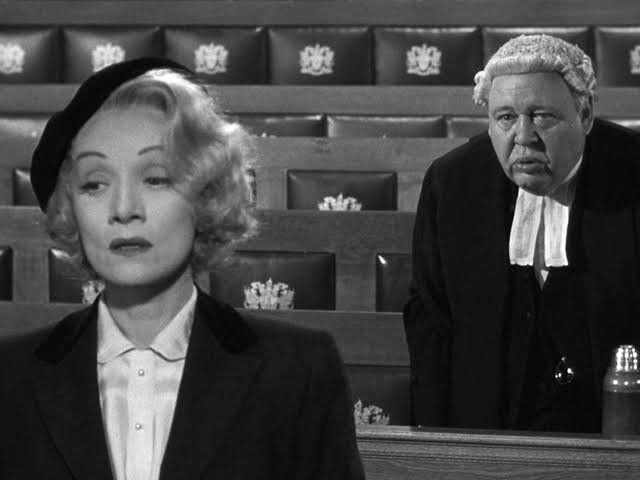
TEHRAN- Billy Wilder’s classic courtroom drama “Witness for the Prosecution”, based on a work by renowned British mystery writer Agatha Christie, was screened and reviewed at Tehran’s Arasbaran Cultural Center on Wednesday.
The special screening, featuring Persian subtitles, was held in cooperation with Cinema Cafe. Following the screening, a critical discussion of the film took place with Amir Qaderi, director and editor-in-chief of Cinema Café.
Released in 1957, “Witness for the Prosecution” is an American legal drama combining elements of mystery, film noir and dark comedy. The film stars Tyrone Power, Marlene Dietrich, Charles Laughton, Elsa Lanchester and John Williams. It received six nominations at the 30th Academy Awards, including Best Picture, Best Director for Wilder, Best Actor for Laughton and Best Supporting Actress for Lanchester. It also earned five Golden Globe nominations, with Lanchester winning the award for Best Supporting Actress.
The screenplay was written by Wilder and Harry Kurnitz, with Larry Marcus credited for the adaptation. The film is based on Christie’s 1953 stage play of the same name, which she developed from her earlier short story. The story’s intricate construction, shifting loyalties and carefully concealed motives made it particularly suited to the courtroom setting, where testimony, credibility and the interpretation of evidence become central to the unfolding drama.
At the center of the film is Sir Wilfrid Robarts (Charles Laughton), a distinguished London barrister known for his sharp legal mind and formidable courtroom skills. Recovering from a heart attack, Robarts has been advised by his doctors to avoid stressful criminal cases. His recovery is also closely supervised by his nurse, Miss Plimsoll (Elsa Lanchester), who is determined to keep him away from the pressures of legal practice. However, the arrival of an unusual murder case proves too tempting for the veteran lawyer to resist.
He agrees to defend Leonard Vole (Tyrone Power), a man accused of murdering Emily French, a wealthy widow who had become attached to him and named him as the principal beneficiary in her will. The circumstances surrounding the crime appear suspicious, and the financial motive makes Vole an obvious suspect. Nevertheless, Robarts becomes convinced that his client deserves a defense and takes on the case despite his fragile health and the objections of those around him.
The case becomes increasingly complicated when Robarts meets Christine Vole (Marlene Dietrich), Leonard’s German wife and the person who could potentially confirm his account of the evening of the murder. Initially, Christine appears to offer her husband an alibi. However, Robarts is uneasy about relying on the testimony of a spouse, particularly when the jury might regard her loyalty to her husband as a reason to question her credibility.
The trial takes an unexpected turn when Christine appears as a prosecution witness rather than supporting her husband’s defense. She reveals that her marriage to Leonard is not legally valid because she was already married to another man in Germany. This discovery allows the prosecution to call her to testify against him. Her testimony directly contradicts Leonard’s account of the night of the murder and places his defense in serious jeopardy.
As the proceedings continue, Robarts must reconsider everything he thought he knew about his client, his marriage and the circumstances surrounding the crime. A mysterious woman subsequently approaches the barrister with a collection of letters that could undermine Christine’s credibility and potentially change the course of the trial. The evidence introduces another layer of uncertainty, leaving both the defense and the audience to question the motives behind the characters’ actions.
Rather than relying solely on courtroom arguments, the film uses flashbacks, personal revelations and carefully constructed exchanges between its characters to gradually expose the contradictions in their stories. The relationship between Leonard and Christine, in particular, becomes central to the mystery. Their conflicting accounts raise questions about love, loyalty, betrayal and the extent to which personal feelings can influence the pursuit of justice.
Billy Wilder was one of the most versatile filmmakers of Hollywood’s Golden Age. Born Samuel Wilder in 1906 in what was then part of the Austro-Hungarian Empire, he began his career as a journalist before moving into screenwriting in Berlin. Following the rise of the Nazi regime, he left Germany in 1933, eventually settling in Hollywood, where he established himself as both a screenwriter and director.
Wilder’s extensive filmography spans several genres, from film noir and psychological drama to romantic comedy and social satire. Among his best-known works are “Double Indemnity” (1944), “The Lost Weekend” (1945), “Sunset Boulevard” (1950), “Sabrina” (1954), “Some Like It Hot” (1959) and “The Apartment” (1960). His films frequently combine sharp dialogue, moral ambiguity, dark humor and an interest in the contradictions of human behavior. He received six competitive Academy Awards during his career, including honors for directing, writing and producing.
SAB/
Disclaimer : This story is auto aggregated by a computer programme and has not been created or edited by DOWNTHENEWS. Publisher: tehrantimes.com