
London: The light from the atomic bomb was so blinding that John Morris could see every sinew and bone beneath his skin when he covered his eyes with his hands.
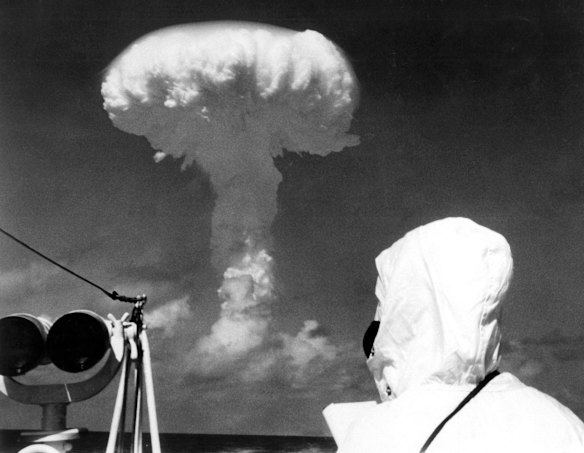
Morris was standing on Kiritimati (known at the time as Christmas Island) in the Pacific in November 1957 when British forces conducted a thermonuclear test more than 80 times the power of the bomb that levelled Hiroshima.
“I had sunglasses on, and my back to the explosion,” he told BBC Manchester. When he turned around, he saw a fireball that looked like molten rock and saw birds falling to the ground on fire.
Like the other defence personnel around him, he was dressed in a shirt and shorts; there was no protective gear.
“We had wagons to take us if anything went wrong. The tyres had melted in some instances,” he recalled. “The windscreen wipers had stuck to the windscreens. The wagons were made of steel. We couldn’t get on them for three hours because they were that hot.
“That’s how much care they took about our safety.”
Morris was a teenager and doing his national service when that bomb went off. Now, at 89, he is finally seeing a public inquiry into what happened. The investigation will look into all British nuclear tests, including those at Maralinga in South Australia and the Montebello Islands off the coast of Western Australia.
On Tuesday, British Prime Minister Andy Burnham said the Independent Panel into Nuclear Test Veterans would assess the impact on veterans and their families after years of calls for action on the exposure to radiation. The panel, led by retired bishop James Jones, is expected to deliver its findings within a year.
Australia held a royal commission in the 1980s to look into the British tests of the 1950s, which took place with the agreement and support of the Australian government of the time. Parliament held inquiries over subsequent decades into compensating those who suffered lasting health damage.
There has been no similar exercise in Britain.
The new inquiry is focused on UK veterans, but its work seems sure to reach Australia.
The British conducted their first test at the Montebello Islands in 1952, followed by more at the same site and in South Australia over that decade. They did nine tests in the late 1950s on Kiritimati and Malden islands in the Pacific, which are now part of Kiribati.
More than 20,000 British servicemen took part in the tests in some way.
One veteran, Brian Unthank, told the BBC on Tuesday night (Wednesday morning, AEDT) that the prime minister should issue a “total, abject apology” for the way veterans and their families were treated.
Unthank, 88, was a cook in the Royal Air Force when he was posted to Kiritimati.
“We were just guinea pigs, lab rats,” Unthank told the London Telegraph two years ago. He said his teeth fell out within two years of the bomb test. His first wife had 13 miscarriages. One of his sons was born with two holes in his heart. His daughter was born with two wombs.
Others were exposed. Indigenous Australians were left unprotected, as were the people of the Pacific Islands. Soldiers from Fiji were sent to support the operations. A New Zealand ship was ordered to sail beneath a blast to collect readings. More than 17,000 Australians participated in the tests in some way.
Morris, from Rochdale near Manchester, has fought for decades to get the Ministry of Defence to admit the damage to those who served. He witnessed four hydrogen bomb blasts.
His first son died at the age of four months, but it took his family six decades to obtain the autopsy report; he told the Manchester Evening News it showed the child had deformed lungs.
The British government denied for years that it conducted tests on personnel, only to admit in 2024, after a long campaign by The Daily Mirror, that it took blood samples to monitor the impact of the tests.
Hundreds of veterans took the government to court to seek the facts about the tests and clear the way for compensation, but they lost in the Court of Appeal in 2010 and again in the Supreme Court in 2012. At the time, the government said it had no intention of paying financial damages.
Burnham, who has met Morris, took a different approach. He supported an inquiry before he became prime minister and raised hopes that he would act when he took office.
“My message to the community is this: we will be led by the truth, and I am clear that the government must act on the recommendations of the panel,” he said on Tuesday.
Morris told the BBC on Tuesday night that the battle over what took place had been going on “inside my head” for a long time.
“I was sent to Christmas Island totally unaware of what I was being led into,” he said.
“I am looking for, and I sincerely hope, that finally we will get justice.”
Get a note directly from our foreign correspondents on what’s making headlines around the world. Sign up for our weekly What in the World newsletter.
 David Crowe is Europe correspondent for The Sydney Morning Herald and The Age.Connect via X or email.
From our partners
Disclaimer : This story is auto aggregated by a computer programme and has not been created or edited by DOWNTHENEWS. Publisher: www.smh.com.au