
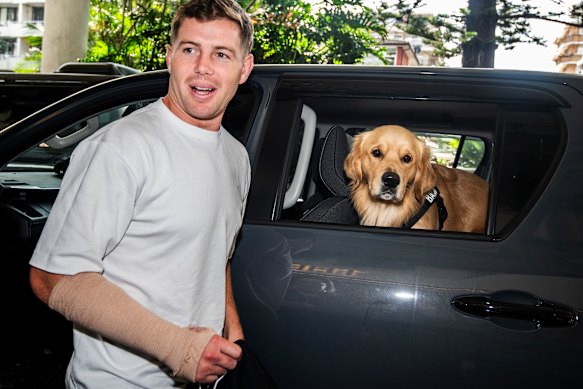

For a man who shoved his broken wrist back into place – twice – Blayke Brailey is surprisingly squeamish about the eight-centimetre scar left behind.
“I can’t even look at it,” the Sharks skipper and Blues bench hooker says.
“I get queasy about blood and those sorts of things. Even a scar like this, I don’t like looking at it.”
Brailey can appreciate how weird it sounds. He shocked Cronulla’s medical staff when, as he was walking from the field, he pushed a bone back into place after an awkward tackle on Manly’s Jason Saab a month ago.
Then in the Shark Park sheds with Andrew Fifita and an audience of physios and doctors around him, Brailey repeated his party trick, “Because I was trying to convince them, and myself, that I could go back on.”
“Honestly, I was kidding myself thinking I had a dislocation in the middle of my forearm … there are no joints there. It was clearly broken, but I had no pain, I could shake someone’s hand, tie my shoelaces. I thought I could play on.
“Then we had a test where I had to grip something and turn. Half my arm moved one way, the other half moved the other way and, yeah, I was done then.”
Brailey’s Cronulla comeback 20 days after surgery should not surprise in this context, particularly when teammate Cameron McInnes describes him as the toughest player he’s seen.
His return for NSW doesn’t either, given how Harry Grant played the Blues off a break in Origin II while they struggled for potency around the ruck.
Reece Robson’s retention at hooker for next Wednesday’s decider has raised eyebrows given the calls for Brailey or Api Koroisau to add more of a running and creative threat at dummy half.
Phil Gould, the most successful NSW coach in Origin history, has argued the Blues’ ability to combat Grant’s match-winning running game rests as much on “being less aggressive and less technical” with their marker defence as it does on what they do when in possession.
Robson and Brailey pointed to slowing down Queensland’s ruck speed as the simplest fix after Lindsay Collins and Tino Fa’asuamaleaui overpowered NSW’s middles from the 30-minute mark at the MCG.
Koroisau went unused on the NSW bench as Kotoni Staggs’ sin binning threw out their interchange plans, and Robson ended up playing 80 minutes in the Maroons’ 44-24 win.
Brailey also argued that Robson’s defensive work in Origin’s opening exchanges is underestimated by his critics, and backed the Blues to replicate their successful Origin I dummy half tactics.
“I think that’s tough on Robbo. He’s such a tough player and he works so hard in the middle,” Brailey said.
“I think everyone sees the highlights and the big breaks, but they probably don’t see the clean-up work and all the extras he does in the middle.
“Obviously Harry played really well [in Melbourne] and showed how once there is fatigue in the game, that having a running hooker as a threat is massive.
“Getting over the advantage line and bringing big middles onto the ball, that’s the ideal scenario for a dummy half, isn’t it?
“Hopefully I can come on whenever I get the chance and bring that same sort of energy and ruck speed. I think the combo with Robbo worked well in game one, and I’m excited to hopefully match Harry with his attacking flair and run threat”.

From our partners
Disclaimer : This story is auto aggregated by a computer programme and has not been created or edited by DOWNTHENEWS. Publisher: www.smh.com.au



