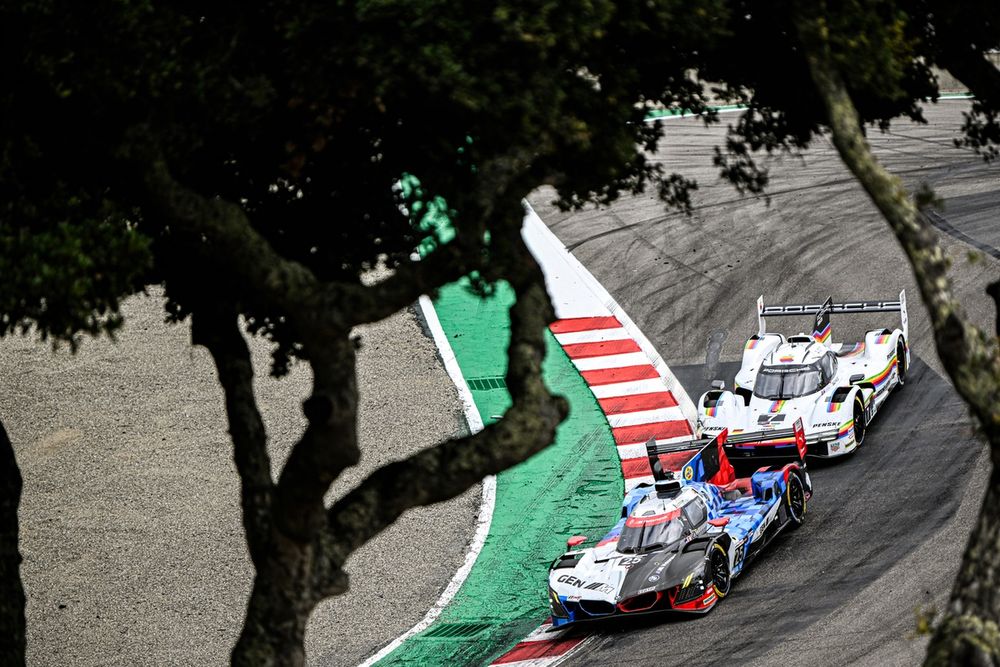
As both the current and old-spec Porsche reach new weight heights, the BoP remains secondary in the often-chaotic IMSA races on the Detroit street course.
New weight increases for both the 2026- and the 2025-spec Porsche 963 headline the Balance of Performance for the 2026 Chevrolet Detroit Sports Car Classic.
After the small break at Laguna Seca raceway, the factory Porsche 963s are back to 1,100 kilograms as they were at Long Beach. The 2025-spec Porsche 963 from the JDC-Miller squad, fresh from its sensational win at Monterey, is now at the heaviest it’s ever been at 1,082 kilograms.
However, this is only half of the story. The factory cars actually enjoy a better power-to-weight ratio than at both Long Beach and Laguna Seca thanks to an almost 9 kW power increase below 190 kph (118 mph).
Even the 2025-spec Porsche 963 isn’t worse off than it was at Laguna Seca. Thanks to 14.5 kW more below 190 kph compared to the latest race in California, its power-to-weight ratio is even slightly improved.
But to understand the whole picture, we need to look at the values for all competitors.
Below 190 kph: Aston Martin almost reeled in
The tables for Detroit lead to the following power-to-weight ratios:
- Aston Martin Valkyrie – 1.981 kg/kW
- BMW M Hybrid V8 – 1.991
- Acura ARX-06 – 2.021
- Cadillac V-Series.R – 2.027
- Porsche 963 old – 2.106
- Porsche 963 – 2.250
While the Aston Martin Valkyrie retains its baseline advantage. but the rest of the field has closed the gap. This is especially true for the BMW M Hybrid V8. which breaks below the 2.0 mark for the first time this year.
Compared to Laguna Seca. the following picture emerges:
- Acura ARX-06 -0.057 kg/kW
- BMW M Hybrid V8 -0.044
- Cadillac V-Series.R -0.018
- Porsche 963 -0.008
- Porsche 963 old -0.001
- Aston Martin Valkyrie +-0.000
This signals a major boost for both Acura and BMW, while Porsche only makes marginal gains.
The Aston Martin Valkyrie, which has been operating at the optimum power-to-weight ratio of 1.981 kg/kW since Sebring, remains unchanged.
For a street course, we also have to consider how this improved power-to-weight ratio is achieved. On a tight street circuit, a race car needs massive punch out of low-speed corners. Compared to permanent road courses, pure weight becomes secondary.
The 2025-spec Porsche makes the biggest step forward with a 14.56 kW increase, effectively offsetting its 30 additional kilograms. The John Church-led squad shouldn’t be too disappointed with this configuration following their Laguna victory.
The second-biggest gain goes to the Acura ARX-06 with nearly 12 kW, followed by the 2026-spec Porsche (+8.84 kW), the BMW (+5.72 kW), and the Cadillac (+2.08 kW).
Compared to Detroit 2025. we get the following changes. Bear in mind that four LMDh cars have received updates over the winter:
- BMW M Hybrid V8 -0.114 kg/kW
- Porsche 963 old -0.102
- Cadillac V-Series.R -0.013
- Aston Martin Valkyrie +-0.000
- Acura ARX-06 +0.036
- Porsche 963 +0.042
Acura’s gains relative to Laguna Seca quickly fade when compared to last year’s BoP at this very track. The Meyer Shank Racing entries are the second-hardest hit behind the Penske Porsches.
In a remarkable twist, the 1,082 kg JDC-Miller Porsche is actually in a much better position than in 2025, when Porsche was restricted to 480 kW at 1,060 kg – yielding a massive net gain of over 33 kW.
The biggest step forward goes to BMW, gaining almost 25 kW while losing 7 kg compared to 2025. Conversely, the Acura ARX-06 – the race-winning car from 2025 – faces a tougher task, carrying 21 kg more than last year with only a single additional kW to compensate.
Above 200 kph: Tight margins at high speed
The 200 kph (124 mph) threshold is only genuinely cleared on the long main straight leading into the tight hairpin.
Above this transitional zone, the grid stacks up as follows:
- Aston Martin Valkyrie – 1.981 kg/kW
- Cadillac V-Series.R – 2.097
- Acura ARX-06 – 2.101
- BMW M Hybrid V8 – 2.109
- Porsche 963 – 2.115
- Porsche 963 old – 2.117
The aerodynamically draggy Aston Martin retains its clear BoP advantage at higher speeds, while the rest of the field remains separated by a minuscule corridor of just 0.02 kg/kW as it was at Laguna Seca.
When we compare these numbers to Laguna Seca, however, we can see clear changes:
- Aston Martin Valkyrie +-0.000 kg/kW
- Cadillac V-Series.R +0.007
- BMW M Hybrid V8 +0.009
- Acura ARX-06 +0.014
- Porsche 963 +0.031
- Porsche 963 old +0.038
With only 5 kW gained since Monterey, the 2025-spec Porsche loses the most ground due to its 30 kg weight penalty. A similar trend affects the 2026-spec Porsches, which have already been operating at the maximum 520 kW limit in the high-speed range since Long Beach.
Aside from the Aston Martin remaining at its 1.981 kg/kW baseline, every other manufacturer faces a slightly worse high-speed power-to-weight ratio than at Laguna Seca Raceway.
The final table compares the high-speed BoP to Detroit last year:
- Porsche 963 -0.093 kg/kW
- Porsche 963 old -0.091
- Aston Martin Valkyrie +-0.000
- BMW M Hybrid V8 +0.033
- Acura ARX-06 +0.053
- Cadillac V-Series.R +0.113
The BoP structure has evolved massively since 2025, even for the older Porsche homologation. Porsche gains the most year-on-year above 200 kph, thanks to a maximum 40 kW increase for the 2026 spec and an impressive 33.76 kW bump for the 2025 spec.
The heaviest losses are sustained by the Cadillac V-Series.R, which drops 24 kW while carrying eight additional kilos. This is largely a byproduct of its winter upgrade, which targets higher top speeds via a lower-drag rear wing configuration.
Acura suffers even more from its 21 kg increase compared to 2025, as it also sheds nearly 2.7 kW. BMW gives up performance here as well after gaining so much in the sub-190 kph range; its 11.1 kW deficit compared to 2025 cannot be offset by a 7 kg weight reduction.
Conclusion
#25 BMW M Team WRT: Philipp Eng, Marco Wittmann, #7 Porsche Penske Motorsport: Felipe Nasr, Julien Andlauer
Photo by: Brandon Badraoui / Lumen via Getty Images
On paper alone, BMW must be labeled the favorite for the 2026 Detroit street race. The performance gains below 190 kph are substantial, and this is the speed range that truly dictates lap time on this slow, unforgiving street circuit.
However, Detroit is arguably the track where pure BoP matters the least. Track position and strategy carry far more weight on a layout featuring only one realistic overtaking opportunity.
Executing the perfect strategy, however, is a monumental task on a historically caution-heavy track. Ultimately, luck will play a major role in deciding the winner. Team Penske has historically excelled in mastering these chaotic variables.
Nevertheless, given the stark numbers, the pressure will be on BMW to deliver.
Balance of Performance Detroit in detail
Values in parentheses = Change from Laguna Seca 2026/ Detroit 2025
Acura ARX-06
- Min. Weight: 1.051 kg (-5 kg / +21 kg)
- Max. Power <190 kph: 520.00 kW (+11.96 kW / +1.00 kW); 697 hp
- Max. Power >200 kph: 500.24 kW (-5.72 kW / -2.671 kW); 671 hp
- Max. Engine Speed: 9.512 rpm
- Max. Energy per Stint: 907 MJ (+3 MJ / +5 MJ)
- Fuel Replenishment: 22.675 MJ/sec (+0.075 MJ/sec / +0.125 MJ/sec)
Aston Martin Valkyrie
- Min. Weight: 1.030 kg (+0 kg / +0 kg)
- Max. Power <190 kph: 520.00 kW (+0.00 kW / +0.00 kW); 697 hp
- Max. Power >200 kph: 520.00 kW (+0.00 kW / +0.00 kW); 697 hp
- Max. Engine Speed: 8.400 rpm
- Max. Energy per Stint: 909 MJ (+9 MJ / +1 MJ)
- Fuel Replenishment: 22.725 MJ/sec (-0.100 MJ/sec / +0.025 MJ/sec)
BMW M Hybrid V8
- Min. Weight: 1.031 kg (-11 kg / -7 kg)
- Max. Power <190 kph: 517.92 kW (+5.72 kW / +24.92 kW); 695 hp
- Max. Power >200 kph: 488.80 kW (-7.28 kW / -11.102 kW); 656 hp
- Max. Engine Speed: 8.000 rpm
- Max. Energy per Stint: 896 MJ (-6 MJ / +9 MJ)
- Fuel Replenishment: 22.400 MJ/sec (-0.150 MJ/sec / +0.225 MJ/sec)
Cadillac V-Series.R
- Min. Weight: 1.038 kg (-5 kg / +8 kg)
- Max. Power <190 kph: 512.20 kW (+2.08 kW / +7.20 kW); 687 hp
- Max. Power >200 kph: 495.04 kW (-4.16 kW / -24.100 kW); 664 hp
- Max. Engine Speed: 8.800 rpm
- Max. Energy per Stint: 896 MJ (-5 MJ / -2 MJ)
- Fuel Replenishment: 22.400 MJ/sec (-0.125 MJ/sec / -0.050 MJ/sec)
Porsche 963 (2025 Homologation)
- Min. Weight: 1.082 kg (+30 kg / +22 kg vs. 2025 Factory car)
- Max. Power <190 kph: 513.76 kW (+14.56 kW / +33.76 kW vs. 2025 Factory car); 689 hp
- Max. Power >200 kph: 511.16 kW (+5.20 kW / +31.16 kW vs. 2025 Factory car); 685 hp
- Max. Engine Speed: 8.158 rpm
- Max. Energy per Stint: 914 MJ (+19 MJ / +35 MJ)
- Fuel Replenishment: 22.850 MJ/sec (+0.475 MJ/sec / +0.875 MJ/sec)
Porsche 963 (2026 Homologation)
- Min. Weight: 1.100 kg (+16 kg / +40 kg vs. 2025 Factory car)
- Max. Power <190 kph: 488.80 kW (+8.84 kW / +8.80 kW vs. 2025 Factory car); 656 hp
- Max. Power >200 kph: 520.00 kW (+0.00 kW / +40.00 kW vs. 2025 Factory car); 697 hp
- Max. Engine Speed: 8.158 rpm
- Max. Energy per Stint: 910 MJ (+19 MJ / +31 MJ)
- Fuel Replenishment: 22.750 MJ/sec (+0.475 MJ/sec / +0.775 MJ/sec)
We want your opinion!
What would you like to see on Motorsport.com?
– The Motorsport.com Team
Disclaimer : This story is auto aggregated by a computer programme and has not been created or edited by DOWNTHENEWS. Publisher: motorsport.com