
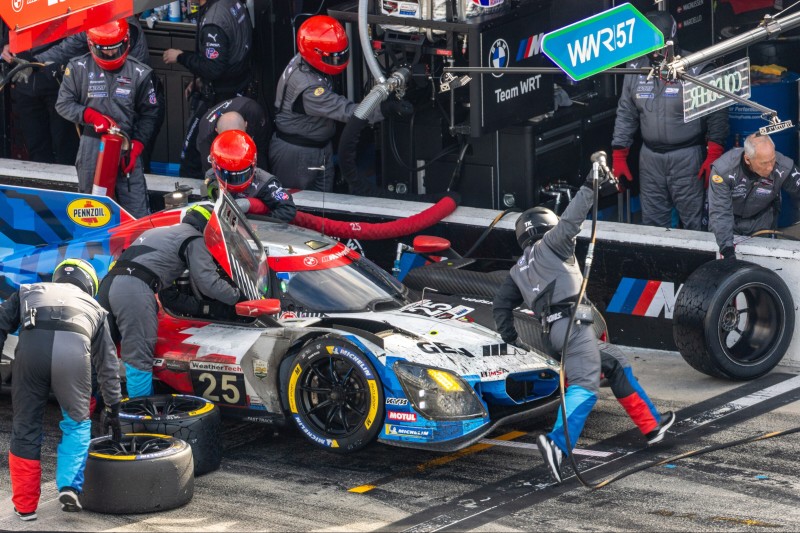
Fresh off its historic breakthrough victory in the World Endurance Championship last month, BMW is now gearing up for the ultimate endurance test at the Circuit de la Sarthe with its heavily-revised M Hybrid V8.
For spectators trackside, the most immediate visual indicator of the car’s update is its significantly scaled-down kidney grille. According to Achim Klein, BMW M Hybrid V8 project leader, the slimmed-down grille mirrors the design language of upcoming production models.
Following the highly controversial, oversized front grilles seen on the G80-generation M3 and M4, the Munich-based manufacturer is pivoting toward a more understated layout for its upcoming “Neue Klasse” fleet—a philosophy that has seamlessly carried over into the hypercar programme.
However, the more important aspect of the overhaul is the raw performance. “After spending three seasons operating with the original iteration of the chassis, we reached a developmental ceiling where further progress was no longer possible. This technical package unlocks completely fresh setup philosophies and performance boundaries for us,” Klein explained.
At the core of this upgrade is driver confidence and a broader set-up window. Because absolute peak performance is strictly regulated by the Balance of Performance (BoP) framework, success in the Hypercar class hinges entirely on a team’s ability to extract consistent pace across shifting track conditions and characteristics.
“The drivers were asking for a more predictable platform, particularly when managing unpredictable crosswinds and low-grip conditions,” Klein explained. The vast majority of the aerodynamic revisions remain hidden beneath the bodywork, focusing primarily on internal cooling ducts and modified airflow channels.
This packaging was further refined to exploit the two-stage BoP system introduced by the regulators back in 2024, which effectively neutralised prior design compromises.
With a last-minute turnaround, BMW turned things around in Daytona
Photo: Rolex
Daytona shock: A last-minute rescue mission
Despite the long-term promise, the updated package initially triggered alarm bells. During the IMSA season opener at the Daytona 24 Hours, the BMWs struggled significantly throughout practice, running well outside the optimal operating window.
Drivers reported a frustrating regression to the handling difficulties of the programme’s first two years, when the car was notorious for catching out even factory professionals.
“Daytona served as our initial high-stakes operational test under the new multi-series structure, and it was immediately clear that our trackside procedures and routines were not yet cohesive,” admitted Bernhard “Berno” Demmer, Hypercar and GTP programme director at WRT.
“We lacked a comprehensive grasp of the car’s trackside dynamics simply because the clock ran out on us during winter preparation. That deficit caught up with us brutally in Florida.”
The event also marked the competitive debut for WRT’s newly-established American arm based in Charlotte. While the crew had to be integrated from scratch, they received crucial reinforcement from WRT’s seasoned WEC staff at Daytona.
Compounding these difficulties are modern testing restrictions, which turn technical developments into a high-stakes gamble compared to the unrestricted testing eras of the past.
“As an engineer, my instinct is always to demand 30 sets of tyres to systematically validate 30 different setup variables. But the regulations don’t allow for that, meaning the testing limits hit us hard,” Demmer noted. However, these restrictions are a level playing field for everyone.
In a dramatic turn of events, the engineering team managed to turn the situation around just before the green flag waved, relying on a radically reworked, un-validated set-up trajectory.
“We put in gruelling hours behind closed doors. In the end, we stripped everything back and focused exclusively on the core parameters of the setup. It was a massive gamble because we had no time to validate the changes,” Demmer said.
The risk paid off. In the race, the BMW M Hybrid V8 displayed competitive long-run pace, culminating in an unexpected podium finish. “The psychological boost for the entire organisation was immense. We were surprised to see such an immediate performance swing, proving definitively that our core concepts were correct,” Demmer recalled.

The #20 BMW has received a special design for the 2026 24 Hours of Le Mans
Photo: Rainier Ehrhardt
Breakthrough at Laguna Seca
Following the cancellation of the WEC season opener in Qatar due to the regional conflict, the WEC side of the WRT operation was able to provide minor operational backing at Sebring. However, by the time the IMSA schedule arrived in Long Beach, the American branch was entirely on its own due to a direct scheduling conflict with the WEC race at Imola. Nevertheless, the cross-continental synergy remained intact.
“The telemetry and engineering data flowed constantly between both branches. While the final race results in California were masked by on-track incidents, the underlying car performance represented a monumental leap forward”, Demmer explained.
Meanwhile, the WEC squad delivered a solid but unspectacular fifth and sixth-place finish at the delayed season opener in Imola. The real validation, however, was waiting across the Atlantic. At Laguna Seca Raceway and the Detroit street circuit, the #25 BMW secured back-to-back podium finishes.
“Laguna Seca was a critical milestone because it significantly deepened our understanding of the revised car. It was WRT’s first competitive outing in the GTP class at that venue. It is an incredibly demanding circuit with its abrasive track surface, heavy camber changes, and unique technical sectors like the Corkscrew,” Demmer stated.
Despite the trophy, the veteran engineer – his career spanning successful leadership roles at Team Phoenix, Manthey Racing, Porsche Penske Motorsport, and Sauber in Formula 1 – remained characteristically self-critical:
“The underlying philosophy of the evo kit has performed as intended. Unfortunately, the race execution with the sister car left a lot on the table. The #24 showed incredible speed, but we decided early on a short middle stint, leaving us vulnerable to the timing of Cautions.”
Yet, WRT’s tactical depth saved the day as the #25 car capitalised on an alternative strategy to secure third place. Only Laurin Heinrich, who delivered a masterful performance to take a sensational victory in the customer JDC-Miller Porsche 963, remained untouchable for that day.
Detroit delivered an almost identical narrative. WRT split the strategies between the two cars, once again propelling the #25 car onto the podium. “On a tight street circuit like Detroit, you are forced to commit to a strategic path incredibly early because it is a one-stop race,” Demmer said.
He also explained that the tactics were originally reversed: “We had to swap the strategies on the fly because the #24 broke the minimum tyre pressure thresholds. IMSA gave us a technical warning, forcing us to pivot immediately. Once he was unleashed on fresh rubber, Dries Vanthoor was the fastest car on the track.”
A subsequent collision followed by a penalty ultimately derailed the Belgian’s charge, but the sister car was perfectly positioned to secure the podium.
Crucially, the data gathered on Detroit’s slow, bumpy surface provided vital lessons for the opposite demands of Le Mans: ” We are focusing massively on braking. Detroit only features one heavy braking zone, but the data taught us a lot. It also confirmed that the car’s mechanical grip is at a very good level.”
Relieve at Spa-Francorchamps
Between the two American races was a monumental milestone: a flawless one-two finish at the 6 Hours of Spa. The result marked BMW’s first overall victory in the modern WEC era and its first major top-class endurance triumph since the historic Le Mans win in 1999.
In the context of an official sports car world championship, it was BMW’s first overall victory since Nelson Piquet and Hans-Joachim Stuck triumphed at the 1981 Nurburgring 1000km in the iconic BMW M1.
“It felt like a massive weight was lifted off our shoulders,” Demmer admitted. “There was an undeniable pressure following us because this car had yet to taste victory in WEC. Breaking that curse was incredibly liberating.”
He was quick to dismiss any suggestions that the result was a byproduct of favourable Balance of Performance adjustments, as WEC’s BoP secrecy makes it impossible to counter theories that this was just BMW’s turn to win: “This was earned entirely on merit. Alpine, Peugeot, and Aston Martin were matching our pace. Cadillac was also firmly in the window. We were honestly surprised that some of our competitors failed to maximise their operational potential, whereas we executed a flawless weekend where every single variable aligned perfectly.
“Barring a few minor operational details, the team executed a textbook weekend. Our race pace was robust, which gave us the confidence to pull the trigger on an aggressive strategy. It paid off beautifully—just a perfect, comprehensive performance.”
The Ultimate Test at Le Mans
With the undisputed highlight of the season looming at Le Mans, the mid-pack times recorded during the official pre-test do not rattle Team WRT. “We are not losing sleep over the headline times,” Demmer said.
“The Le Mans test day is a highly complex, multi-dimensional exercise. To be completely blunt, we spent zero time looking at what our rivals were doing.”
By multi-dimensional, Demmer refers to the exhaustive validation of different bodywork configurations, including alternating front and rear bodywork assemblies.
“The schedule was relentless. We had to balance energy management mapping, brake wear analysis, race simulations, and ensure all drivers including reserve drivers completed their mandatory laps. Furthermore, the track evolution during the morning session is massive.”
The primary challenge moving into race week will be a drastic upswing in ambient temperatures. Some models project Sunday temperatures soaring to 32 degrees Celsius, while practice and qualifying sessions are expected to run in cool 20-degree conditions.
Demmer: “Naturally, we would prefer practice conditions that mirror the projected race climate, particularly for validating the hard tire compound. Realistically, we won’t be able to simulate that thermal load ahead of time. Our goal is to extrapolate the data as closely as possible, and the final decision to run the hard compound will likely be made live during the race”
However, the BMW M Hybrid V8 is gentle on its tyres, meaning a high-temperature race could play directly into the hands of the German manufacturer. So, where does BMW stand in its understanding of the new evo package?
The team says it has taken a “another monumental leap forward”, and is actively working to unlock sharper single-lap pace, an area where it excelled during the early European WEC rounds. This focus remains crucial for the upcoming rounds on the calendar where track position is paramount.
“Our qualifying specialists are demanding a more aggressive, sharper balance. We are currently analysing how far we can push the car’s setup envelope to deliver that edge,” Demmer said.
Ultimately, the technical overhaul has delivered exactly what was promised on paper, which is also reflected in the results. The final box left to tick for the revised BMW M Hybrid V8 is a victory at a true crown jewel event. And there is no better stage to achieve that than Le Mans.
We want your opinion!
What would you like to see on Motorsport.com?
– The Motorsport.com Team
Disclaimer : This story is auto aggregated by a computer programme and has not been created or edited by DOWNTHENEWS. Publisher: motorsport.com



