Serving on boards can unlock new industry influence and career growth—but women are increasingly being shut out of the room.
Board placements for women are down 33% over the last year, according to Merline Saintil, the cofounder of Black Women on Boards. The veteran executive said companies are looking for specific titles when picking new members—and most of them are titles that women have been underrepresented in.
“Placements are happening, but they’re happening specifically for CEOs,” Saintil told editorial director Diane Brady at Fortune’s annual Most Powerful Women Summit. “We’re back to CEO, CFO profile now. So if you’re a technologist or someone outside of that, I would just say keep relationship building, keep networking.”
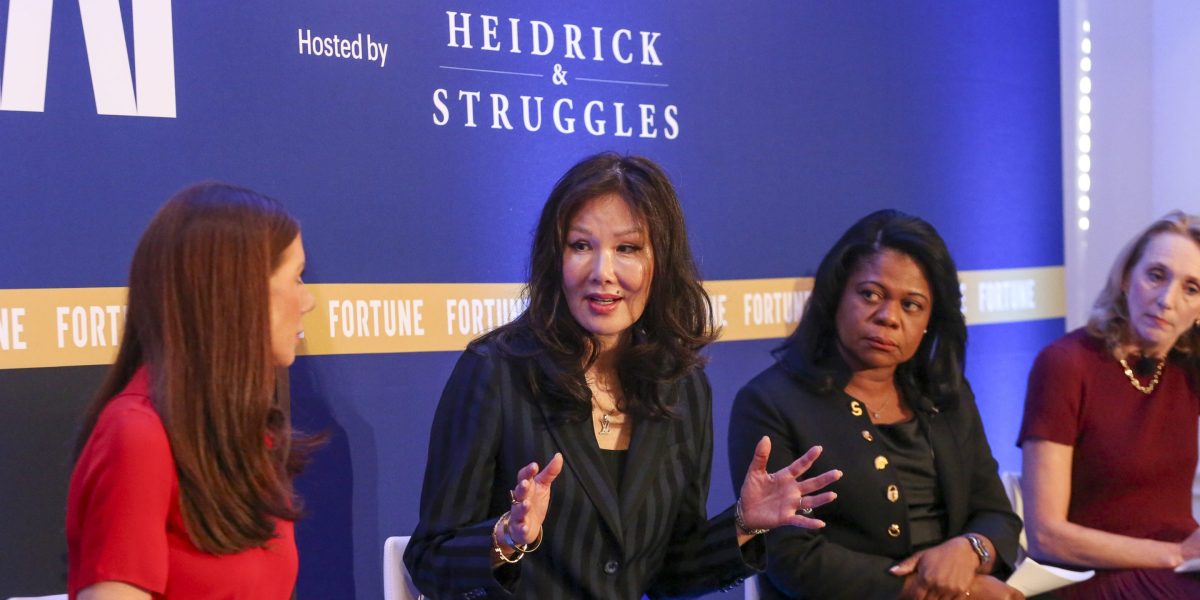
In a discussion with other leaders from Heidrick & Struggles, TwinPoint Collective, and Logitech, the executives discussed the changing landscape for board recruitment and how women can position themselves for a seat. Jane Bargmann, global managing partner of private equity, industrial and life sciences at H&S noted a growing trend of leaders ditching their day jobs for a full-time board career. She said they’ll join a slew of publicly-traded and PE companies, spending their “retirement” brokering deals and serving on boards of portfolio companies.
“What we’re seeing now is people make the decision to step out of a full-time role or an operating role earlier and build a portfolio of boards,” Bargmann said. “Some retired individuals are just as busy as CEOs.”
But the executives warn against throwing in the towel too soon. Hanneke Faber, CEO of software manufacturer Logitech, has found that boards aren’t recruiting members who have kicked their feet up. Companies are looking to bring on C-suite candidates who are in-the-know, and able to keep up with today’s fast pace of change. The Logitech leader agrees with Bargmann that recruiters are on the hunt for CEOs and CFOs, but also drawing from the C-suite more broadly—where women have an opening.
“This thought of, ‘Let me step out of my day job and go do boards,’ [is] not such a good idea at the moment. Because we want people who are current, who are dealing with some of these issues in their day job,” Faber said. “Being current is a huge help for getting on a board today.”
While board seats can offer a new chapter for seasoned executives, landing one increasingly depends on staying active in the C-suite and leveraging the right connections.
Annie Young-Scrivner, the cofounder and CEO of private equity firm TwinPoint Collective, said relationships can be instrumental in finding board opportunities.. She recalled that in her final CEO stint as the leader of global beauty brand Wella Company, she worked with H&S to completely reestablish her board. Since most of Wella’s consumers were women, she requested the line-up be 100% female to better serve their interests. And when hunting for the perfect people to take the slots, it can call come down to connections.
“It makes a huge difference…tapping into that network,” Young-Scrivner said. “As we’re searching, the networks really help. So conferences like this, as you widen your aperture and your scope of connectivity, [are] really important.”
Disclaimer : This story is auto aggregated by a computer programme and has not been created or edited by DOWNTHENEWS. Publisher: fortune.com