
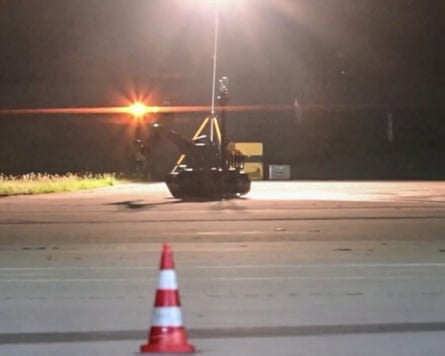
German police deployed a bomb disposal robot after a drone carrying explosives was found at Leipzig airport, causing alarm and the diversion of several flights.
A DHL cargo plane that had been forced to abort its landing at the airport then collided with an unknown object in mid-air as it was climbing away from the airport. It later landed safely elsewhere.
The counter-terrorism team at the Dresden prosecutor’s office and the Saxony state police have taken over the investigation into the incidents, which security experts said could amount to a serious escalation in tensions with Russia if it was determined the Kremlin played a role.
Investigators said that overnight on Wednesday “a drone carrying an unknown explosive device was spotted by an airport employee in the security area of the cargo operations zone near the south runway” of Leipzig airport, a facility classified as “critical infrastructure”.

“A suspected second unidentified flying object collided with a cargo aircraft after it had taken off again following the previous closure of the runway. Minor damage was detected on the aircraft after it landed in Hanover,” the investigators said.
The airport in eastern Germany serves as a hub in the transport of military goods, including by the German armed forces and Nato allies, and also serves as a base for Ukraine’s Antonov Airlines.
A Nato official said: “We are aware of the incident, which the German authorities continue to investigate.”
The drone, a quadcopter that was fitted with an explosive device, was found near a Ukrainian Antonov cargo plane, according to media reports.
Some of the Ukrainian aircraft are emblazoned with patriotic slogans including “Be Brave Like Kherson” and “Be Brave Like Bucha”, the site of a civilian massacre early in the full-scale Russian invasion.
The tabloid Bild speculated that the explosive could have been fabricated from fertiliser and petrol, while a team from the public broadcasters NDR and WDR, and the Süddeutsche newspaper said the device had contained pentaerythritol tetranitrate, or PETN – a primary ingredient in semtex that belongs to the same chemical family as nitroglycerin.
Interior minister Alexander Dobrindt, who was on holiday in Italy, said he would travel to Leipzig to hold meetings with federal and state authorities.
The newspaper Die Zeit said investigators were examining several possible scenarios including an attempt by Russia to launch an attack on Ukrainian equipment in Germany.
Ukraine’s ambassador to Germany, Oleksii Makeiev, blamed Moscow. “Who else could it be but Russia?” he told the commercial broadcaster Welt TV. Moscow has not commented so far.
Konstantin von Notz, the opposition Green party’s spokesperson on intelligence oversight, called for an investigation to be conducted with the utmost urgency and also hinted at possible Russian involvement.
“Should it transpire that a state is behind this action, this would constitute not merely terrorism but state terrorism directed against the federal republic of Germany and its citizens,” he told Der Spiegel.
Marc Henrichmann, the CDU chair of the German parliament’s intelligence oversight committee, said the latest incident looked like “an attempt to target a company of importance for Ukraine”.
If the details are confirmed, it “would represent a new level of escalation in these sorts of attacks”, he told the Rheinische Post newspaper.
Several aircraft, including a passenger plane from Mallorca, were diverted because of the incident. Operations in the northern part of the airport resumed two hours later.
The southern runway, where the drone was found, remained closed. Police deployed a bomb disposal robot to examine the object.
Police and prosecutors said: “There is no danger to the lives or safety of passengers or airport staff. Passenger air traffic is unaffected.”
Germany and other European countries have had a series of suspicious unauthorised drone overflights at airports, military facilities, ports and logistics companies. They have accused Russian agents of being behind some of the flights, which Moscow has denied.
European security agencies investigated incendiary devices concealed in parcels that caught fire in 2024, raising concerns about sabotage of air cargo operators. Some of the devices were found at a DHL warehouse in Leipzig and in freight shipments in transit across Europe.
Tobias Meyer, the chief executive of DHL, said in a quarterly results call:: “We’ve got plans for cases like this, and we’ll try to make sure that the influence on our customers will be as low as possible.”
Germany is the biggest single national supplier of military aid to Ukraine and has accused Russia of orchestrating a campaign of sabotage, espionage and disinformation against it, which the Kremlin has denied.
Last year, a Chinese national was convicted for passing on information about flight schedules and cargo movements at Leipzig-Halle airport to a man spying for Beijing.
Separately, Die Zeit reported that Russian secret services were plotting an attack against Stefan Thumann, the head of German drone manufacturer Donaustahl.
The report said German investigators were tipped off by a foreign intelligence service at the end of last year and arrested a Ukrainian man and a Romanian woman this spring. Thumann is said to be under police protection.
In 2024, US intelligence services reportedly foiled a Russian plot to assassinate the chief executive of Germany’s leading arms manufacturer, an apparent attempt at retaliation over the company’s role in providing a large amount of armaments for Ukraine.
The plan to murder Armin Papperger, the chief executive of Rheinmetall, was reportedly one of several Russian government schemes to kill defence industry executives in several countries in Europe that have been supporting Ukraine’s war effort. The plot against Papperger was believed to be the most advanced.
Disclaimer : This story is auto aggregated by a computer programme and has not been created or edited by DOWNTHENEWS. Publisher: theguardian.com




