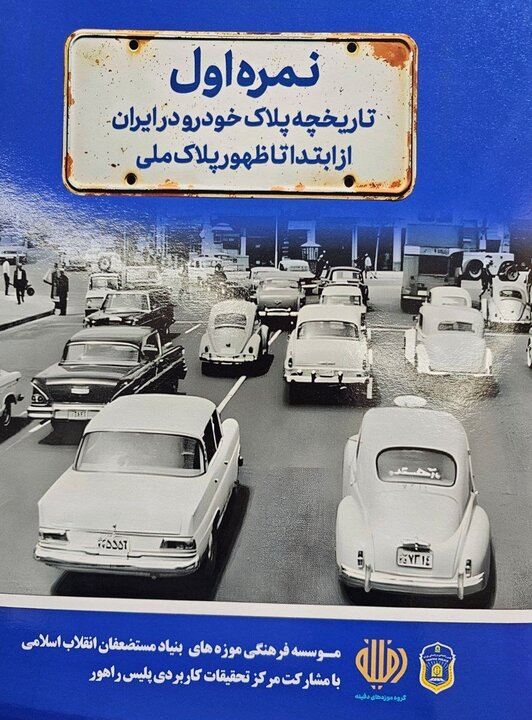
TEHRAN – A book tracing the history of vehicle license plates in Iran, from the arrival of automobiles to the introduction of the country’s national registration system, was unveiled on Saturday at the Mostazafan Foundation’s headquarters in Tehran.
Titled Nomreh Aval (First Number), the book was prepared through a joint initiative involving the Applied Research Center of Iran’s Traffic Police, the Historical Car Museum of Iran and the Dafineh Museum Institute, which is operated by the Mostazafan Foundation.
Hamidreza Soleimani, managing director of the Foundation’s Museum Institute, said the publication was the culmination of at least 12 years of research by the institute and its research team.
“The technology that entered Iran also changed our social contracts,” Soleimani said, explaining how the introduction of automobiles and traffic regulations reshaped public behavior. Street signs, for example, now guide how vehicles should move and interact on roads, he noted.
He described the book as the first comprehensive reference on the history of vehicle license plates in Iran, saying it could serve researchers and automobile enthusiasts.
Soleimani also highlighted the research potential of the Historical Car Museum of Iran, which houses 320 historic vehicles, each with its own story and historical significance.
The book examines the evolution of vehicle registration plates in Iran, beginning with the arrival of automobiles and the establishment of the first numbering systems, and continuing through the introduction and adoption of national license plates.
According to its publishers, the work draws on historical research, documentary evidence and reliable sources, particularly archival materials held by Iran’s classic car museum. It brings together information that, in many cases, had not previously been compiled in a single publication, aiming to provide a documented account of how vehicle plates developed over time.
Reza Sakhaei, head of the Applied Research Center of the Law Enforcement Command’s Traffic Police, said vehicle license plates might initially appear to be a simple administrative matter, but they also reflect aspects of Iran’s modern history.
He added that vehicle registration and identification systems now serve purposes beyond their original function.
Sakhaei also discussed plans to develop smart glasses for traffic police officers, saying the technology could help officers monitor vehicles and drivers. The proposed device would incorporate a camera similar to those worn on police uniforms, with additional functions allowing users to move menus to the palm of their hand, he said.
Sakhaei described the newly unveiled book as a contribution to preserving Iran’s historical identity and collective memory.
Ainollah Jahani, the book’s technical supervisor, said the research had also brought to light unusual old vehicles, some of which could be used for museum displays and, in certain cases, might still be operational.
The publication adds to the research potential of Iran’s historic automobile collections, documenting how a practical system of vehicle identification evolved alongside the country’s transportation infrastructure and changing social practices.
AM
Disclaimer : This story is auto aggregated by a computer programme and has not been created or edited by DOWNTHENEWS. Publisher: tehrantimes.com