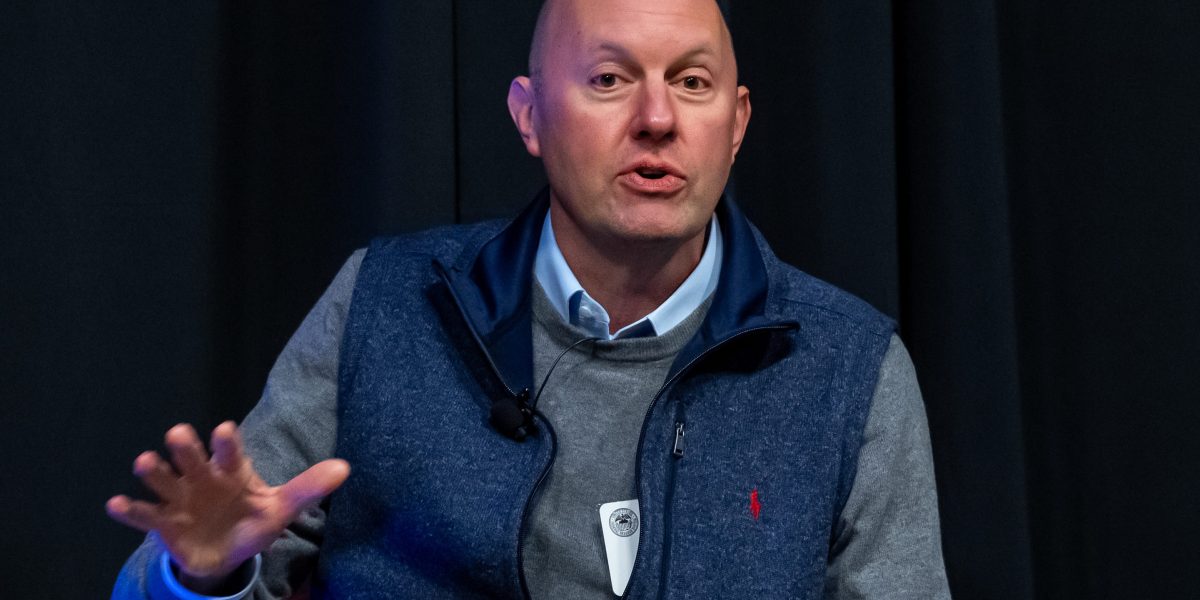
Marc Andreessen got the last word at the Federal Reserve’s big AI conference in San Francisco on Monday, and he used it to tell the central bank that nearly everyone in the room was going to be let down.
“My line has been both utopians and the doomers are going to be disappointed,” the venture capitalist said at the San Francisco Fed, “specifically disappointed by the scope and magnitude of the real-world impact, and specifically the economic impact.”
Andreessen co-leads the Productivity and Jobs Task Force, which Fed Chairman Kevin Warsh set up to tell the central bank what super intelligence—“SI,” in the White House’s preferred term—will do to growth, prices and jobs. On Monday, Andreessen previewed what he’ll contribute to the group’s report. Without using the name, he described one of the oldest problems in economics: William Baumol’s “cost disease,” the reason flat-screen TVs get cheaper every year while hospital bills, tuition and rent go the other way. His case is that AI won’t cure it, and could even make it worse.
The Fed hasn’t quite laid out that outcome.
The task force is advisory, and Andreessen has no vote on interest rates. He co-leads it with Stanford economist Charles Jones and Microsoft executive Asha Sharma, one of five outside panels the Fed named in June to rethink how the central bank works. Its charge, per the Fed, is to assess the economic impact of “new general-purpose technologies, including super intelligence, to inform the Federal Reserve’s policy judgments.” The panels report to the rate-setting committee with recommendations due by year-end, though Warsh said in October that “some, but not all” would turn their homework in on time. The Fed’s task force page lists no ethics or recusal terms for the panels. Andreessen’s firm, Andreessen Horowitz, raised more than $15 billion in new funds in January, as venture firms raced to keep up with the AI boom.
Andreessen is also Silicon Valley’s best-known accelerationist. His 2023 “Techno-Optimist Manifesto” declared, “We believe in accelerationism,” which he defined as “the conscious and deliberate propulsion of technological development.” It listed @BasedBeffJezos, the pseudonymous account behind the “effective accelerationism,” or e/acc, movement, first among its “patron saints,” and it named the enemy: “Our enemy is stagnation.” When OpenAI’s board fired Sam Altman a month later, Andreessen posted simply “E/acc!” This is the man who told the Fed that stagnation might win out over an AI-powered industrial revolution on Monday.
The Fed’s three scenarios
Warsh opened the day by laying out three “illustrative scenarios” Fed board staff have begun to evaluate. In one, AI lifts productivity, the gains are broadly shared and the economy stays close to full employment. In another, growth still runs above its long-term average, but automation pushes unemployment higher. In the third, AI “could disappoint after significant capital investment and stock market gains,” stocks fall, the economy slows and it eventually recovers “without the productivity gains.”
All three turn on whether AI arrives in force. Andreessen’s version is duller: most of the economy just doesn’t let it in.
He splits the economy in two. The “fast sectors,” like consumer electronics, media and commodity goods, take up new technology quickly, and “what those sectors all have in common is they have rapidly falling prices.” The “slow sectors”—health care, education, housing, and law and government—“are not legally allowed to have rapid change, like literally not.”
The machine “cannot get an MD, cannot prescribe medication,” he said. “The machine cannot get admitted to the bar.” The slow sectors, in his telling, pair restricted supply with subsidized demand: you can’t easily build new housing or open new hospitals, and when voters revolt over the cost, Washington steps in with student loans and housing subsidies. “So, of course, prices can only go up.”
Then he followed it to its end. As prices crash in the fast sectors, they shrink as a share of GDP, and the slow sectors take over. Health care, he said, “is already a fifth of US GDP and I don’t see why it doesn’t go to a fourth, a third and then half and then ultimately 80%.” (The government’s count is 18% in 2024, or $5.3 trillion, per CMS actuaries.)
“You might interpret this as good news because it means the AI revolution is not going to, you know, destroy all the jobs or kill everybody,” he said. “You could also view this as very negative, which is productivity growth just simply may not grow very much. Economic growth just simply may not grow very much. We may just continue to stagnate.”
Andreessen called himself “extremely optimistic,” saying that AI gives the country “a magic formula” and comparing it to being “handed this elixir to boost productivity growth.” But policy is a problem, he suggested. The decisions about what to do with AI, he said, “are going to matter actually way more than what the technology is capable of,” because without them “the technology will simply not get rolled out.”
That landed in a room where, three hours earlier, Warsh had brought up “secular stagnation,” the 1930s worry that economists returned to after the financial crisis, and asked whether superintelligence “dramatically” changes that picture.
A 60-year-old diagnosis
Baumol, the late New York University and Princeton economist, worked this out in the 1960s, starting with the economics of the performing arts. A string quartet needs the same four musicians and the same playing time it did in Mozart’s day, but those musicians have to be paid wages set by an economy where factory workers keep getting more productive. So live music, and later education and medicine, keep getting more expensive relative to everything else, and keep taking a bigger share of spending.
In his 2012 book, The Cost Disease, Baumol projected that if health costs kept growing at their recent pace, they would rise from 15% of the average person’s income in 2005 to 62% by 2105. He was an optimist about it. “No matter how painful rising medical and educational bills may be, society can afford them,” he wrote, because productivity elsewhere makes everyone richer. The real threat, he added, was “foolish public policy.”
For Baumol, the disease was built into the work: you can’t speed up a string quartet. For Andreessen, it’s built into the law. That matters for the Fed, because an agency that sets interest rates can’t fix zoning boards or medical licensing.
The economist who has done the most to bring Baumol into the AI debate was in the audience. Jones, who is on leave at Anthropic, stayed quiet because the company is preparing to go public, as Andreessen remarked to the crowd. In a 2017 paper for the National Bureau of Economic Research, Jones, Philippe Aghion and Benjamin Jones argued that “growth may be constrained not by what we are good at but rather by what is essential and yet hard to improve,” crediting the idea to Baumol.
San Francisco Fed President Mary Daly asked a panel of executives where their “weak link” was, and Erik Wexler, CEO of the nonprofit hospital system Providence, gave the slow-sector answer. “We’re part of the weak link,” he said. Providence operates in seven states, and as each writes its own AI rules, “it’s almost like sometimes being in seven different countries.”
Earlier on the same panel, though, Wexler complicated Andreessen’s picture. AI tools that listen in on appointments and write up the notes are saving some physicians “two to four hours of time a day,” he said, and doctors have called it “life-changing.” In 35 years in the industry, he said, he’d never heard them say that about anything else. So the hours are being saved inside a slow sector. The open question is whether they ever show up in the price of a hospital visit.
The chair’s bet
Andreessen’s forecast cuts against the case Warsh made before he got the job. In a Wall Street Journal op-ed late last year, Warsh wrote that AI “will be a significant disinflationary force, increasing productivity and bolstering American competitiveness,” as Axios reported. In speeches and writing, he argued AI-driven productivity could justify lower interest rates, an echo of Alan Greenspan’s Fed holding off on hikes in the late 1990s.
As chair, he has hedged. “My judgment is we have seen an improvement in productivity; we can’t measure it precisely,” he told reporters on Oct. 28, adding that “most of that change in productivity precedes everything we’re talking about—super intelligence.” The Fed held rates at 3.75% to 4% that day, and a reporter told him most of his colleagues “seem to be on board with raising rates in December.” Warsh declined to prejudge the meeting.
On Monday, Warsh didn’t push back on Andreessen. He restated the argument in Fed terms, as product prices versus services prices, and moved on. He closed the day “cautiously optimistic,” calling it “a hinge point for the US economy,” and said, “I’d rather have our problems than anyone else’s in the world.”
Same argument, bigger stage
Andreessen has been making this case for years. In 2017 he warned that the slow sectors were “basically just going to eat the economy,” and in March 2023 he wrote that “AI is simply already illegal across most of the economy.” Back then the argument was a rebuttal to the job-loss doomers. On Monday, in front of the Fed chair, it came with the other half of the bargain: if the jobs are safe, the productivity boom may be stuck too.
For companies, the slow sectors are a line item. Workers now pay an average of $7,471 a year toward employer family health coverage, up 9% from 2025, according to KFF’s annual survey. That’s the part of the economy that, by Andreessen’s account, AI isn’t legally allowed to touch.
For the Fed, the question is what kind of disinflation AI brings, if any. Earlier in the day, Warsh asked a panel of economists whether AI might do to services what the China shock did to goods—“productizing services”—and push prices down. Stanford’s Nick Bloom said falling token costs made him “kind of bullish.” Stanford President Jonathan Levin gave Baumol’s answer without the name: health care and education are “the parts of the economy where the disinflationary pressures from automation have not hit,” where “the costs have continued to rise with wages.” Whether that changes depends on what people want, he said, “and there’s also regulation.”
If Andreessen is right, AI’s price cuts land mostly where prices were already falling, and services, where inflation has been hardest to bring down, stay out of reach.
Stripe CEO Patrick Collison sketched the range for the room. At one end sits the old complaint that new technology shows up “everywhere but in the productivity statistics,” a line that goes back to economist Robert Solow in 1987. At the other is a bet between two people Collison described as having “considerable influence” over AI, on whether global energy use doubles in a single month sometime in the next decade. Andreessen is betting on a third outcome: a decade where nothing that dramatic happens, and the prices Americans complain about most keep climbing.
Warsh has asked his task forces for recommendations by year-end, and the Fed’s next rate decision comes Dec. 9. Andreessen put the choice to the central bank as “a political economy” question: “what kind of pace of change do we want, how much productivity growth do we actually want?”
Generative AI was used for research assistance and/or transcription of this article. The reporter independently reported and verified the factual claims in this article, and a human editor reviewed it before publication.
Disclaimer : This story is auto aggregated by a computer programme and has not been created or edited by DOWNTHENEWS. Publisher: fortune.com