September movies: What’s worth watching
If you’re heading to the cinema or just your couch, our reviewers have you covered with the new releases you need to know about each week.
And don’t forget to sign up to our Screening Room newsletter for must-see movies, interviews and the latest news from the world of film. Popcorn not included!
Charlie Harper ★★
(M) 102 minutes
It took two first-time directors, Mac Eldridge and Tom Dean, to oversee the bittersweet young-adult romance Charlie Harper. But I would guess that the material is personal for one of them in particular – probably Dean, who gets a solo credit on the script.
Charlie (Nick Robinson), one of the two protagonists, never actually says he wants to be a writer. Indeed, he’s insistent about having no ambition of any sort. Still, he reads poetry, which sets him apart from the average American slacker, and he listens to history podcasts and has heard of Proust.
On top of all that, we learn early on that he owns an electric typewriter, confirming his status as both an aspiring intellectual and an old soul – even by the standards of the late 2000s, that long-ago golden age when Obama was swept to power and all things seemed possible.
Heart of the Beast ★½
(M) 100 minutes
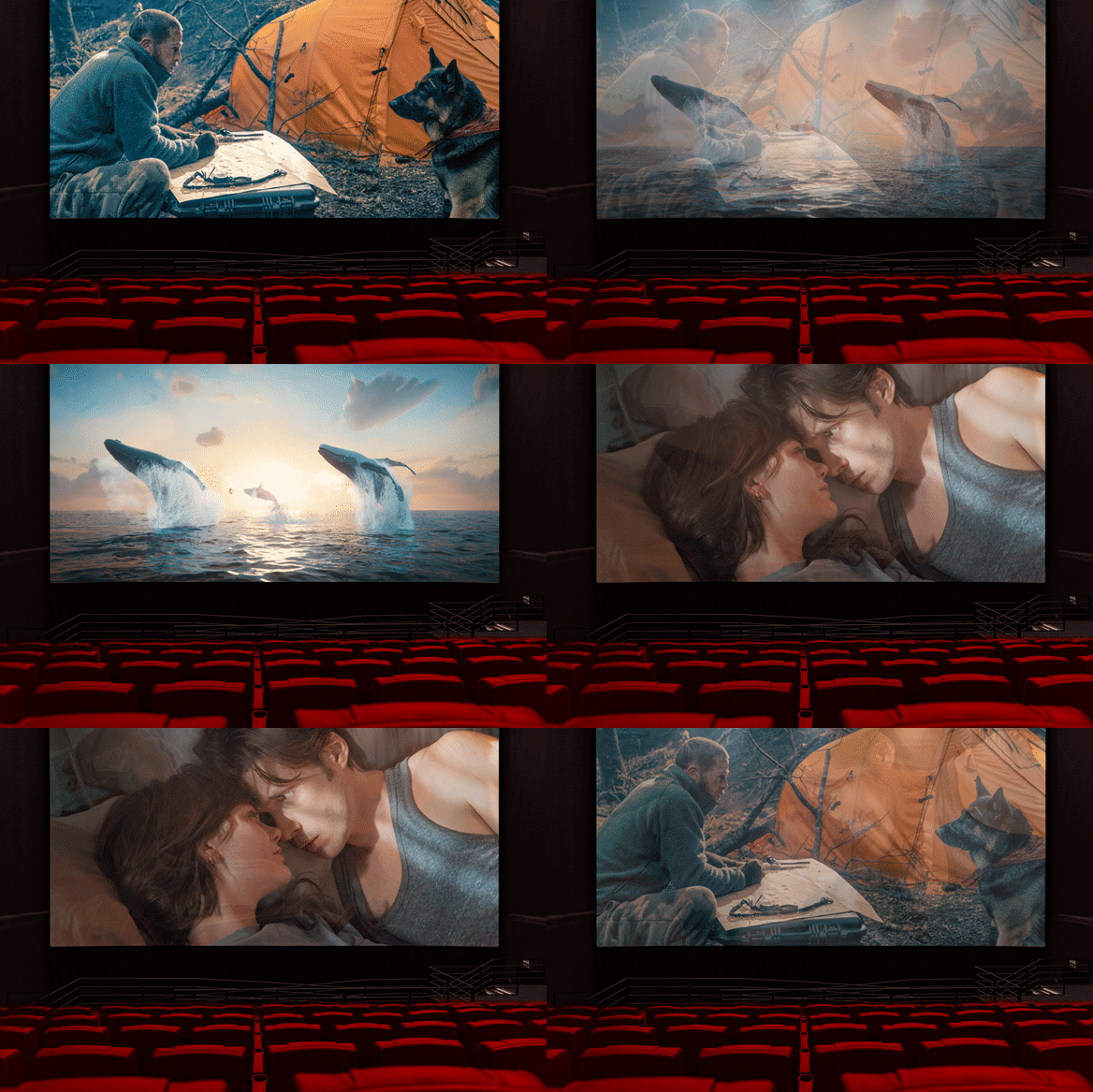
Any filmmaker who specialises in tough-guy posturing the way David Ayer does is guaranteed to have a repressed sentimental side. A traditional excuse for letting this softness show is if there are animals involved, as in Ayer’s Heart of the Beast – not the horror movie the title suggests, but a survival adventure with Brad Pitt stranded in the Alaskan wilderness alongside his faithful canine companion.
Ayer is probably best known for the ill-fated 2016 superhero blockbuster Suicide Squad; his other works have ranged from the grim World War II movie Fury, also with Pitt, to the entertainingly silly The Beekeeper, with Jason Statham as a retired government assassin who keeps bees.
The recurring theme is that violence as a way of life is glorious yet traumatising (or vice versa). The pattern continues with Pitt’s character Belmont, who spent three decades as a Green Beret and is haunted by frantic, sepia-toned flashbacks to his tours of duty in the Middle East.
The Last Whale Singer ★★½
(PG) 91 minutes
There’s little doubt the makers of The Last Whale Singer have the best of intentions. But I’m not sure those intentions translate to the best of results in this sometimes plodding, often formulaic, and hugely derivative animated tale of an orphaned humpback searching for his one true path.
German-Iranian writer-director Reza Memari has said he was inspired by a documentary he saw 15 years ago about humpback whales, and particularly the fact they have among them “singers”. From that grew the seeds of his story about Vincent (Vincent Tong), a whale so traumatised by the death of his parents that he has suppressed his own instinct to sing.
Vincent’s father Humphrey (Chimwemwe Miller) had a remarkable ability not just to sing but to rejuvenate the ocean-floor environment; as he vocalises, a golden glow emanates from his body, breathing new life into all it touches – sea grasses, coral, the creatures who feed on and live among them.
Resident Evil ★★★½
(MA), 94 minutes. In cinemas
It’s been a few years since the last Resident Evil movie, but the franchise has kept reinventing itself for almost a quarter of a century, proving that there’s always a place in popular culture for zombies who mutate before our eyes into writhing tentacled monsters. Directed and co-written by newly crowned horror king Zach Cregger, this latest, mostly ingenious reboot is both a new departure and yet another return to ground zero.
I couldn’t tell you exactly how much Cregger borrows from the Japanese video games which preceded the films. But this new Resident Evil has the kind of linear narrative expected in a video game, following a single character who confronts a series of life-or-death challenges while acquiring skills and firepower as he goes.
Played by Austin Abrams from Cregger’s recent hit Weapons, the hapless hero Bryan is roughly the opposite of Alice, the ultra-competent superwoman who was played by Milla Jovovich in half a dozen earlier Resident Evil instalments.
Coyote vs Acme ★★★
(PG) 103 minutes
It all began in 1990 with an inspired piece of comic writing in the Shouts and Murmurs section of The New Yorker.
Humorist Ian Frazier dreamed up a court case starring Looney Tunes’ Wile E. Coyote as the plaintiff in a suit against Acme, the fictional manufacturer of the many specialised products the hapless predator had tried in his eternal pursuit of the Road Runner. The list included “itching powder, giant kites, Burmese tiger traps, anvils and two hundred-foot rubber bands” and the injuries to Mr Coyote caused by these dubious purchases had been serious enough to be “a major impediment” to his social life.
This sparked strong interest from Looney Tunes’ studio, Warner Bros, and shooting eventually began on a film that mixed animation with live action in the manner of the 1988 hit Who Framed Roger Rabbit. The studio’s animation division struck hard times before the film could be released and management decided it should join Batgirl, among other animated films it was shelving at the time as tax write-offs.
Forgotten Island ★★★★
Forgotten Island ★★★★
(PG) 108 minutes
Memory is everything in Forgotten Island, a wonderfully inventive celebration of friendship and magic and the sometimes painful ebb and flow of friendship from childhood to early adulthood.
It’s set in the 1990s, in the pre-digital era, a time before mobile phones (remember that?), when fun was something to be made rather than downloaded. It’s set in the Philippines, where perennial mischief-maker Jo meets brainiac Raissa outside the principal’s office, both sent there for ostensibly poor behaviour (though “independent thought” would be more accurate). And it’s set in a supernatural realm reached through a magical portal, a place where dreams and nightmares come true, and where memories are either stolen or desperately clung to.
The film is written and directed by Joel Crawford – an American man married to a Filipina – and Januel Mercado, a Filipino-American animator (the pair met while working on Kung Fu Panda 2, became fast friends, and went on to make Puss in Boots: The Last Wish and The Croods: A New Age together, albeit with Crawford directing). And it positively brims with a love of Filipino culture.
Broken English ★★
(MA) 100 minutes
My annoyance with Broken English kicked in within the first minute or so, when we’re introduced to the whimsically imagined Ministry of Not Forgetting, a shadowy hall of records belonging to no particular era, like the dystopian alternate Britain of Terry Gilliam’s Brazil.
Some of the technology appears to be more or less 21st-century, but there are rotary phones and banks of clunky monitors, and the staff dress as if World War II never ended.
To say the least, it’s a roundabout way to introduce a documentary on Marianne Faithfull, who died last year aged 78 but is not for the moment in much danger of being forgotten.
Practical Magic 2 ★★
(M) 130 minutes
When you’re a witch, time doesn’t work the way it does for the rest of us. At least, that’s one takeaway from Practical Magic 2, which sees Sandra Bullock and Nicole Kidman returning as the sisters Sally and Gillian Owens, members of a largely benign dynasty of witches who have dwelt in Massachusetts since Puritan days, the magic passing from one generation of women to the next.
Based on a novel by Alice Hoffman, the original Practical Magic didn’t altogether enchant either critics or the general public when it came out in 1998. But it’s since picked up enough of a cult to warrant this belated sequel, spearheaded by Bullock and Kidman as producers.
The new film appears to be set in the present day – but here’s where the timeline gets wonky. In the first film Sally’s daughter Kylie, played by Evan Rachel Wood, was aged around 11. In Practical Magic 2, we’re introduced to a new version of Kylie played by Joey King, still only in her mid-20s almost three decades on.
Paw Patrol: The Dino Movie ★★★
(G) 88 minutes
Hollywood has been in love with dinosaurs since the pioneering special effects master Ray Harryhausen and a collaborator irritated palaeontologists by inventing their own species. Named the Rhedosaurus, it starred in The Beast from 20,000 Fathoms in 1953.
Dinosaur movies have been proliferating ever since, boosted by the box office’s embrace of Jurassic Park in 1993.
The latest example, the Canadian animation Paw Patrol: The Dino Movie, further stretches the imagination by exploring the notion of the cute dinosaur. Returning to a story it introduced in 2020 in the Paw Patrol TV series about a team of remarkably enterprising rescue dogs, it takes the pups to their own personal Jurassic Park.
The Valley ★★½
(CTC) 180 minutes
It was almost an hour into Ian Darling’s three-hour The Valley when the penny dropped. From the outset, Kangaroo Valley, the misty, secluded small town which is the subject of this contemplative documentary, felt strangely familiar to me – but not because I’d ever visited in person.
A map of the NSW Southern Highlands confirmed that Kangaroo Valley is less than an hour’s drive from the locations for another recent Australian film, James Robert Woods’ satire The Birthday Trip, where a group of unlovely media professionals gather at a winery for a largely disastrous weekend celebration.
That in turn brings home that Kangaroo Valley, in the midst of what traditionally has been dairy farming country, is now a tourist destination foremost. Darling makes no effort to hide this; indeed, he includes a scene where the locals congratulate themselves on winning a bronze medal in the NSW tourism awards. But the film, an ambitious experiment in its way, feels more like an endless tourism ad than it should.
Disclaimer : This story is auto aggregated by a computer programme and has not been created or edited by DOWNTHENEWS. Publisher: www.smh.com.au