
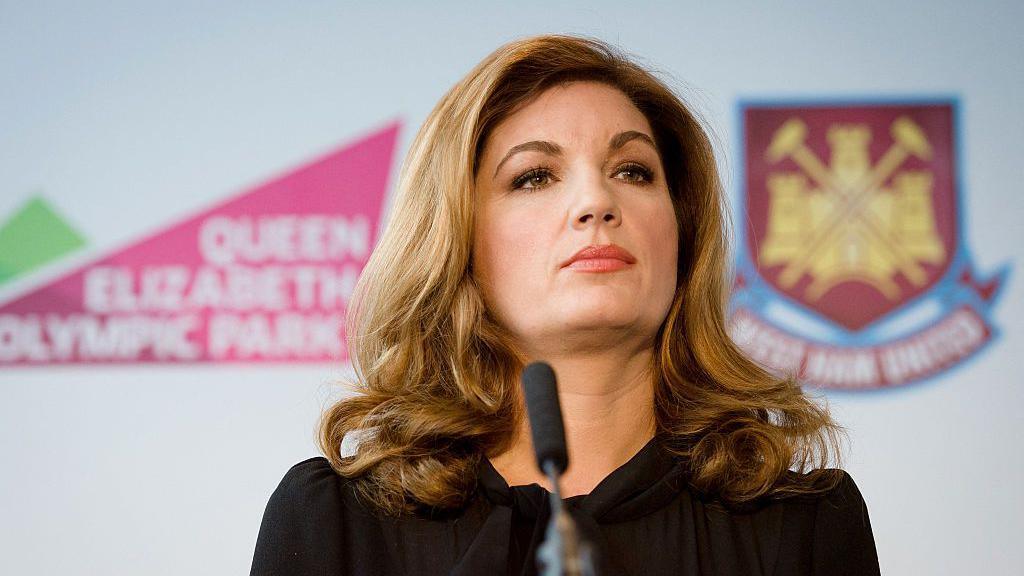
Baroness Karren Brady has stepped down as vice-chair of Premier League club West Ham after 16 years.
The businesswoman, who was appointed in January 2010 by then joint-chairs David Sullivan and David Gold, left on 15 April.
She told The Times she made the decision to leave in mid-February, having first started considering it in January.
In a statement, Brady said: “It has been a privilege to work alongside the board, management, players, staff and supporters at West Ham United.
“Together we have achieved remarkable milestones, but the highlight for me will always be lifting the Uefa Europa Conference League trophy – a moment that will stay with me forever. I am deeply grateful for the relationships, challenges and opportunities that have shaped my time at the club.”
Brady’s arrival at West Ham followed more than 16 years at Birmingham City, where she was appointed managing director aged 23 in 1993. She later became the youngest managing director of a UK public limited company when she floated the club on the London Stock Exchange in 1997.
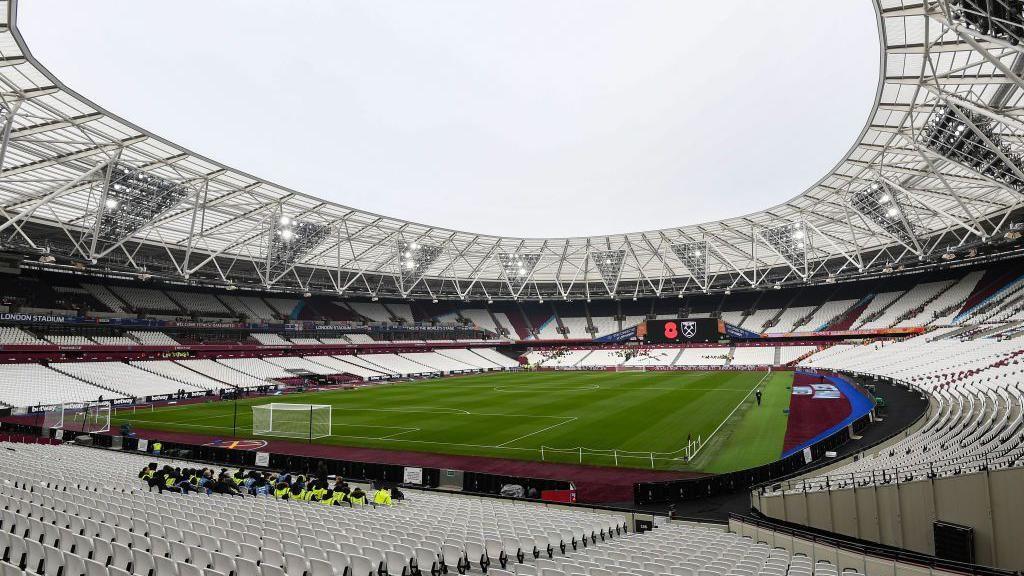
At West Ham, Brady oversaw the club’s move from Upton Park to the London Stadium in 2016, beating off competition from Tottenham to secure the tenancy, as well as Declan Rice’s £105m transfer to Arsenal.
On the field, the club achieved European success, reaching the Europa League semi-finals in 2021-22 and winning the 2022-23 Europa Conference League – their first major trophy since 1980.
West Ham have spent 14 consecutive seasons in the Premier League, but are in danger of relegation to the Championship, sitting just two points clear of 18th-placed Tottenham with five matches to play.
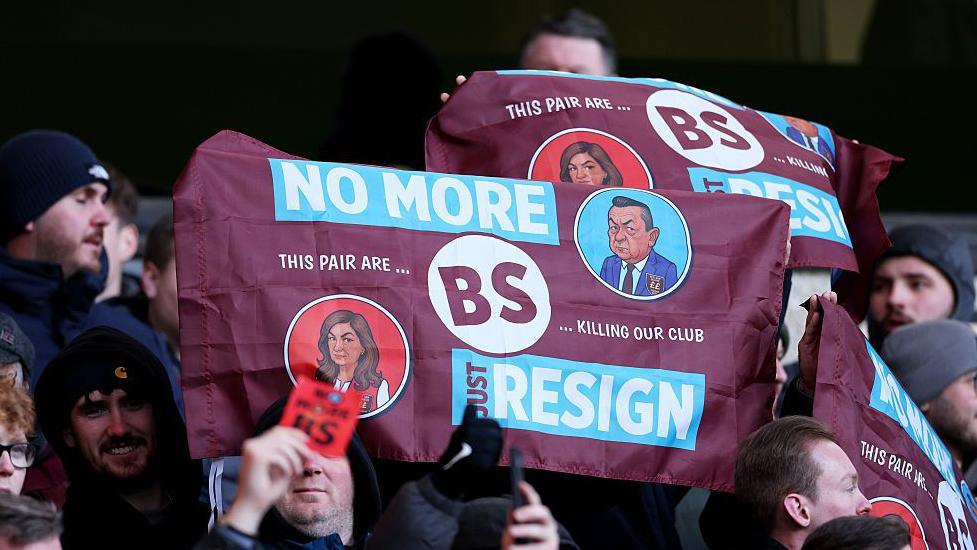
Some West Ham supporters have frequently protested against Brady and co-owner Sullivan, including during the 2025-26 season, with on-field performances and dissatisfaction with the stadium among their complaints.
Brady has also been involved in the women’s team, who are 11th in the Women’s Super League.
They remain the only WSL team yet to play at their club’s larger, men’s stadium and the girls academy is the only in the league to be ranked category 2.
West Ham‘s joint-chair Daniel Kretinsky alluded to the opposition to Brady as he praised her work at the club.
“Her contribution to West Ham United‘s growth, such as the long-term contract for the London Stadium, shareholders transition and the British record transfer of Declan Rice, has been absolutely essential and not always fully appreciated,” Kretinsky said.
“Karren is also very highly appreciated in the Premier League leadership community and was an excellent representative of our club there.”
Joint-chair Sullivan, who also worked with Brady when he owned Birmingham City, hailed her as an “exceptional leader” and a “key figure in the club’s development”.
Alongside her career as a football executive, Brady has spent 16 years as Lord Alan Sugar’s assistant on BBC show The Apprentice and entered the House of Lords as a life peer in 2014.
Analysis: A trailblazer who polarised opinion
Brady has long been seen as a leading woman in football, a trailblazer who others followed, but many West Ham fans see her as one of the main figures responsible for taking the club away from its roots, relocating to a hated athletics stadium and landing the club in its present state.
One of the most significant figures in the game, Brady has polarised opinion, never frightened to voice a view, no matter how controversial, and even using the House of Lords as a platform to voice the Premier League’s opposition to the Football Regulator.
Yet for all her own forceful and powerful personality, at West Ham she will forever be known as the third member of the trio responsible for moving the club out of their beloved, but antiquated, Boleyn Ground and into the London Stadium.
With current majority owner Sullivan and long-time business partner David Gold, who died in January 2023, Brady helped negotiate a hugely favourable deal to move into the Olympic Stadium in 2016.
The plan was to turn West Ham into an elite club and regular European contenders. It did not turn out the way envisaged.
Many long-time fans were against the move in the first place. The distance from the pitch to the stands and a lack of atmosphere, created in huge part by below-par performances, only widened the disconnect.
Sullivan, Gold and Brady were subjected to venomous abuse, which continues and is partly responsible for her decision to leave with immediate effect as the club battles to avoid relegation from the Premier League for the first time since 2011 – and extend their longest consecutive run of top-flight seasons since the 1960s, when World Cup heroes Bobby Moore, Martin Peters and Geoff Hurst were in their pomp.
There were positives.
The 2023 Conference League final over Fiorentina in Prague will go down as one of the best nights in West Ham‘s history – part of a run of three successive European campaigns, something the club had never done before.
The ‘Moore, Peters, Hurst’ statue outside the London Stadium is significant, as are aesthetic changes, like the maroon carpet behind the goal, which at least helps to create a sense of ‘West Ham‘ at the ground. Brady always felt if she had been given the chance, she could have delivered the lucrative naming rights deal that is yet to be negotiated.
But for many, Brady’s achievements at West Ham are far outweighed by the negatives that surround the stadium move.
It could well be that in 20 years’ time, when the arguments have stopped, she gets credit for looking to a brighter future for the club. But in the here and now, most West Ham fans will be glad she has gone.
 Getty Images
Related topics

Disclaimer : This story is auto aggregated by a computer programme and has not been created or edited by DOWNTHENEWS. Publisher: BBC



