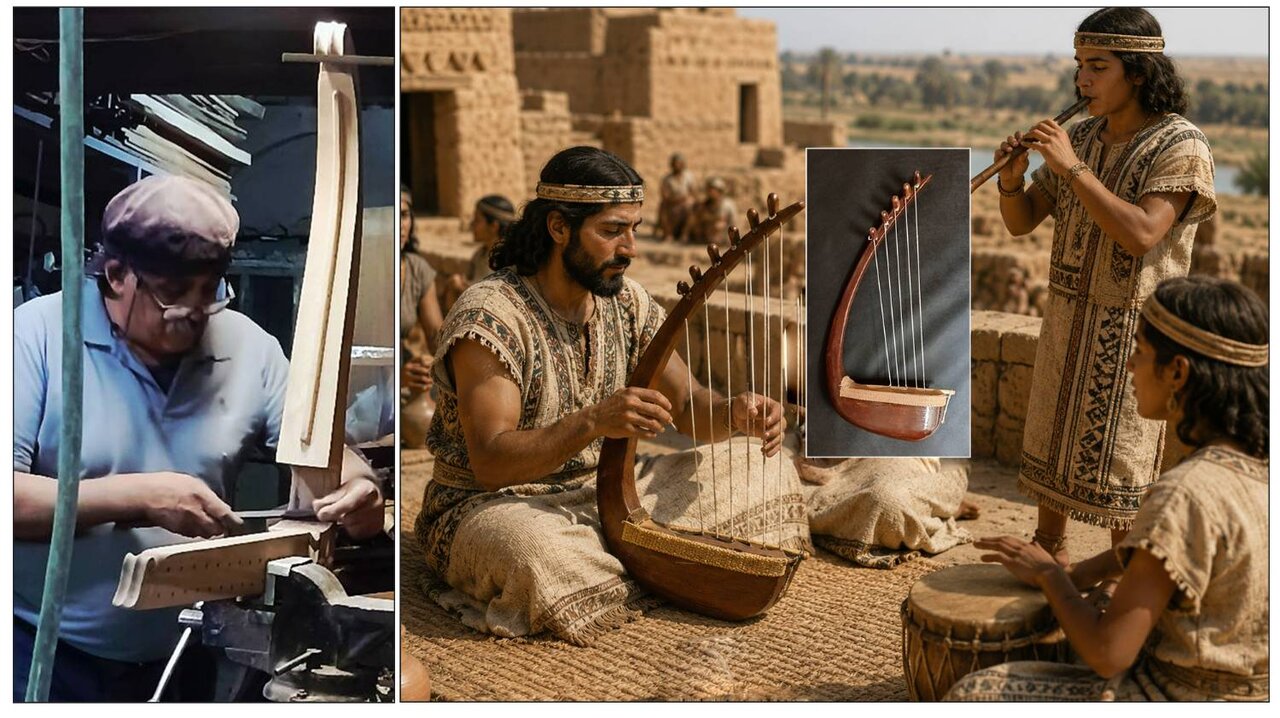
TEHRAN – For more than two decades, Iranian musician, instrument maker, and researcher Abdolali Bagherinejad has pursued an ambitious goal: reviving the sound of a harp that fell silent over 6,000 years ago. The celebrated curved harp has been reconstructed through meticulous study of ancient visual evidence from the archaeological site of Chogha Mish, near Dezful in southwestern Iran’s Khuzestan province.
The story begins with a small carved seal discovered at Chogha Mish by American archaeologists Helene J. Kantor and Pinhas Delougaz. Dating to the fourth millennium BCE, the seal bears an extraordinary image: a complete musical ensemble consisting of a harpist playing a curved five- or six-string harp, accompanied by a singer, a wind-instrument player, and a percussionist. Bagherinejad regards this scene as the earliest known visual representation of an orchestra, placing the Iranian plateau among the world’s oldest centers of organized musical performance.
Using the seal as his primary source, Bagherinejad began his research in 1995. His greatest challenge was transforming a stylized two-dimensional image into a fully functional musical instrument. By carefully analyzing the proportions of the human figures and comparing them with average human stature, he estimated the harp’s original dimensions and structure. The result is a curved harp featuring a wooden soundbox covered with stretched animal skin to amplify vibration. Silk strings, tensioned by wooden tuning pegs, complete the instrument. According to Bagherinejad, every aspect of the reconstruction—from the curve of the frame to the number of strings—was derived directly from the archaeological evidence.
The harp’s history extends far beyond Chogha Mish. Bagherinejad’s research traces its presence across successive periods of Iranian civilization. At the Elamite rock reliefs of Kul-e Farah near Izeh, dating to around 1800 BCE, accompanying inscriptions identify individual musicians by name. Two figures declare, “I am Sumumu, the harpist,” and “I am Sumunikir, the harpist,” making them among the earliest known musicians in recorded history. Centuries later, at the Sasanian royal site of Taq-e Bostan, harpists appear in elaborate courtly scenes, performing in royal boats and ceremonial gatherings. Following the advent of Islam, Persian literature continued to celebrate the instrument. One famous example is the story of the poet and musician Rudaki, whose harp playing so moved the Samanid ruler that he reportedly set off barefoot toward Bukhara.
What sustained Bagherinejad through twenty-five years of research was not only the harp’s extraordinary antiquity but also the disappearance of its distinctive sound from modern Iranian musical life. After relocating to Karaj, he presented his first research concert on the harp’s 6,000-year history in 2008, featuring performances by his wife and daughters, and donated one of his reconstructed instruments to the Kerman Museum. Since then, he has organized dozens of research concerts, lectures, and educational exhibitions in cities including Karaj, Qazvin, Mashhad, and Tehran. Among the most notable was a performance at Tehran’s Vahdat Hall in August 2009. His month-long exhibition, Archaeo-Musicology of Iran, showcased reconstructed harps alongside life-sized sculptures of ancient musicians, bringing Iran’s distant musical past vividly to life.
In January 2025, his efforts received official recognition when Iran’s Cultural Heritage Organization registered Iranian Harp Construction as a national craft. For Bagherinejad, the designation represented not only a personal achievement but also a significant step toward preserving and promoting a shared cultural heritage.
Today, the reconstructed harps are no longer confined to museums and exhibitions. A growing number of young Iranian musicians are learning and performing on them through Bagherinejad’s workshops, educational programs, and publications on the harp’s history and playing techniques. Collaborations with institutions such as the Soleimanieh Palace Museum in Karaj have further expanded public access to this revived tradition.
For Bagherinejad, the project is far more than an academic exercise. The harp, he argues, is not merely an archaeological artifact but a living voice that carries the emotions, ceremonies, and stories of ancient communities. Reconstructing it means restoring a cultural connection that stretches back six millennia. His work stands as a powerful reminder that the music of ancient Iran—once believed lost forever—can still be heard, appreciated, and shared with the world.
Abdolali Bagherinejad (born 1967 in Kermanshah, Iran) is an Iranian master luthier, musician, and music researcher who has dedicated more than four decades to studying and revitalising Iran’s musical heritage. He began learning the tanbur and daf in childhood and started building musical instruments in 1982. During the 1990s, he taught music and established a workshop in Ahvaz, where he crafted a wide range of Persian and Kurdish instruments, including the tar, setar, santur, qanun, oud, and kamancheh.
Inspired by the ancient reliefs of Taq-e Bostan, Bagherinejad embarked on historical research that led to his first reconstruction of a Sasanian harp in 1996, a design he later refined in 2007. He is also recognized as a leading specialist in the traditional one-piece tanbur, and in 2012, his distinctive craftsmanship in this field was registered as part of Iran’s national intangible cultural heritage. In addition to his work as an instrument maker and performer, he has authored educational books on the history, construction, and performance techniques of the harp.
AM
Disclaimer : This story is auto aggregated by a computer programme and has not been created or edited by DOWNTHENEWS. Publisher: tehrantimes.com