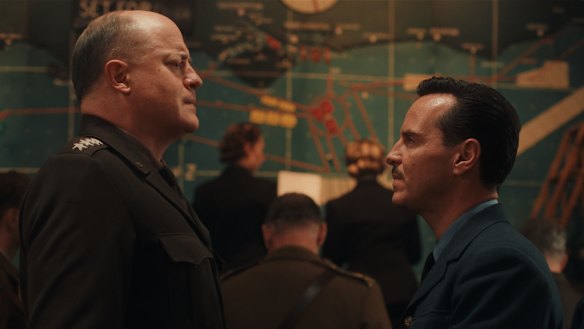

While the D-Day landing’s historical significance during World War II is well-known, Brendan Fraser admits that he still learnt a lot preparing to play the American commander of the Allied Forces, General Dwight D. Eisenhower, in the gripping film Pressure.
For one thing, he learnt how much truth there was in an apparently throwaway comment that Eisenhower made decades after the largest seaborne invasion in history began the liberation of France in 1944, laying a platform for the Allies’ victory on the Western Front.
Fraser, who is continuing his career resurgence since winning an Oscar for The Whale three years ago, says Pressure’s Australian director, Anthony Maras, showed him an interview from the 1960s where Eisenhower was asked what gave him the advantage on D-Day.
“Eisenhower answered, ‘Well, it’s because we had better weathermen than the Germans’,” Fraser says. “And he wasn’t wrong. Maybe he was trying to be funny but it was the truth.”
That little-known story of how a brilliant meteorologist saved the D-Day landing from disaster is what Pressure is about. Taking place over 72 hours, it centres on Royal Air Force Group Captain James Stagg, a prickly Scot played by Andrew Scott, who is charged with forecasting weather conditions for D-Day when he arrives at Allied Headquarters in a historic English manor.
The American military already has its own meteorologist, Colonel Irving P. Krick (Chris Messina), who has worked successfully with British Army General Sir Bernard Montgomery on previous military operations. He is using historical data, based on weather maps from previous decades, to predict fine conditions for the planned invasion date, June 5.
But Stagg’s more scientific method – based on readings from outstations – predicts storms that he believes would risk hundreds of Allied lives that day.
It’s a supreme test of character at a crucial time of the war: Stagg has to convince Eisenhower to ignore Krick’s forecast and postpone the invasion for what he thinks could be almost two weeks.
“This film is a warning,” Fraser, 57, says. “It’s a cautionary tale of what happens when we disregard science and nature with our own human folly.”
A handsomely shot film, Pressure also features Damien Lewis as Montgomery, the Commander of Allied Ground Forces for the invasion, and Kerry Condon as First Lieutenant Kay Summersby, who is Eisenhower’s private secretary, confidante and possibly more. It is based on a hit play by David Haig, co-writer of the film with Maras, who is best known for directing the 2008 Indian terrorist attack thriller Hotel Mumbai.
It’s another meaty role for Fraser since following up his Oscar-winning performance as an obese reclusive in The Whale with Killers of the Flower Moon and Rental Family. He came to NSW earlier this year to play a visionary technologist stranded on a mission to Mars in the sci-fi thriller Starman, and, after a Zoom interview about Pressure from Deauville in France, he was off to shoot a fourth Mummy film with Rachel Weisz in the UK.
So how has his life changed since the Oscar?
“Some things have not changed at all,” Fraser says. “I feel that it was affirming, humbling. It gave me a sense of obligation to earn what comes in the future … and also to not rest on any laurels. But at the same time, feel confident that I don’t have anything to prove any more.
“When I got it, I had a profound gratitude, a profound sense of accomplishment and [remembered] that it took many people to bring me to the place where I was able to be the lucky guy that was chosen.”
Researching the role before shooting Pressure, Fraser learnt something else that affected how he played Eisenhower – that the American general oversaw a disastrous rehearsal for the D-Day invasion, Exercise Tiger, six weeks earlier.
It was a debacle that he calls “one of military history’s saddest events of a friendly fire incident”.
Thirty thousand troops took part in a mock beach landing in Devon, south-west England, that was staged with live shelling to replicate battle conditions. More than 700 of them were killed.
“Historians haven’t really agreed on what happened but it’s a combination of missed radio signals [and] some harassment by U-boats at sea,” Fraser says. “Fog of war so to speak.
“The American forces who were attacking the beach in that exercise did not get the ‘stand down for one hour’ order and they walked right into their own artillery fire …
“It was kept secret for the next 45-odd years. Not until the 1970s-’80s when a local fisherman put on a mask after wondering ‘why do my nets keep getting snagged every morning in the same spot on the surf?’ and they took a look and came back up and went ‘tank’, no, not water tank, Sherman tank.
“They dragged it up onto the beach and the history of that is now out in the open.”
Fraser says the offer to star in Pressure came suddenly.
“I was in an agent’s office and they said, ‘Hey, we have a filmmaker who wants to meet you and he has a project about Ike Eisenhower. Are you interested?’,” he says. “I thought, ‘Dwight Eisenhower, right?’ My ignorance on display, I remembered ‘I like Ike’. I remember him as the president, but that was later in his career. I said ‘absolutely, I’ll chat with him’.”
Fraser found Maras charming and funny.
“He said, ‘How does it feel to have an Oscar? Man, you’ve done it’,” he says. “I said, ‘it feels like, I don’t know, a Tuesday’. He said ‘that’s why you need to play Ike, because he’s just like you. He’s humble. He’s a regular guy. He cares about people. He wants to do the right thing.’ And, you know, flattery will get you everywhere.”
Fraser was initially daunted, though, to be playing a real-life character for the first time.
“I told him, ‘look, I’m not that kind of actor. I’m not that guy. I don’t do carbon copy performances. There’s Bob Hoskins, there’s Garry Oldman, there’s Meryl Streep. They know how to do that. Me, I don’t know if I do unless I’m already a carbon copy. But I’m not. Dimensionally, my body is a different shape to Eisenhower’s.’ I’d like to think I have more hair than he did but he was a four-pack-a-day smoker and he lived his entire military career without ever having fired a shot in anger.”
As he found a way of playing Einsenhower, Fraser saw him as a diplomat. “He was a great communicator,” he says. “He had, yes, a charisma about him. People listened to him because he listened to them.
“He made sure he got the best opinions from the people who knew what they’re talking about, and then he owned what the question was when it came time for him to make a decision …
“He wasn’t a loose cannon and he didn’t rub [the enemy’s] nose in defeat … There sure are days when I wish I was hearing more about that kind of leadership.”
Given their different experiences of D-Day, it’s not surprising that American and English audiences have responded most to different parts of the film at festival screenings and premieres.
While Fraser thinks Americans felt a sense of satisfaction from learning more about “those pivotal 72 hours before the invasion of the largest seaborne amphibious assault in history”, the British, judging from the Leicester Square premiere in London, were particularly engaged with Staggs’ character.
“He spoke truth to power,” he says. “He stood his ground. He didn’t take no for an answer. He didn’t care that there were those who would dislike him for not giving them the answers that they wanted to hear. He was determined to speak the truth, no matter how frightening it may be.”
Maras says he needed an actor who could show the vulnerability of a general at a time when he was unproven and, after Exercise Tiger, had “this black cloud, this doubt lingering over him”, drinking up to 20 coffees a day and smoking heavily.
“I thought Brendan would be a compelling choice for that,” he says. “Eisenhower was a guy that America really loved and trusted, and Brendan Fraser, as a person, brings a lot of that into the cinema with him.
“He’s someone we inherently love and trust. I was very glad that those natural qualities in him were able to come out and show a different type of wartime leader.”
Fraser says that as much as he would love to see what a French audience makes of Pressure, he will have to leave before the night’s screening.
“I need to get back to London because we start shooting the Mummy film on Monday morning,” he says. “And what can I say, I need my beauty rest.”
Pressure opens in cinemas on October 29.
From our partners
Disclaimer : This story is auto aggregated by a computer programme and has not been created or edited by DOWNTHENEWS. Publisher: www.smh.com.au