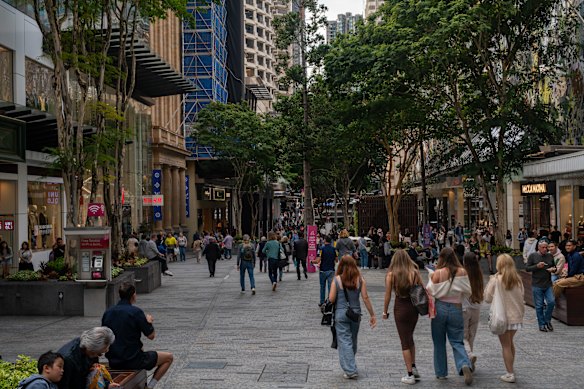

Brisbane’s reputation as a destination for dining, culture and major events has enhanced, according to new research, with Queenslanders increasingly visiting the inner-city for experiences other than work.
But while out-of-towners are embracing the city, Brisbane residents appear less enthusiastic than a year ago.
On Tuesday, the Committee for Brisbane will release two reports – its annual economic Inner City Vitality Report and Brisbane in 2026: How Queenslanders Experience the Inner City, which explores how Queenslanders perceive and use the city.
The latter report, based on an Ipsos survey of 600 Queenslanders conducted in September, found concerns about housing affordability, safety and ease of navigation have tempered residents’ optimism in the lead-up to the 2032 Olympic Games.
While the city’s overall rating remained at seven out of 10, the proportion of Brisbane residents awarding the city top marks fell from 21 per cent to 13 per cent over the year.
Overall satisfaction with quality of life dropped from 78 per cent to 72 per cent. The decline was most pronounced among men and people aged between 30 and 49.
“As a growing and changing city, challenges are inevitable,” Committee for Brisbane chief executive Jen Williams said.
“The opportunity now is to address these concerns while protecting the experiences, places and qualities that people value most, and continuing to build on what makes Brisbane distinctive and authentic.
“The story of Brisbane’s inner city is no longer simply about office towers, business activity or a destination people visit from nine to five. It is increasingly a place people choose to visit, choose to spend time in and choose to return to.
“A city that locals love will be a city the world loves.”
The Brisbane in 2026 perceptions survey found 72 per cent of Queenslanders living outside Greater Brisbane had visited the inner city during the past year, with dining overtaking shopping and entertainment as the city’s biggest drawcard.
Thirty-six per cent of regional Queensland respondents nominated dining as the city’s main attraction, up from 25 per cent a year earlier.
Dining was also ranked Brisbane’s strongest overall attribute, scoring 7.5 out of 10 among both Brisbane and regional respondents. Culture, atmosphere and the city’s natural environment also ranked highly.
While South Bank remained the highest-rated inner-city precinct (7.2 out of 10), ratings dropped for both Kangaroo Point (down from 7.1 to 6.7) and the Victoria Park precinct (down from 7.0 to 6.4), perhaps unsurprising given it is now a construction site for the new Brisbane Stadium.
The Inner City Vitality Report found nighttime pedestrian movements along Fortitude Valley’s Brunswick Street have declined since 2022.
“This downward trend suggests a weakening of Fortitude Valley’s nighttime vitality and its role as a vibrant, active destination beyond standard business hours,” the report finds.
“Reversing this decline will be important to supporting local businesses, improving perceptions of safety and reinforcing the Valley as a diverse, genuinely 24-hour precinct.”
Queen Street Mall, meanwhile, experienced a record 10.2 million pedestrian movements in the first half of 2026.
Williams said one of the strongest messages from the 2026 research was Brisbane’s inner city served all of Queensland.
“When we invest in major cultural venues, public spaces, transport infrastructure and city-shaping projects, the benefits flow well beyond Brisbane’s boundaries,” she said.
“Regardless of where Queenslanders live, Brisbane’s inner city is increasingly where the state comes together for major events, business, culture, recreation, and access to Queensland’s leading health and tertiary education institutions.”
Housing affordability emerged as the city’s biggest weakness, with 38 per cent of respondents identifying it as the area most in need of improvement.
Safety ranked second at 33 per cent, followed by ease of navigation. Affordable accommodation was Brisbane’s lowest-rated attribute, scoring just 4.9 out of 10 among residents and 5.1 among regional Queenslanders.
But respondents remained broadly positive about Brisbane’s future.
Thirty-nine per cent of Brisbane residents said they expected the city would improve over the next 12 months, compared with 16 per cent who expected it to worsen.
There was broad support for hosting the 2032 Olympic and Paralympic Games, with 54 per cent of Brisbane residents and 48 per cent of regional Queenslanders backing the event.
Twenty-seven per cent of Brisbanites opposed the hosting of the Games, compared to 28 per cent in the rest of Queensland.
“Brisbane is increasingly a city of experiences,” Williams said of the reports’ findings.
“More people are choosing to spend time in the city for what it offers, whether that’s discovering new restaurants, attending major events, enjoying our cultural institutions or simply connecting with the energy and vibrancy of city life.
“What’s emerging is a city that is distinctly Brisbane. A city that embraces our subtropical lifestyle, our river, our culture and our relaxed approach to city living.”
Start the day with a summary of the day’s most important and interesting stories, analysis and insights. Sign up for our Morning Edition newsletter.
From our partners
Disclaimer : This story is auto aggregated by a computer programme and has not been created or edited by DOWNTHENEWS. Publisher: www.smh.com.au