
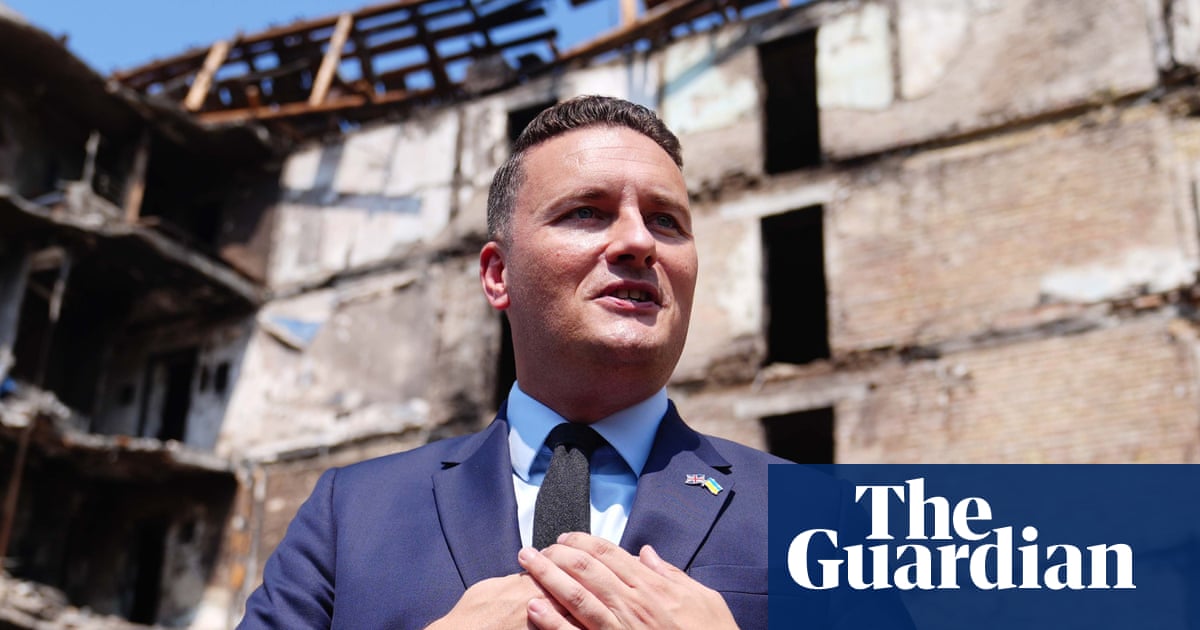
Britain stands behind Volodymyr Zelenskyy, the defence secretary has said, after Donald Trump called for the Ukrainian president to be replaced and the US announced a controversial agreement to buy Russian diesel.
Wes Streeting said Ukrainians alone should be able to decide who leads their country as he indicated Trump was facing domestic political pressure over fuel prices before next month’s midterm elections.
Asked on the BBC’s Sunday with Laura Kuenssberg programme whether Britain supported Zelenskyy staying in office, Streeting said: “We are in no doubt that the aggressor here was Vladimir Putin. He is the person who chose to start this war. He is the person who could end this war tomorrow, and he chooses not to. So, we stand with Ukraine. We stand with President Zelenskyy.”
Trump said on Saturday that Ukraine should get a new leader capable of reaching a peace agreement, accusing Zelenskyy of failing to end the war and blaming Ukrainian strikes on Russian oil refineries for increasing American diesel prices.
Zelenskyy condemned the diesel agreement as a gift to Putin, warning that increased Russian energy revenues would help finance the war against Ukraine.
Trump has been facing rising political pressure over the economic fallout from the war with Iran, which has driven up global energy prices weeks before Americans vote in the midterm elections.
Soaring fuel costs have hit Americans and added to wider inflation, damaging Trump’s standing with voters. The squeeze is felt particularly in agricultural states such as Iowa, Kansas, Texas and Ohio where farmers depend on diesel to operate machinery and transport their produce.
These traditionally Republican-leaning states battling rising cost of living pressures will create a headache for Trump, whose party is trying to hold on to its majorities.
Streeting told Sky News on Sunday: “Let’s be candid about this: midterms are coming up, cost of living is an issue. No doubt President Trump is feeling the same pressure that lots of leaders are facing in terms of wanting to ease cost of living pressures, energy prices.
“I think it’s just a political reality, isn’t it? We would obviously prefer a stronger approach on sanctions.”
Streeting sought to avoid a deeper public confrontation with Washington, insisting Britain’s priority was to maintain western unity. “Let’s not overstate the impact of President Trump’s decision on purchasing oil from Russia and let’s not also understate US support for Ukraine,” he said.
In a phone call with Zelenskyy on Saturday, Andy Burnham, the prime minister, restated his “complete solidarity” with Ukraine.
Downing Street said the leaders had agreed to meet in person in the coming days. Burnham has also pledged to strengthen sanctions against Russia, while both called for an immediate energy ceasefire.
Gen Sir Richard Barrons, one of the authors of Britain’s strategic defence review, warned that Trump’s Russian diesel deal would lead to more Ukrainian deaths by helping Moscow fund its war.
He told Sky News that money from Russian oil and gas was used to pay for the “missiles and drones that it fires at Ukraine”. Asked if the deal would mean more Ukrainians being killed, he said “for sure”, adding that security interests were being “sacrificed on the altar of an election”.
Meanwhile, Streeting said Britain was not currently considering offensive military operations against the Houthis, after an attack on King Khalid international airport in Riyadh, Saudi’s capital, killed 12 people and injured more than 300 others.
Streeting said he had been discussing further military assistance with Saudia Arabia, and he declined to categorically rule out future involvement. Asked on the BBC whether Britain could join US offensive operations, he said: “That’s not what we’re looking at, at this stage,” insisting there was no military solution to the conflict.
The defence secretary described the overnight attack as a “shocking escalation” and said the UK was already providing air-to-air refuelling and ground-based air defence support.
Streeting said he had spoken to his Saudi counterpart on several occasions in recent weeks about what further support Britain could provide. “I think there is clearly more to do, as evidenced by what we saw last night,” he said.
Disclaimer : This story is auto aggregated by a computer programme and has not been created or edited by DOWNTHENEWS. Publisher: theguardian.com




