
Brothers who both had meningitis within a year lucky to be alive
-
Published
Two brothers who contracted meningitis within a year of each other say they are lucky to be alive.
Saul and Drew Darlington from Wrexham, now 29 and 26, initially thought it was a “weird” coincidence they both caught the illness as teenagers but later learnt they had a rare condition which meant they were susceptible to it.
“The day I had it, if I had gone to sleep that night, I’d have probably died,” said Saul who, along with his brother, now wants to raise awareness of the symptoms of meningitis, particularly among young people.
Nearly 20,000 young people have been vaccinated in Wales through catch-up clinics, following a deadly outbreak of meningitis B in Kent earlier this year.
 Image source, Drew Darlington
Saul was 17 and on a school trip when he first started feeling cold and experiencing sensitivity to light, but when a purple rash developed, the family went to A&E.
“It all happened very fast,” said Saul.
“When my mum used the word meningitis, I could see how worried she was. It was really concerning – it was all so alien to us.”
Saul spent a week in hospital and said the experience was “really scary”, especially as he was so young.
Almost exactly a year later, his then 16-year-old brother Drew began to feel unwell as he was studying for his GCSEs with a high temperature but no other obvious symptoms.
Things escalated quickly following a trip to the GP.
“When I left the house I had no rashes on me at all. When the doctor lifted up my top, I had a big rash all over my chest and belly,” he said, adding that purple dots on the roof of his mouth had also developed.
Drew spent two weeks on the children’s ward at Wrexham Maelor hospital.
“I did think it’s a bit weird isn’t it really that we’ve both caught it, what are the odds of that?” said Saul.
It was touch and go for the first 48 hours before Drew slowly began to recover, but he lost a lot of weight and it would be months before he felt completely well.
“I’m really thankful the doctor called the ambulance straight away when he noticed the rash – those quick decisions potentially saved our lives,” said Drew.
 Image source, Drew Darlington
Saul and Drew have both since recovered but take daily antibiotics after tests revealed they both had properdin deficiency – a rare immunodeficiency which means they are more susceptible to infections such as meningitis.
They enjoy hiking and running, with Saul taking on the London Marathon in 2025 to support the charity Meningitis Research Foundation and to raise awareness of the illness.
“A lot of the symptoms just display themselves as being a bit tired or hungover, and it’s so much more than that,” said Saul.
“You’ve just got to be vigilant,” added Drew. “You don’t have much time when dealing with meningitis and every hour counts in potentially saving your life.”
What are the symptoms of meningitis in adults?
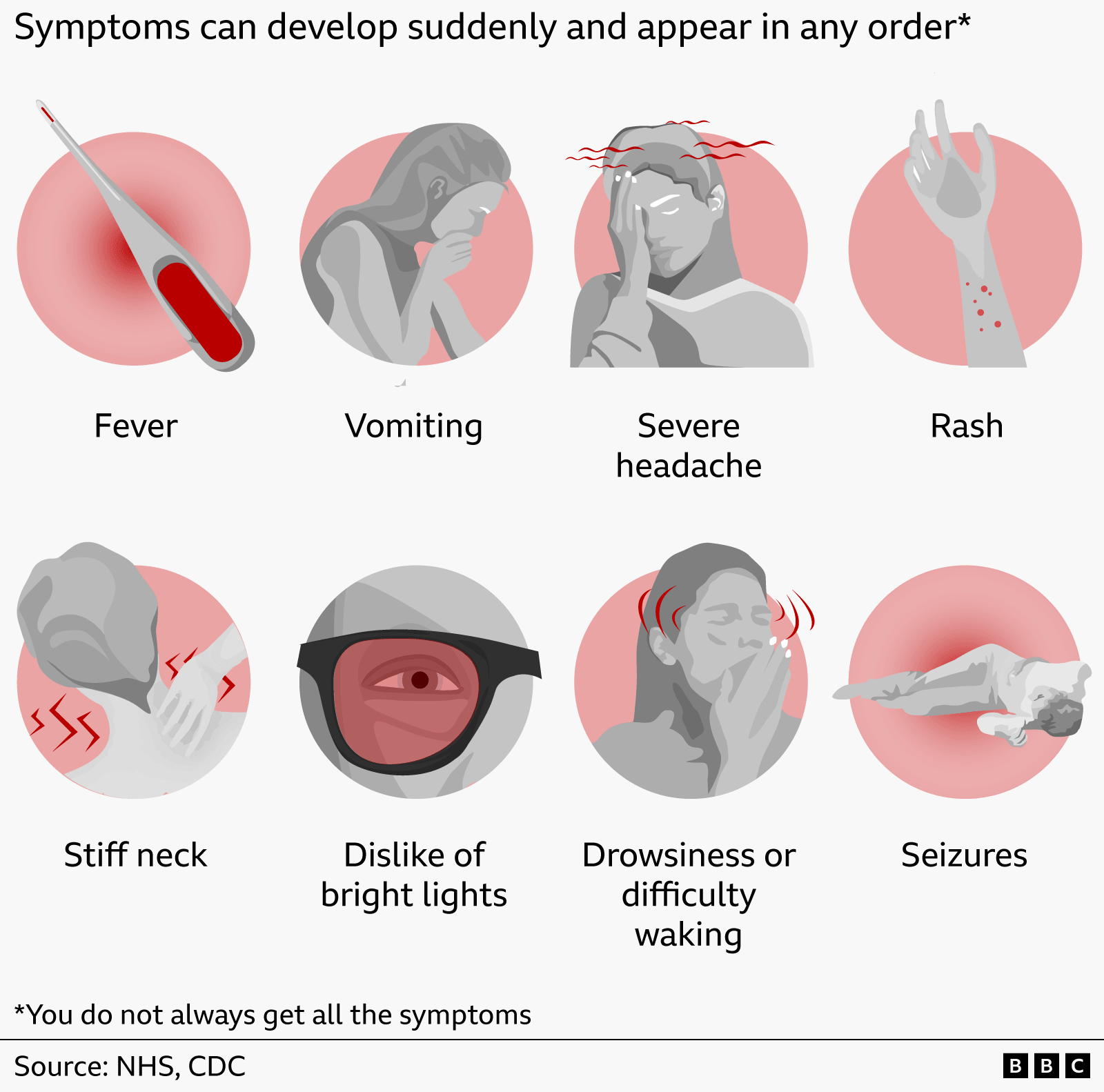
Symptoms, external can develop suddenly and can include:
-
a rash that doesn’t fade when pressed with a glass
-
sudden onset of high fever
-
severe and worsening headache
-
stiff neck
-
vomiting and diarrhoea
-
joint and muscle pain
-
dislike of bright lights
-
very cold hands and feet
-
seizures
-
confusion/delirium
-
extreme sleepiness/difficulty waking
What is meningitis?
Meningitis is an infection of the protective membranes that surround the brain and spinal cord.
It can affect anyone but is most common in babies, young children, teenagers and young adults. It can be very serious if not treated quickly.
The cause of the infection – either certain bacteria or viruses – can be determined by tests.
Bacterial meningitis is rarer but more serious than viral meningitis. It can lead to blood poisoning or sepsis, and can affect the brain.
“We know that young people can be at increased risk of meningitis for a number of reasons,” said Caroline Hughes from the Meningitis Research Foundation.
“The bacteria spreads more easily in that group, it’s lots of people mixing together, and more independence as people move away from parents.”
She said it was important to be aware of the signs and symptoms, and to have all the vaccines available to you.
The deadly outbreak of meningitis B in Kent earlier this year sparked a vaccination catch-up campaign across Wales and England aimed at young people starting further or higher education in September 2026, and who hadn’t had protection against the most prevalent strain.
Public Health Wales said 19,700 young people have had their first dose through the programme, with 14,459 also having a second dose, which needs to be given four weeks apart.
Clinics are being put on at universities across the country during the first few weeks of term.

“We had one student come in who had a friend who died of meningitis just last year, so she was really appreciative that we were here,” said Dalia Nassr, one of the vaccination nurses for the Cardiff and Vale University Health Board visiting universities in the area.
“We know students are very busy, they are trying to find their way around campus, and most haven’t registered with a GP yet – so by coming here we just give them the opportunity to just walk in at any time,” she said.
More top stories
-
-
Published10 hours ago

-
-
-
Published1 day ago

-
-
-
Published15 hours ago

-
Disclaimer : This story is auto aggregated by a computer programme and has not been created or edited by DOWNTHENEWS. Publisher: BBC