The “Golden Age of Radio” supposedly ended in the ’50s, with the advent of television. But guess what? TV shows were broadcast with radio signals. And today? Radio is everywhere. You have a radio in your car, but maybe you prefer to stream music on your phone. Well, how does the music gets to you? Via radio waves from cell towers, is how. Your GPS runs on radio too. For that matter, so does your home Wi-Fi.
Radio waves are a kind of electromagnetic radiation, just like visible light. But they’re at the bottom end of the spectrum, which makes them harmless to humans, because low frequency means low energy. (High-frequency, high-energy radiation like x-rays or gamma rays are another story.) That’s part of the reason radio waves are ideal for wireless communication. They can also travel vast distances and pass through obstacles like walls.
So radio is as relevant as ever. But did you know you can easily build your own radio transmitter and receiver at home with some simple supplies? I’m going to show you how. It’s a fun project and a good excuse to explore some cool physics.
What Is an Electromagnetic Wave?
For that matter, what is a wave? Imagine you have a long string with one end tied to a door handle. You’re standing across the room, holding the other end. Now, if you shake your hand up and down, you’ll create a disturbance on the string, and that disturbance will move along the length of the string. That’s a wave. Basically, waves transfer energy without transferring matter.
What if you take away the string? In that case, you’d look like a sad human shaking hands with an imaginary friend. Without the string, there’s no wave. Waves need something to “wave” in—they need a medium. You can’t have ocean waves without water. You can’t have sound waves in space, since there’s no air for them to ripple through.
But what if, instead of string, you shook an electric charge (like an electron) up and down? Electric charges create electric fields, so this moving charge will create an oscillating electric field, and that makes an electric wave. And here’s where it gets weird: It turns out that a changing electric field also creates a changing magnetic field. And vice versa: A changing magnetic field creates a changing electric field. We know this from Maxwell’s equations.
This means we have electric and magnetic oscillations traveling together, and each is the medium of the other. The combination is called electromagnetic radiation, also known as “light.” Yes, radio waves are just light, and light can self-propagate through empty space—at the speed of light, as a matter of fact.
A Piezoelectric Radio Station
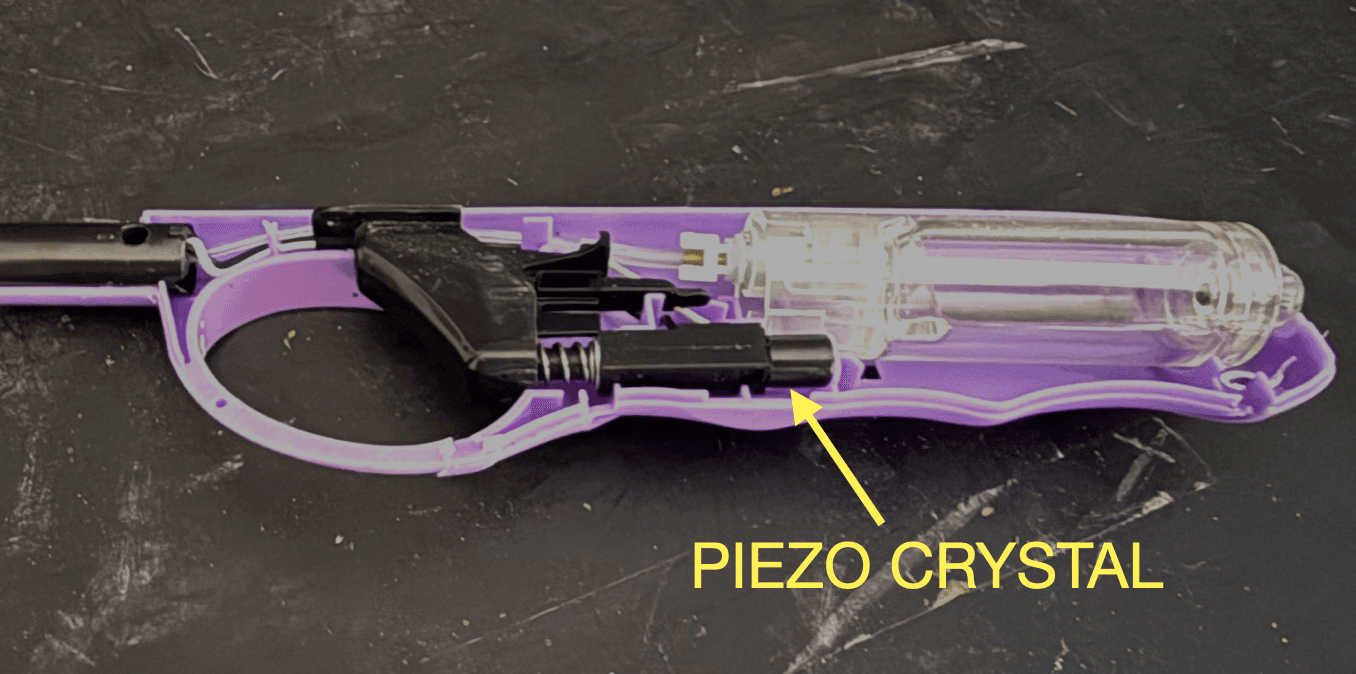
OK, let’s make a radio wave! For a transmitter, all you need is a grill lighter—you know, the kind with the long tube. When you hold down the trigger, gas is released through the end of the tube and is ignited with a small spark. Here’s one I cut in half:
See that piezoelectric crystal? These things are amazing. When you hit them they get momentarily deformed, and that produces a high voltage for a split second. So the trigger on the lighter has a spring-loaded hammer that whacks the crystal, and the voltage results in a spark.
That’s great for a barbecue, but for a radio what we want is the voltage, not the spark per se. That voltage from the crystal creates an electric field, which exerts a force on free charges in the air. (There’s always some free charges floating around, like electrons and ions.) These charges accelerate and collide with air molecules, kicking loose more free electrons that also accelerate and collide, and so on, in an exponential chain reaction. We call this an electron avalanche.
And guess what happens? Accelerating charges create a changing electric field—which, yup, creates a changing magnetic field, et cetera, and that disturbance radiates outward as an electromagnetic wave. Oh, and in the process, nitrogen and oxygen atoms in the air get excited. When they drop back down to a lower energy level, they emit light. That’s the visible spark.
So let’s put this into practice. If you have an AM radio, try this: Tune it to someplace on the dial where there is no station. Now hold the lighter near the antenna and pull the trigger. You will hear a nice little click through the speakers. That’s because you are producing radio waves. Cool, right? That lighter is a radio transmitter. Now all we need is a receiver.
The Coherer Receiver
To detect the radio wave, we are going to build a simple circuit. It consists of a container with a bunch of aluminum foil balls connected to a button cell battery and an LED. This is what it looks like:

You need a nonmetal cup (I’m using a glass beaker) so the current will be forced to travel through the aluminum, and there’s a strip of foil over the edge of the cup to connect the wires to the balls. Oh, don’t forget that an LED only works in one direction. Most of them have a long and a short wire. The long wire connects to the positive terminal of the battery.
Why balls of aluminum foil? Well, aluminum is a conductor, but smushing it up into balls means the contact points between balls are tiny. That restricts the flow of current. Also, aluminum foil develops a surface layer of oxidation when exposed to air, which likewise increases the resistance.
The result is that when you connect everything, there’s not enough current at first to light up the LED. But remember, our lighter creates an electromagnetic wave, and when the electric field part of that wave hits the interface between two balls, it breaks up the oxidation layer and creates a better connection. Bingo! The light turns on, telling us we detected a radio signal.

This type of receiver is called a coherer, and it’s a real thing. In fact, it’s basically what Marconi had in his miraculous wireless telegraph in the 1890s, only he used nickel and silver shavings instead of foil balls. When a radio wave hit the filings, they clung together (cohered), allowing current from a battery to flow through and trigger some kind of sound.
Radio Days
Of course, like existing telegraph lines, Marconi’s system could only transmit text messages by Morse code, sending short bursts (dots) and long bursts (dashes) of radio waves. But it could cover great distances and cross oceans. In fact, this system was used by the Titanic in 1912 to send an SOS to another ship, which ended up saving 700 people.
It would be a while before radio systems were able to transmit and receive continuous signals to carry voice and music, and it wasn’t till the development of the vacuum tube that radios really got good at this and became the centerpiece of modern living rooms in the 1920s.
Still, it’s crazy to think how easy it is to send a radio signal with a simple instrument like our lighter. If you connected that to an antenna, you could increase the power to broadcast to a pretty wide area. There’s just one problem with this system: It only has one channel. If you had many people all trying to communicate at once—well, let’s just say it wouldn’t work in the cell phone era.
Disclaimer : This story is auto aggregated by a computer programme and has not been created or edited by DOWNTHENEWS. Publisher: wired.com