While billions of dollars in contracts have been inked and construction is well underway, the SRL is shifting from its original city-shaping purpose, according to interviews with insiders and secret documents the government sought to suppress.

There aren’t many people in Labor circles who can sell an idea like Bill Shannon. In 1999, it was his eponymous ad agency that came up with the “Labor cares” tagline that helped sink the Kennett government. Today, his We’re All in This Together jingle made for industry super with singer Ben Lee is an irremovable earworm.
So, when Jacinta Allan’s government needed to make sure the Suburban Rail Loop was playing well among voters, Shannon was the natural choice for the job. There was just one catch: he was called in six years after the mega-project was announced and diggers were already in the ground.
His first piece of work – a document titled “SRL Narrative Research and Implications” – was handed to the government in December 2024. It surveyed public opinion about the SRL and considered ways to sell it to Victorians, amid rising concerns about the $34.5 billion price tag of the project’s first stage, the SRL East tunnel between Box Hill and Cheltenham.
A redacted version was obtained by this masthead under freedom of information laws. Shannon’s full research, according to insiders who have seen it, did not find the project was overly popular or unpopular. Nor did it justify a claim made privately by Labor MPs over the past two years – that the SRL is “more popular than Taylor Swift”.
What Shannon did find, however, was that in the middle of a housing crisis, deliberately tying the project to the homes that would be created around its six stations could help its image. The way to sell the SRL was to talk less about underground trains than what could be built on top.
The Shannon Company’s presentation – shared with Allan’s cabinet and the Suburban Rail Loop Authority (SRLA) board – talked of a “change narrative” and “brand refresh”. There were even logos drawn up for Suburban Rail Loop Housing.
But by May last year, the work to reposition the SRL was abandoned. While Allan still calls it Australia’s biggest housing project, Shannon’s logos never saw the light of day.
To some inside the SRLA, it was another false start in a series of missteps that had come to characterise the agency in charge of Victoria’s largest infrastructure project. They were left to wonder why, with $14 billion in contracts signed, the SRL was still in need of a narrative.
While tunnelling is set to begin soon, the SRLA is in the midst of its second restructure in 18 months. Kevin Devlin, its interim chief executive, has been on loan from the Victorian Infrastructure Delivery Authority (VIDA) for seven months. Staff believe no replacement is coming, and that after November’s election, the two entities will merge.
So what is the SRL? In 2018, its architects envisioned an unprecedented urban renewal project to deliver on the long-held ambition to make Melbourne a “city of centres”. In 2026, even some of its biggest backers agree that ambition has been scaled back.
This masthead has obtained hundreds of pages of documents about the project under freedom of information laws, some of which were only released after legal battles stretching over two years as the state government fought their publication all the way to the Victorian Civil and Administrative Tribunal. This masthead has also interviewed more than a dozen bureaucrats, politicians, stakeholders and experts, many of whom spoke on the condition of anonymity to detail internal deliberations.
Taken together, they paint a picture of a transport project doing its best to stay within budget, as those city-shaping plans are watered down by an authority forced to reverse-engineer policies to suit government announcements and combat financial pressures.
A Suburban Rail Loop spokesperson said: “Melbourne needs an orbital rail line just like London and Tokyo – because it means better connections closer to schools, jobs and universities. The final planning controls for the six SRL stations have been finalised – giving communities certainty on what will get built and where.“
Before an election that could decide the future of the SRL, questions remain about its true purpose. The answer is important. If the urban renewal element is not fully realised, the project will struggle to justify its already heavily questioned price tag.
Five years ago, when The Age investigated the conception of the SRL, a consultant who worked on it said the distinction between precinct project and transport project was crucial.
“Because if it is a transport project, there are a hell of a lot of better ways to spend your money,” they said.
Now, in the words of a senior public servant: “I don’t know if it’s got any identity at all.”
Transport project or urban renewal project?
This is the fundamental tug of war at the heart of the Suburban Rail Loop.
To two of the loop’s architects, Tom Considine and James Mackenzie, it was always more than a rail line. In 2017, their secret plan was known as the Urban Development Program. It was later renamed Orbital Rail before becoming the SRL.
Jacinta Allan, according to government staff and MPs, sees it primarily as a transport project.
After the SRL East route had been announced, Allan sought to shift the location of a station from Glen Waverley to Mount Waverley, a former senior government figure said, speaking on the condition of anonymity to detail internal matters. This would have shaved at least a kilometre off the tunnel and saved a significant sum of money.
But Glen Waverley is ideal for the mission of decentralising Melbourne. With the right transport connections, The Glen Shopping Centre serves as a ready-made anchor for more homes, jobs and businesses.
Allan has always been happy to spruik the homes enabled in SRL precincts, particularly given the housing crisis. But sources familiar with her thinking say the former transport infrastructure minister has never stopped seeing the SRL through the lens of that portfolio.
This tension has played out over years within the SRLA. “It’s not uncommon to hear about culture clashes between visionary planners and on-the-tools engineers,” a stakeholder said.
Staff on the planning side have become deflated, despite finally publishing maps that will guide the growth of the suburbs above the first six stations. They had hoped to see the SRLA playing a more direct planning role, building up Clayton as a second CBD and developing university campuses at Monash and Burwood into supercharged research hubs.
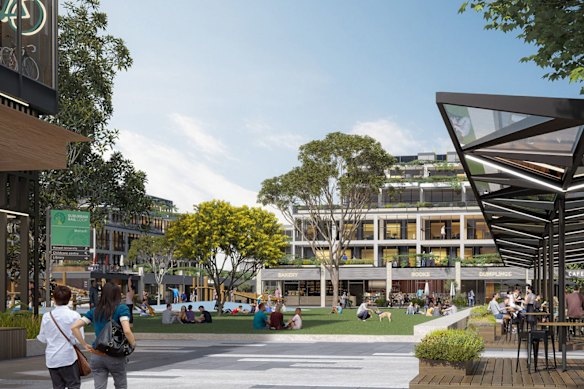
The project’s business and investment case highlighted this ambition to foster “places of state significance” and 20-minute neighbourhoods. Allan, as the Suburban Rail Loop minister, read laws into parliament in 2021 to make this happen, drawing attention to the project agency’s unusual powers to plan the station precincts.
“The development of the precincts and the consequent improvement of economic and social outcomes that flow from these investments are critical to ensuring that the Suburban Rail Loop maximises the benefits it delivers,” she said.
Some councils in the path of the SRL found the laws draconian. Making the SRLA a one-stop shop – awarding contracts, planning the rail line and overseeing the creation of the surrounding precincts – was indeed extraordinary.
But according to those involved in the earlier stages of the SRL, the agency’s precinct structure plans represent a fraction of its ambition to create a “city of centres”.
The maps outline height limits, green space and priority areas for education, health and commercial activity. But they passively encourage development by providing regulatory permission for the private sector to step in where it wants to.
In the words of a former SRLA staffer, this represents “top-down planning rather than active public master development”.
There is nothing inherently wrong with letting the private market naturally build up density in a suburb. But it comes with trade-offs.
Developers will always seek to maximise their returns, leading to smaller apartments at the expense of more family-friendly options. There is no guarantee these properties will be built quickly or affordably. Councils have also argued that while the plans encourage housing, they lack emphasis on local amenities and services.
In the wake of the pandemic, according to Professor Jago Dodson from RMIT’s Centre for Urban Research, there was a “need for government to show that its big investment initiatives align with efforts to resolve the housing crisis”.
“In that period, I think the Suburban Rail Loop shifted from being originally seen as a way of reshaping Melbourne’s urban structure … towards being a mechanism for unlocking large-scale housing supply in those station precincts,” he said.
Dodson says that to succeed, the SRLA needed to be more active managing the precincts, especially given “the public interest doesn’t necessarily align, in all instances, with what the interests of private developers are”.
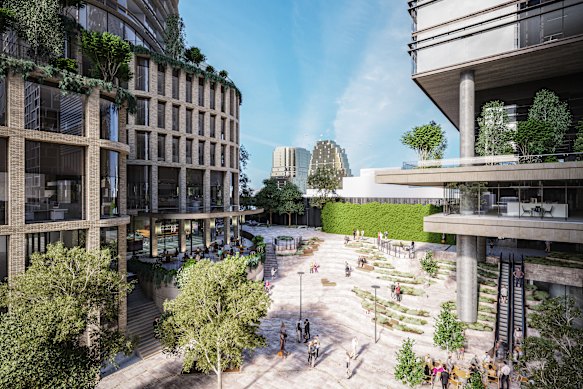
Critics of the SRLA’s approach point to Box Hill Central North, a seven-tower development from Vicinity Centres. The towers sit above what will be the northern end of SRL East at Box Hill station, but were approved by Planning Minister Sonya Kilkenny in 2024, not the SRLA.
In September 2023, a week before Daniel Andrews resigned as premier, a local planning panel wrote to then-SRLA chief executive Frankie Carroll asking for details of how the proposed housing towers fit in with the plans for a new Box Hill SRL station.
They were surprised to read, when Carroll replied four days later – the day Allan became premier – that he had none. Carroll said it was “not possible” to comment on how the proposal would affect future controls for the precincts as “those processes will be undertaken in the future”.
A former public servant familiar with the episode but not authorised to discuss it publicly remarked on the disconnect. “That is one of the most significant projects in Box Hill, and the planning authority [SRLA] had almost nothing to do with it,” they said.
Within the authority responsible for delivering the SRL, there are also concerns that the purpose of the project has been undermined by government’s broader plan to fast-track high-rise housing in transport corridors across Melbourne’s middle suburbs.
These 60 activity centres – largely around railway stations and tram stops – are intended to facilitate the construction of 300,000 homes by 2051. This figure dwarfs the housing ambitions of SRL East, a project intended to “support the delivery” of 70,000 homes over the same period.
In response to the question of why the SRLA needs its own planning powers when the Department of Transport and Planning is handling four times as many homes through the roll-out of activity centres, some involved in the project are blunt: the rail tunnel doesn’t stack up unless it is tied to new housing.
The expectation is now that the SRLA will be folded into VIDA or the department after the election because, according to one insider, “there is nothing that is unique” in its work.
Build it, and hope they come
On the subject of those 70,000 homes – a figure often cited by the Allan government to boast that the SRL is Australia’s biggest housing project – insiders say the line is carefully framed.
The number did not appear in the business case. Instead, it essentially relies on Australian Bureau of Statistics data to model how many homes will be needed organically in each precinct as the population doubles by 2041 – an increase of about 24,500 homes.
From 2041 to the 2050s, this figure will rise to 70,000 homes. This is the maximum possible population capacity the structure plans allow – if the market chooses to build there.
This raises another critical question. Within the SRLA, there is growing concern about whether the private sector will provide the housing stock needed to achieve these targets, especially in competition with the activity centres. SRLA board minutes from last year underscore these concerns.
In February 2025, when the SRLA’s boss of land and planning, Lissa van Camp, briefed the board – chaired by former deputy premier James Merlino – on the structure plans, they raised “current market conditions, and potential challenges in achieving affordable housing and public open space benefits through development”.
These market conditions were later laid bare at a planning hearing by Phileo Australia, which owns the undeveloped Box Hill Brickworks site near the SRL station. It said its residential development would make a $145 million loss – 21.8 per cent of the project’s cost – unless planning rules were modified to allow it to build more densely.
A private sector player who has worked with the SRLA said the authority’s board appeared to understand the scale of the challenge but lacked adequate support from the government.
“They are just used to contracting construction and then owning the asset,” the source said. “The whole idea in the business case is value creation. You use the project’s powers really strategically to enhance productivity, grow the economy and create homes, and the economic benefits are so great that you can clip the ticket through value capture.
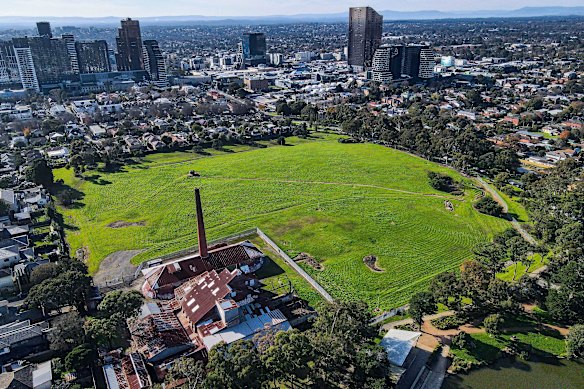
“Instead the mantra now is, build it and, hopefully, they will come.”
Value capture has long been central to the original SRL vision. The government decided early on to pay for a third of the project, $11.5 billion, through taxes and charges collected from the project’s economic benefits. But the final value capture strategy, unveiled last December, has been disparaged by the property industry that is crucial to meeting the housing goals.
The Property Council said the government was “effectively killing its most ambitious housing project in one fell swoop” by implementing “the highest development taxes in the country”.
Urban Development Institute of Australia Victorian chief Linda Allison said: “If it’s a transport project, then fund it fairly. If it’s a housing project, work with the housing industry to set it up for success. Today’s announcement does neither.”
Captured by value
When Daniel Andrews first revealed his Metro Tunnel plans, he promised to split the costs between the state government, the Commonwealth and the private sector.
This plan was later abandoned but then effectively repeated for the SRL, when the government released its business case in 2021.
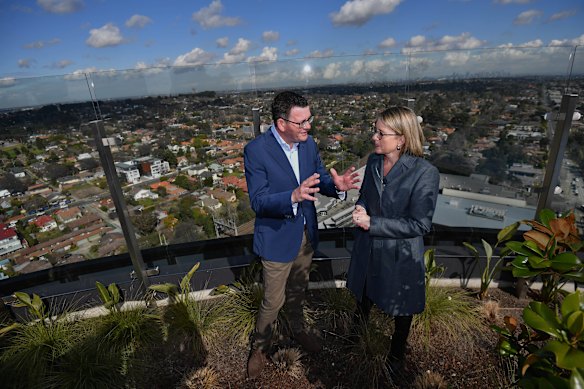
This time, the cash from the private sector would be collected via value capture. Department of Treasury and Finance documents from 2022, obtained by this masthead after a two-year freedom of information fight, explicitly laid out that these taxes and charges would deliver “new revenue streams” into government coffers.
Senior ministers added a key proviso internally: value capture would not involve taxing the family home.
Politically, it would be toxic. Practically, this made it far more difficult to raise a third of the project’s costs. Indeed, the business case drew attention to the fact a citywide levy was used to bankroll the City Loop.
What followed was a four-year process that pinballed around the government, starting within the SRLA before being punted to Treasury.
The final plan did not resemble any value capture mechanism seen across the world. Although $2.9 billion will come from developer charges, the biggest source of revenue is land tax collected in the six SRL precincts over 40 years.
The government argues the land tax take is bolstered by an uplift in property values. Experts are more sceptical about whether it reflects “new revenue”. Urban planner Joe Langley says bluntly: “It’s not value capture.”
After two weeks of questions from this masthead, Treasury revealed the value capture cash would not be treated in any special way. Land tax collected in SRL precincts will go directly into the budget, reported in the same way as every other land tax dollar.
This effectively means the Allan government is footing the bill for two-thirds of SRL East – or, more to the point, two-thirds will be funded by state debt.
Victoria will be paying $23 billion upfront – and hoping Labor remains in charge in Canberra to top up the federal contribution to $11.5 billion – before it recoups money from developer charges, the sale of government land and a congestion levy over several decades.
“The people who said a third of the project could be funded by value capture were not the same people who ruled out taxes on the family home,” a senior government source said.
“It was a square peg in a round hole, and I feel bad for the boffins who had to make it work.”
The tight leash on a big spend
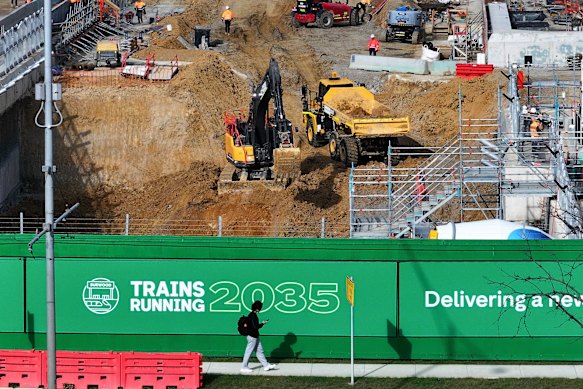
The lengthy effort to figure out how to fund the SRL is akin to building the plane while it is flying. Construction of the project is already well under way – and it is complicated.
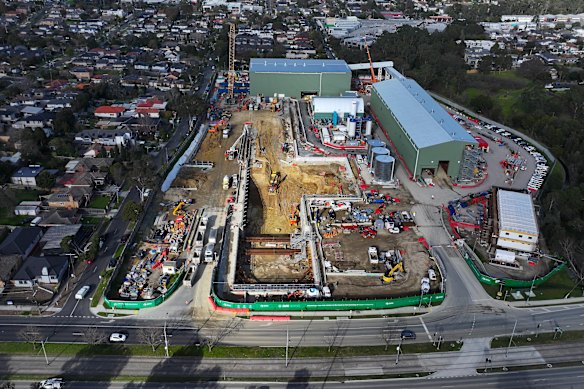
Carroll, the SRLA chief, last year briefed the board on his fact-finding mission with Merlino to another project with “complexities involved with tunnelling, safety, scale and delivery, which are similar to the SRL project”. They had visited Snowy Hydro 2.0, which, if nothing else, offers the SRLA a lesson in what not to do.
The energy project is years late, and its expected cost has ballooned from $2 billion to $12 billion. Some experts think it will end up costing $42 billion.
Keeping a handle on the cost of the SRL is a matter for the Department of Treasury and Finance.
Unlike other Big Build projects, Treasury wanted more checks and balances to ensure every cent of the $34.5 billion could be tracked, with internal documents – which the government fought to suppress – detailing its strict controls.
Treasury’s scheme means a cabinet subcommittee meets every six months for updates on costs for the SRLA, project development and land acquisition. In between, it discusses and signs off on construction contracts. Ministers can see line-by-line how budgets for contracts have adjusted the “risk” of future changes in the final cost, with a particular section for bureaucrats to spell out the cause of any blowouts.
To demonstrate the need for this, a Treasury source pointed to the cost of early SRL works.
Initially announced as a $2.2 billion project, it appeared in the 2021-22 budget with an extra $159 million attached. By 2025, the Victorian Auditor-General revealed the cost was $2.5 billion, having identified additional funding not listed in the budget papers.
“Imagine if you had that across a total budget of $34.5 billion,” the source said.
Top bureaucrats across multiple departments also meet monthly. The purpose, one official said, was not just to ensure accountability, but to swiftly identify issues across eight packages of work.
So far, the construction contracts have come in surprisingly low – particularly for a project costed before wars in Europe and the Middle East fuelled inflation. A construction industry source said this was probably due to the use of a novel “target outturn cost” clause, allowing the government and contractors to keep their books open and share the load of blowouts.
“Overruns might not be fully visible until the 2030s, and even then, not disclosed until they’re in the budget,” the source said.
The federal government has taken a similar interest in restraining spending. Further documents reveal the Commonwealth’s contribution to the SRL – as well as the airport rail project and the North East Link – is contingent on the federal transport department meeting monthly with the SRLA to oversee progress of the project.
Under Anthony Albanese, the Commonwealth is contributing $6 billion to SRL East. But federal infrastructure department secretary Jim Betts told a budget estimates hearing this was tied to tangible milestones and would not cover cost overruns. He said this would also ensure greater accountability over issues such as crime on worksites.
So far, the taint of the Building Bad scandal has not hit the SRL. Allan and her inner circle are convinced it remains popular, having first helped Labor win a clutch of seats from the Liberal Party after it was announced during the 2018 election campaign.
But more popular than Taylor Swift, as some MPs continue to boast?
“In more recent times, the more relevant Swifty reference would be that the Victorian public are embracing her early hit We Are Never Ever Getting Back Together,” a Labor source mused.
Perhaps Bill Shannon could return to repurpose one of his famous campaigns for the SRL. Because whether it is popular or not, with billions of dollars in contracts inked and construction well under way, we’re all in this together.
Start the day with a summary of the day’s most important and interesting stories, analysis and insights. Sign up for our Morning Edition newsletter.
Disclaimer : This story is auto aggregated by a computer programme and has not been created or edited by DOWNTHENEWS. Publisher: www.smh.com.au