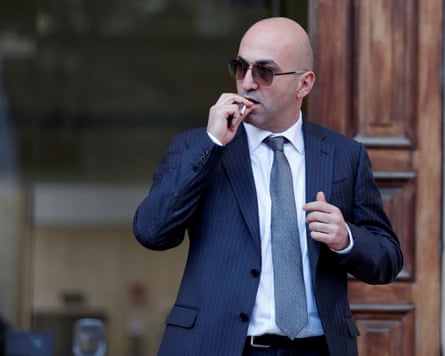
The businessman accused of ordering the murder of the Maltese journalist Daphne Caruana Galizia goes on trial on Wednesday, more than nine years after her death in a car-bomb attack that sent shockwaves through Europe.
Yorgen Fenech, the heir to a property empire worth hundreds of millions, is one of seven men prosecutors accused of involvement in the killing, and the last to face trial.
He faces two charges: complicity in the voluntary homicide of Caruana Galizia, and association with a person or persons in Malta with the intention of committing a crime there. He denies the charges.
The attorney general has called for a life sentence for the murder charge and between 20 and 30 years for the criminal association charge.
A jury was sworn in on Wednesday morning at the courts of justice in Malta’s capital, Valletta.
Of the other six men already prosecuted in relation to the murder, five were convicted and one secured a pardon in exchange for testimony.
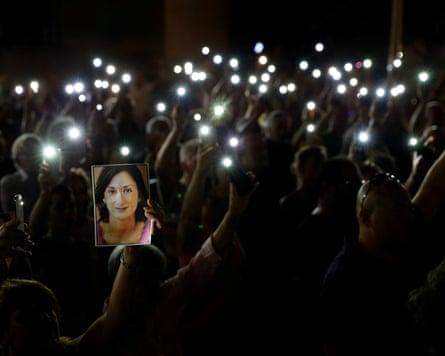
Caruana Galizia died in 2017, shortly after a general election in Malta that was dominated by revelations from her investigations. A magazine publisher, newspaper columnist and blogger, she was one of the most recognised media figures in the country. Her reporting on leading government and business figures had made her a target of repeated attacks by politicians and their supporters.
A subsequent public inquiry, demanded by her family, concluded the state had allowed “an atmosphere of impunity” to spread from the highest level of government to regulators and the police, leading to a collapse in the rule of law and creating a “favourable climate” for her murder.
Caruana Galizia’s car swerved off the road into a field shortly before 3pm on 17 October 2017, as she was driving away from her home in the village of Bidnija.
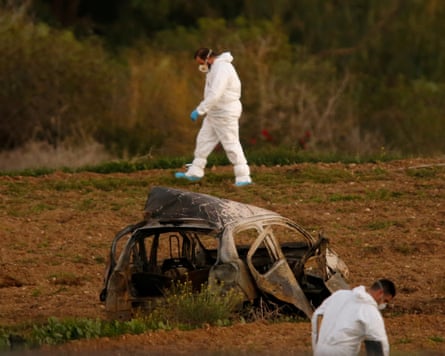
A powerful bomb contained in a children’s shoebox had been placed under the driver’s seat. The bombers, who prosecutors say were paid €150,000 (£130,000) to carry out the attack, had broken into the vehicle the night before after weeks spent watching her movements and planning the attack.
Her son Matthew Caruana Galizia, who had been with her at home, was the first to arrive on the scene, discovering her remains in the burning wreckage of the car. She was 53.
Three men accused of planting the bomb were arrested soon afterwards in a televised raid on a warehouse in the docks of Marsa, across the harbour from the capital. Brothers George and Alfred Degiorgio, and their friend Vincent Muscat were taken into custody.
The investigation then appeared to stall. Reporting by Reuters and the Times of Malta eventually revealed that Muscat and a taxi driver who claimed to have been the middleman had offered to testify. The driver, Melvin Theuma, who is expected to give evidence at Fenech’s trial, claims it was the businessman who ordered and paid for the killing.
Theuma was arrested on 14 November 2019, clutching an ice-cream box containing USB drives with copies of what he claims are covertly recorded conversations with Fenech that the prosecution is relying on. Fenech’s team have requested the original recordings and claim Theuma’s testimony contains “half truths” and “blantant lies”.
On the night of Theuma’s arrest, his lawyers, determined to preserve the evidence, sent the material to The Hague, where it was held at Europol’s offices for safekeeping.
The then prime minister, Joseph Muscat, responded by announcing on 19 November that Theuma, whom he did not name at the time, had been offered a presidential pardon and immunity from prosecution in exchange for information about the killing.
In the early hours of 20 November 2019, Fenech boarded his yacht, Gio, and set to sea. The vessel had been docked in Portomaso marina, a luxury development of waterfront apartments and restaurants overlooked by a 23-floor tower and owned by Fenech’s family company, Tumas Group.
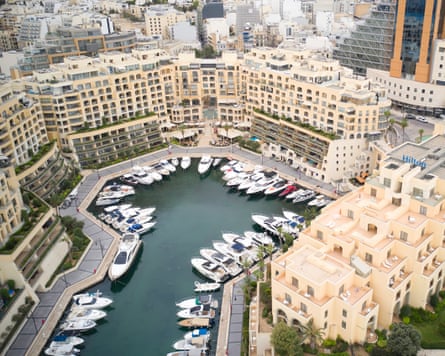
The Maltese military intercepted the yacht and forced it back to harbour, where Fenech was arrested. As more details of the case emerged, Joseph Muscat’s government was engulfed in a political and constitutional crisis. The pressure on him to resign mounted and he stepped down in December 2019.
In the months and years that followed, Fenech was held in custody while the prosecutions of his co-accused ran their course.
Vincent Muscat was given a reduced sentence of 15 years and a presidential pardon after pleading guilty to all charges, including wilful homicide, and testifying against the Degiorgio brothers. They at first denied the charges against them, which also included wilful homicide, before changing their pleas to guilty on the first day of their trial in October 2022. A plea bargain reduced their sentences from life to 40 years.
Two men accused of supplying the bomb, Robert Agius and Jamie Vella, were sentenced to life in June 2025. They are not eligible for parole or any other form of early release.
Theuma has been living under a witness protection scheme since 2019.
Fenech’s legal team have brought repeated challenges, including questioning whether the extensive publicity around the case has jeopardised his right to a fair trial. Delays bringing the case to trial meant the state was eventually obliged to grant him bail in February 2025.
He was released under strict conditions after agreeing to what is believed to be Malta’s largest ever bail. He paid an €80,000 deposit and pledged a €120,000 personal guarantee, while his aunt put her shareholding in Tumas Group, estimated to be worth aabout €50m, up as security.
Strict reporting conditions in the run-up to the trial meant the scheduled date could not be disclosed in advance.
Disclaimer : This story is auto aggregated by a computer programme and has not been created or edited by DOWNTHENEWS. Publisher: theguardian.com