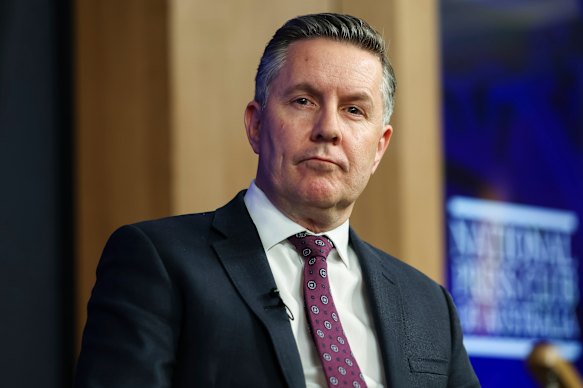

Health Minister Mark Butler has called on the states to step up and provide services for the one in five people who will be kicked off the NDIS as part of the biggest overhaul in the scheme’s history.
The Labor frontbencher also sought to reassure disabled Australians, insisting the development of the new eligibility standards – based on degree of impairment rather than a diagnosis – will be done in consultation with the community.
The disability and NDIS minister announced on Wednesday that the government was overhauling the country’s primary disability support network to drastically cut growth and kick at least 160,000 people off the scheme by the end of the decade.
On Thursday morning, Butler said he had a positive meeting with state and territory disability ministers after his National Press Club address to discuss how they could best implement the changes.
Supports outside the NDIS, which have dried up as the Commonwealth scheme expanded, will need to be reintroduced by the states and territories for people with milder needs who will become ineligible for the scheme. The new eligibility test will come into force from 2028.
Butler said $10 billion had already been allocated for this purpose, including for the Thriving Kids program for children aged eight and under.
“Back in 2023, [premiers] allocated the money. The premiers signed up again at the national cabinet agreement a couple of months ago, in return for which we’re giving them $25 billion of additional funding for their hospitals,” Butler told Sky News.
He said Thriving Kids was in development, but now programs for the rest of the population would need to be developed.
“I’m certainly intent on getting on with that task, and I know my colleagues ultimately will be as well.”
West Australian Premier Roger Cook said on Wednesday he wished he had a confidential briefing before the changes were announced, while NSW Premier Chris Minns said states wouldn’t be able to provide “like-for-like” support.
“The states have been working with the Commonwealth around reform of the whole NDIS system, taking on more of the foundational supports, ensuring that young people in particular can get the supports they need,” Cook told reporters.
“But it’s a Commonwealth program, so we don’t want to pay for it.”
Butler said the changes would be developed in consultation with the community in an effort to reassure families distressed by the changes.
“Certainly, ‘nothing about us without us’ is a core philosophy of the NDIS,” Butler told ABC TV.
Brisbane mother Laura Lucas, whose child is on the NDIS, questioned whether the changes would improve the efficient management of public money.
She said yearly reassessments required to remain on the scheme as wasteful.
“We have many disabled people whose disability is permanent. There’s no need for constant reports that cost thousands of dollars to be done on an annual basis, to prove their disability, to justify their funding. Like, if you could actually manage that, for a start, you would save a lot of money.”
Butler said on Wednesday unscheduled reassessments would immediately be cut, but it remains unclear how frequently reassessment will be required under the new eligibility standards.
Mind Australia chair and former Australian Competition & Consumer Commission chair Allan Fels, who has a daughter with schizophrenia on the NDIS, said on Thursday the changes struck the right balance to keep the scheme sustainable – but warned mental illness should not be ignored in the new eligibility standards.
“In the case of psychosocial disability or mental illness, generally, the NDIS approach has been heavily oriented to physical and intellectual disability, so we just hope the new assessment method gets mental health right,” he told ABC’s RN Breakfast.
Opposition NDIS spokeswoman Melissa McIntosh said the Coalition was open to supporting the reform while attacking Butler for failing to crack down hard enough on fraud in the scheme.
McIntosh said the opposition would have supported mandatory registration for all providers, instead of for just some.
Meanwhile, one of the scheme’s architects said the original NDIS was too optimistic, too rushed, and needed a reset.
Martin Laverty, who is also the chief executive of disability support provider Aruma, said the political deal to establish the scheme in 2013 happened so fast that there was no detailed examination of who should be eligible and what the scheme should fund.
“Now what we have today is the reset,” he told RN Breakfast.
Laverty, who has also served as director of the National Disability Insurance Agency, said people with the most significant and permanent disabilities – a cohort of about 550,000 under the government’s modelling – could “take a guarantee that their eligibility for the scheme is going to continue into the future” because of the paring back of the scheme for milder support needs.
But he said deep consultation with the sector was required to get the details right, and flagged the lack of enthusiasm from states – particularly Queensland – which has agreed in-principle to Thriving Kids but is yet to sign up.
“It’s going to be uncertain until we see the legislation that defines how the functional capacity assessment tool will work.”
Cut through the noise of federal politics with news, views and expert analysis. Subscribers can sign up to our weekly Inside Politics newsletter.
 Brittany Busch is a federal politics reporter for The Age and Sydney Morning Herald.Connect via email.
From our partners
Disclaimer : This story is auto aggregated by a computer programme and has not been created or edited by DOWNTHENEWS. Publisher: www.smh.com.au