The move to electric vehicles is accelerating, yet Germany’s biggest manufacturers are cutting jobs and losing ground to competitors. Here’s why workers are worried and where new opportunities may emerge.
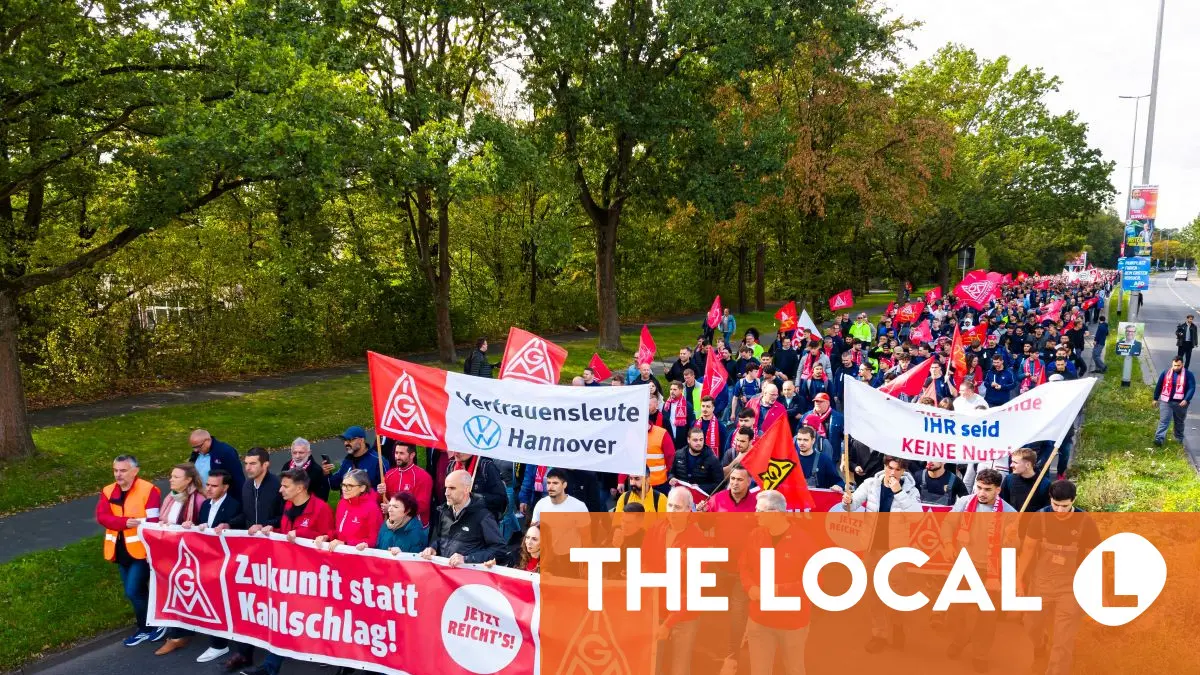
Tens of thousands of automotive workers across Germany demonstrated on Monday in one of the largest nationwide labour mobilisations the industry has seen in years.
According to the union IG Metall, around 175,000 workers took part in roughly 280 events under the slogan “A Future Instead of Mass Layoffs”.
Employees from Volkswagen, Audi, BMW, Mercedes, Bosch and dozens of suppliers joined rallies, workplace meetings and demonstrations.
The protests may look like a familiar conflict between unions and company management, but the dispute also provides an insight into an industry battling to reinvent itself at the same time as profits are falling, factories are under pressure and global competition is intensifying.
The key question is not whether the industry is in trouble – it clearly is – but whether it can successfully turn the shift to electric vehicles (EVs) into a new source of growth and jobs.
Why workers are worried
The immediate backdrop to Monday’s day of action is a growing list of job cuts and restructuring plans.
Earlier this month, Volkswagen approved plans to cut a further 50,000 jobs globally, bringing the group’s planned workforce reductions to around 100,000 positions over the coming years. The future of several German plants also remains uncertain.
Porsche and BMW are pursuing their own cost-cutting programmes, while workers at suppliers across the country are facing layoffs, short-time work or insolvency risks.
At Audi’s Neckarsulm plant, thousands of employees protested against uncertainty surrounding the site’s future after 2034. Workers and union representatives argue that the factory’s long-term survival depends on securing a high-volume electric vehicle model.
Mercedes is currently negotiating changes aimed at improving competitiveness, including a proposal for employees to work an additional three hours per week without extra pay.
READ ALSO: Tesla announces plan to add 1,000 jobs in Germany
The electric vehicle transition is real
Germany is increasingly moving towards electric and hybrid vehicles. Fully electric vehicles accounted for 32.4 percent of all new car registrations in August 2026 and hybrids for a further 39.8 percent, according to figures from Germany’s Federal Motor Transport Authority (KBA).
Petrol vehicles accounted for just 16.7 percent of registrations, while diesel cars represented 10.6 percent. That means more than seven out of every 10 newly registered cars were either electric or hybrid.
And the trend is visible beyond registration statistics. Car giant Volkswagen now has more electric vehicle orders than combustion-engine orders in its home market, according to Motor1.com.
But while German consumers are increasingly buying electric vehicles, there are fears the car industry may be missing out on the rewards.
A recent study by consulting firm EY suggests Germany’s biggest carmakers are falling behind international competitors. According to the study, revenues at Volkswagen, BMW and Mercedes fell by 2.9 percent in the first half of 2026.
By contrast, revenues across the world’s 19 largest automakers increased by 3.6 percent over the same period.
The problem for Volkswagen is that even though demand is moving in the right direction, it’s not necessarily translating into greater security for some of its traditional factories. Sites such as Wolfsburg were built around the combustion engine, while much of the new EV demand is being met by vehicles produced elsewhere in the company’s manufacturing network.
READ ALSO: Volkswagen profits down as competition from China heats up
At the same time, foreign competitors are gaining ground in Germany. For example, Chinese brands increased their market share from 4.4 to 8 percent in just a year, partly by exploiting gaps in the entry-level electric vehicle segment, according to EY.
IG Metall leader Christiane Benner also argues that manufacturers should simplify their model ranges and produce vehicles in larger volumes, saying bluntly that “the luxury strategy has failed”.
Of course, the success of global manufacturers such as Volkswagen or BYD can’t be judged solely by what they sell in Germany, but it’s still a striking development when German consumers are increasingly choosing vehicles built by foreign competitors.
Everyone agrees there is a problem. They disagree about why
Industry groups such as the German Association of the Automotive Industry (VDA) argue that labour costs, shorter working hours and regulatory burdens have made Germany less competitive.
VDA president Hildegard Müller has described Germany’s high labour costs and shorter working hours compared with other countries as significant competitive disadvantages, while Mercedes is currently negotiating a proposal that would see employees work an additional three hours per week without extra pay.
READ ALSO: Has Germany’s ‘migration turnaround’ killed its ability to attract foreign workers?
Union leaders see things differently.
IG Metall president Christiane Benner has argued that layoffs will not solve the industry’s problems. Instead, she says Germany needs more investment in technology, innovation and production sites.
She has also questioned what happened to the record profits made in recent years, arguing that too much money has been paid out to shareholders rather than invested in the industry.
Union representatives have also accused management of strategic mistakes, including reacting too slowly to trends in electric mobility, battery technology and digitalisation.
Where opportunities may emerge
While many traditional automotive jobs are under pressure, investment is continuing in sectors connected to the industry’s transformation.
One example is Tesla’s factory near Berlin. In May, the company announced a $250 million investment to expand battery-cell production at its Berlin-Brandenburg facility – a move which is expected to create more than 1,500 jobs.
Unions are also calling for greater domestic battery production and charging infrastructure investment, but battery technology is only one growth area.
READ ALSO: Germany urges EU action against China to defend carmakers
Industry experts have also pointed to autonomous driving, robotics and software development as important future fields.
Meanwhile, some car manufacturing sites are finding entirely new roles. For example, Volkswagen recently agreed to sell its Osnabrück plant for conversion towards defence-related manufacturing after vehicle production ends there. The deal is expected to preserve at least 1,200 jobs.
Too soon to write-off Germany’s automotive industry?
While it would be easy to look at the latest job cuts and conclude that Germany’s car industry is in irreversible decline, the evidence suggests a more complicated reality.
Electric vehicle sales are growing rapidly.
German manufacturers still possess world-famous brands, deep engineering expertise and one of the most sophisticated industrial ecosystems in the world.
New investment continues to arrive, particularly in batteries and advanced manufacturing.
The challenge now is whether companies, workers and policymakers can agree on how to make that transformation profitable while there’s still time.
READ ALSO: UPDATE – The major German companies cutting jobs this year
Disclaimer : This story is auto aggregated by a computer programme and has not been created or edited by DOWNTHENEWS. Publisher: thelocal.de