As the Men’s Football World Cup descends on the USA amid a wave of controversy, we look ahead to rugby’s own bid to break America…
A sweltering day in Washington and they came from far and wide to wave off the USA team bound for England and the Women’s Rugby World Cup.
The biggest crowd to witness a women’s International in the States packed Audi Field, where Wayne Rooney once played and later managed MLS team DC United, writes Alex Spink.
Then the screaming began. They were there supporting a team ranked tenth in the world but it was Ilona Maher, the sport’s most followed player, most had come to see.
Read more:Maher on her rise in rugby
Rugby is a team game but in US sport, star appeal is what sells. Three days earlier, the US Eagles centre had delighted her eight million social media disciples by going to Hollywood and picking up a sporting Oscar, the high-profile ESPY award for Best Breakthrough Athlete.
In a nation where rugby is very much a minority sport, thousands stayed behind afterwards for a closer glimpse of Maher, who toured the perimeter posing for selfies and high-fiving each and everyone. Alan Gilpin, chief executive of World Rugby, looked on approvingly.
Ilona Maher, the star of American rugby
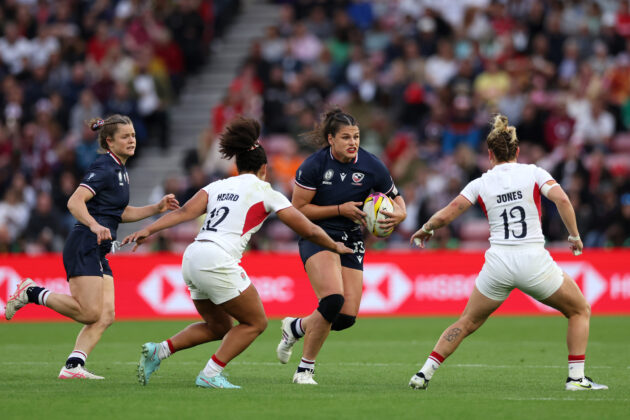
Ilona Maher of the USA runs with the ball whilst under pressure from Tatyana Heard and Megan Jones of England during the Women’s Rugby World Cup 2025 Pool A match between England and USA at the Stadium of Light on August 22, 2025 in Sunderland, England. (Photo by Morgan Harlow – World Rugby/World Rugby via Getty Images)
He had been at the Tokyo Olympics, delayed a year due to the pandemic and held behind closed doors in the summer of 2021, when a colleague tapped him on the shoulder.
“Have you seen this American sevens girl doing all this stuff on TikTok, taking the mickey out of cardboard beds in the athletes’ village, comparing the village to the villa on Love Island?” Gilpin smiles at the memory.
“I didn’t know who Ilona was back then,” he admits. “We all do now. She’s the biggest driver of brand rugby in the US.”
Read more: How France have mastered rugby
Nine months after those Olympics, the USA was awarded the hosting rights for the 2031 and 2033 men’s and women’s World Cups. It was accompanied by some fanfare and a lot of ambitious targets.
The headline goal was to establish rugby as a mainstream sport, with more than 500,000 registered players and strong links to the college and high-school sports ecosystem.
The governing body talked about creating an $80 billion economic opportunity for rugby in the USA over the next 20 years; not an insubstantial sum of money.
“With an estimated 55 million fans in the US, 800,000 players and over 3,100 registered clubs, rugby is already very much alive and kicking in the US,” Gilpin insisted.

Chief Executive Officer Alan Gilpin (L) of World Rugby stands with the Webb Ellis Cup (Getty Images)
What state is US rugby in?
So where are we now? Well, the USA failed to make the knockout stage of the Women’s World Cup and Maher announced she would return to the sevens game as 15s didn’t pay enough. She has yet to step foot back on a rugby pitch.
The men have qualified for the 2027 tournament in Australia, but to do it they had to end a five-game losing streak and win a fifth-place play-off against Samoa, three days after Major League Rugby shrunk from 11 teams to just seven with Houston SaberCats the latest to drop out.
None of which sounds particularly encouraging with the 2031 and 2033 tournaments in mind.
Read more: How to stream MLR
World Rugby is committed to delivering not only the biggest – by attendance and revenue – and best-viewed men’s Rugby World Cup ever, but the first financially sustainable Women’s Rugby World Cup two years after that. They report a 3.6 million US audience on World Rugby social media channels, up by more than 230,000 this year.
The US, they add, is also the biggest market on social media globally (580,000) for SVNS. Gainlines, WR’s fastest-growing ‘brand’ channel (fitness and training), has 307,000 US followers, the biggest from any country.
The custodians of the sport are on a mission to drive up interest stateside by showcasing personalities through fan-first, entertainment-led content on social media. Put simply, to create stars and celebrate them.
Maher is the biggest of these by a country mile and thanks to her and her USA sevens team winning Olympic bronze in Paris, the women’s game stateside is growing fast. As a result of that podium place last year, American businesswoman Michele Kang gifted $4 million to the programme to help the team soar even higher at the Los Angeles Games in 2028.
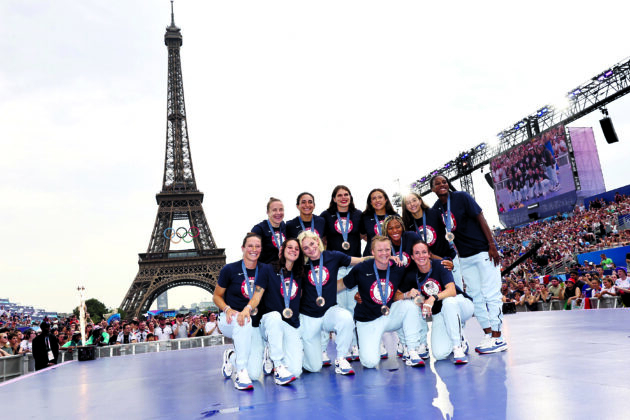
Team United States Women’s Rugby Seven’s athletes pose for a photo (Getty Images)
Women’s Elite Rugby, a six-team semi-professional league, started this year and an increasing number of US universities and colleges are investing in their women’s rugby programmes. The holy grail for all sport is a younger audience.
Maher is the recruiting sergeant that sports dream about. The combination of her, with her body-positive messaging and magnetic personality, and Olympic success, so prized by US sports fans, has earned women’s rugby a slice of the action stateside that has so far eluded the men’s game.
Read more: PWR fixtures
Competition is key
“You need a national team that’s competitive,” says Chris Latham, head coach of the Chicago Hounds. “You need a national team that can sell that underdog story of ‘out of the ashes, no hope and all of a sudden they jag a win’.
“Americans are a very introverted lot in that they think America is the only place on Earth. They don’t tend to look outside. If an American team isn’t competing, up there with the best, they just won’t look.”
Reaching their first Men’s World Cup since 2019 by beating higher- ranked opposition is a start, but the crowd in Denver was sparse and the 29-13 win followed five defeats in a row in the Pacific Nations Cup, their worst run since 2014.
The club game is also cause for concern. Eleven teams competed this year in MLR. Playing standards went up, attendances and viewing figures too. The eighth season in 2026 had the potential to raise the bar further.
Instead, the league has shrunk. San Diego Legion has merged with RFC LA, becoming California Legion. New Orleans-based NOLA Gold and the Miami Sharks have stepped away for at least a year. And now Houston. That’s 11 down to seven.
Read more: All you need to know about the Nations Championship
Doubt also surrounds Utah Warriors, reportedly seeking new investment. “Private owners are not going to keep pumping money in and not seeing a return on their investment over a very long period,” admits Latham, who won a World Cup and 78 caps for Australia.
“For it to be sustainable, there needs to be revenue coming in so it can be reinvested into developing local talent that has relevance to the area. Once you have that, you can start to build the product and promote it by selling dreams.
“That’s how you make young people want to pick up a rugby ball, rather than any other type of ball, at an early age.”
Adam Freier, like Latham a former Wallaby and the recently appointed CEO of California Legion, told Forbes: “I don’t think anybody should be looking at these teams stepping back as representative of a lack of rugby growth in this country. It’s not.”
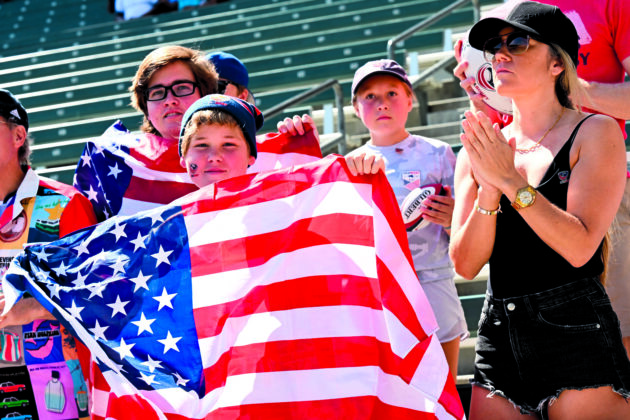
USA rugby fans cheer with flags during the rugby union match between Fiji and the United States (Getty Images)
Are alarm bells starting to ring?
World Rugby will hope he’s right. With no clarity as to what next season’s MLR will look like, or even when it will begin, the alarm bells are ringing. Yet Latham says hope is not lost.
“Rugby union in the US is never going to compete with the NFL, but what it can do is sell a dream,” he says. “Look, rugby’s a unique sport and people need to understand this. There’s a product there that can be sold, one without limits.
“Rugby offers an opportunity to travel the world, meet new people, broaden your horizons and play a game and join a community unlike any other in the world. Go anywhere where rugby is played, say you play the game and, all of a sudden, you’ve got a family for life. You don’t get that in any other sport.
“I truly believe we don’t need the sort of money required to compete with the major sports in America. Just enough to be able to get our foot in the door. Because once rugby has you hooked, the whole world is open to you.”
Read more: Rugby’s amateur internationals
World Rugby does not underplay the size of challenge the sport faces to crack America, but it is unwavering in its belief that it can, and will, put on two successful World Cups.
“When we awarded the 2019 World Cup to Japan, everybody said to me in the first year, ‘You’ll move that, it won’t happen in Japan, you’ll go to South Africa or France’,” Gilpin reveals. “It was an amazing tournament and Japan is now the third biggest commercial market in rugby.
“We know the men’s World Cup is driving all the investment World Rugby is making in the game. We also know that whatever measure you use for where growth markets are for men’s World Cups, the place to be is the USA.
“When it comes to media rights for sports, the USA is half the global market. Yet we don’t play here. If rugby commanded one per cent of the North American sports rights market, it would double rugby’s global economy to £8 billion.
“Rugby is great at being a big sport in small markets. It’s fantastic to be the biggest sport in New Zealand and Ireland, but we need to be moving towards the bigger markets. We’ve got to go after some of the growth markets.”
‘We want to make it easier for people in the US to follow rugby’
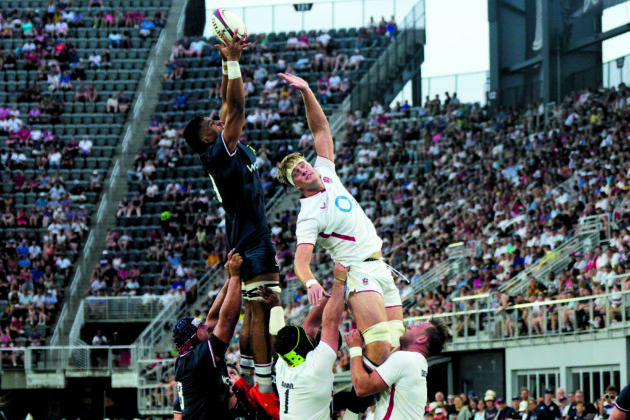
Viliami Helu #19 of the United States goes up for the ball against Alex Coles of England (Getty Images)
Since awarding the USA the tournaments in 2022, World Rugby has set in train a US$250 million growth plan to make USA Rugby a better, more sustainable, annual business. That is a serious investment.
Read more: Mo-unga on World Cup hopes
Gilpin explains: “Commercially, and in terms of audience building, we recognise we have to bring more high-quality rugby to the States; that the odd Ireland-New Zealand game in Chicago is, in isolation, not enough.
“So we have said to a number of unions, ‘Come with us on the journey and let’s create an incentive model where we effectively, with some commercial partners, become the promoter of your matches here’.
“We’ve bought out USA Rugby’s commercial rights, which just doesn’t happen in rugby, and become rights’ holder in this market place. We want to make it easier for people in the US to follow rugby and for brands to get involved.
“We’ve started to build this ecosystem. We’re asking unions if they are prepared to bring games here outside some of the official international windows. We are mapping through six to eight years of content with a view to getting 12-13 international matches a year.
“And not just USA rugby matches. Can we bring the Lions here on the way to NZ in 2029, or the women (Lions) in 2027? It might sound like fantasy but can we bring a regular Six Nations game, can we bring an EPCR final here?
“The answer is always in the commercials. If we can show our stakeholders they can bring content here and be well rewarded for it, they are up for that conversation. And they are increasingly dealing with brands that have got big investments here.”
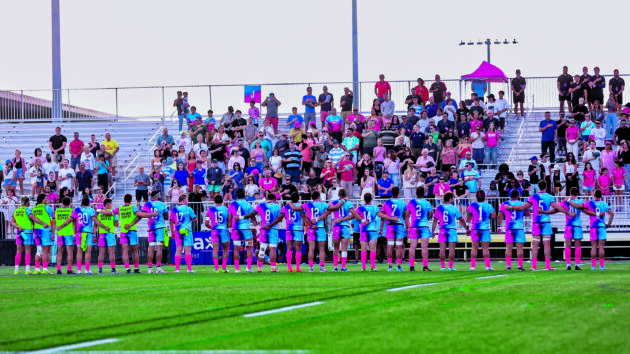
Miami Sharks rugby team lineup for the national anthem prior to their MLR season opener against Old Glory DC at Florida Blue Training Center on February 15, 2025 in Fort Lauderdale, Florida. (Photo by Chris Arjoon/Getty Images)
Rugby union in the USA faces threats on a number of fronts. With MLR contracting, there are reports that Super Rugby is looking at a Hawaii/West Coast franchise, talk that Super Rugby Americas could move for a Miami franchise and the URC a club on the East Coast to add to their multinational league.
“Anyone who wants to invest in the sport, whether it’s sovereign wealth funds, so-called rebel leagues or otherwise, we want to engage in that conversation,” Gilpin says. “We’re not looking for disruption, we want to try and bring that investment to improve the ecosystem that we’ve got. Probably the last thing rugby needs is ‘smash it up’ but we do need investors to come in and help us be better in what we do.
“We welcome conversations because the game on the field, across men’s and women’s and sevens, has never been better. This Women’s World Cup and the last one in New Zealand have been amazing, the men’s World Cup in France produced incredible drama.
“Super Rugby had a great season this year, the business end of the EPCR competitions was fantastic. We’ve seen cracking English Premiership and French Top 14 games, Japan League One is packed with stars.
Read more: Here are all the remaining Premiership fixtures this season
“But sometimes we hide the game away too much from the casual audience. We don’t move as a global sport quickly enough to adapt to the environment we’re in. Other sports are much more agile than we are. You’re seeing it with padel and pickleball. You’re seeing it in the US with the Premier Lacrosse League (PLL) being partnered by ESPN.
“There’s shifting business models all the time and we’ve got to be a bit more agile in rugby. Whether that’s about how they attract investment, how they create short-form digital content to drive new audiences, rugby has a lot to learn. It has to make itself more investable to compete.
“The upside is that there’s probably, quietly in the background, a bigger coalition of the willing than there’s been for a long time. People who recognise this is the time to really push on.”
The clock is ticking. Six years from now the stars will look to earn their stripes in the US of A. Only after the FIFA World Cup went stateside in 1994 did football, aka soccer, start to take hold in North America. Rugby’s challenge is to have the wheels turning before 2031. The sport cannot afford a standing start.
Download the digital edition of Rugby World straight to your tablet or subscribe to the print edition to get the magazine delivered to your door.
Disclaimer : This story is auto aggregated by a computer programme and has not been created or edited by DOWNTHENEWS. Publisher: rugbyworld.com