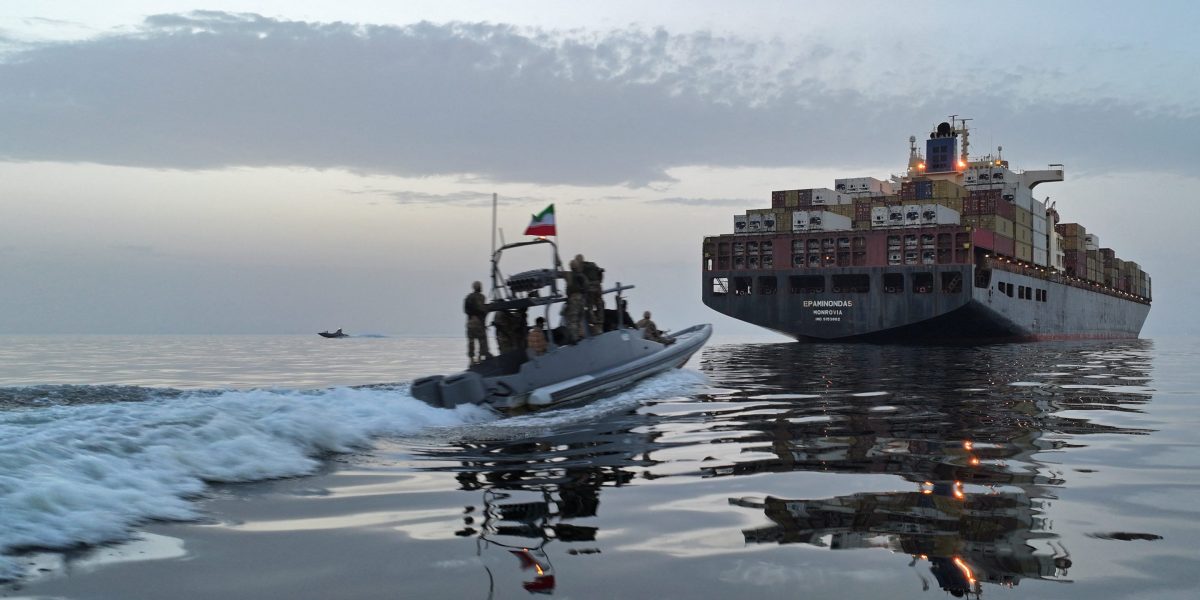
A cargo ship near the Strait of Hormuz said it was attacked by multiple small craft, according to the British military’s United Kingdom Maritime Trade Operations center on Sunday, marking at least two dozen attacks in and around the strait since the Iran war began.
Meanwhile, Tehran said it was reviewing the U.S. response to its latest proposal on ending the war but made clear these were not nuclear negotiations.
All crew on the unidentified northbound cargo ship were safe after the attack off Sirik, Iran, east of the strait, the British monitor said. Iranian officials have asserted that they control the strait and that ships not affiliated with the United States or Israel can pass if they pay a toll, challenging the freedom of navigation guaranteed by international law.
There was no immediate claim of responsibility for the attack, the first reported in the area since April 22, the monitor said. Tehran effectively closed the strait by attacking and threatening ships, and the threat level in the area remains critical.
Iranian patrol boats, some powered only by twin outboard motors, are small, nimble and hard to detect. U.S. President Donald Trump last month ordered the U.S. military to “shoot and kill” small Iranian boats that deploy mines in the strait.
The fragile three-week ceasefire appears to be holding, though Trump on Saturday told journalists that further strikes remained a possibility.
Iran reviews U.S. response to its latest proposal
Tehran is reviewing the U.S. response to its latest proposal, Iran’s judiciary Mizan news agency cited Foreign Ministry spokesman Esmail Baghaei as saying.
But “at this stage, we have no nuclear negotiations,” Baghaei said. Iran’s nuclear program and enriched uranium have long been the central issue in tensions with the U.S., but Tehran would rather address it later.
Iran’s proposal wants other issues resolved within 30 days and aims to end the war rather than extend the ceasefire, according to Iran’s state-linked media.
Trump on Saturday said he was reviewing the proposal but expressed doubt it would lead to a deal, adding on social media that “they have not yet paid a big enough price for what they have done” in the nearly 50 years since the Islamic Revolution there.
Iran’s 14-point proposal calls for the U.S. lifting sanctions on Iran, ending the U.S. naval blockade of Iranian ports, withdrawing forces from the region and ceasing all hostilities, including Israel’s operations in Lebanon, according to the semiofficial Nour News and Tasnim agencies, which have close ties to Iran’s security organizations.
Iran sent its proposal via Pakistan, which hosted face-to-face talks last month between Iran and the United States.
Pakistan’s prime minister, foreign minister and army chief continue to encourage the U.S. and Iran to speak directly, according to two officials in Pakistan who spoke on condition of anonymity because they were not authorized to speak to the media.
Also on Sunday, Iranian Foreign Minister Abbas Araghchi spoke with his counterpart in Oman, which oversaw previous rounds of talks before the war, and in Brazil.
Iran stands firm on Strait of Hormuz
Trump has offered a plan to reopen the Strait of Hormuz at the mouth of the Persian Gulf, where about a fifth of the world’s trade in oil and natural gas typically passes, along with fertilizer badly needed by farmers around the world.
Iran’s grip on the strait, imposed after the U.S. and Israel launched the war on Feb. 28, has shaken global markets.
The British military monitor on Sunday said it had received reports that ships near Ras al-Khaimah, the northernmost emirate in the United Arab Emirates and close to the strait, have received radio warnings to move from anchorages. It was not clear who sent the VHF messages.
Tehran “will not back down from our position on the Strait of Hormuz, and it will not return to its prewar conditions,” Iran’s deputy parliament speaker, Ali Nikzad, said Sunday while visiting port facilities on strategic Larak Island.
The U.S. has warned shipping companies they could face sanctions for paying Iran in any form, including digital assets, to transit the strait safely.
Meanwhile, the U.S. naval blockade since April 13 is depriving Tehran of oil revenue it needs to shore up its ailing economy. The U.S. Central Command on Sunday said 49 commercial ships have been told to turn back.
“We think that they’ve gotten less than $1.3 million in tolls, which is a pittance on their previous daily oil revenues,” U.S. Treasury Secretary Scott Bessent told Fox News on Sunday. He said Iran’s oil storage is rapidly filling up and “they’re going to have to start shutting in wells, which we think could be in the next week.”
Iran’s currency continues to tumble
On Sunday, the second day of Iran’s working week, the rial weakened further against the U.S. dollar. In Tehran’s Ferdowsi Street, the capital’s main currency exchange hub, the dollar was trading at 1,840,000 rials.
Analysts say there is a strong possibility the currency will slip further.
The rial was trading at 1.3 million to the dollar in December, a record low at the time, and triggered widespread protests over the worsening economy. Markets in Tehran remain unstable, with prices of some goods rising daily.
According to reports in Iranian media, several factories have not renewed contracts for workers after the Iranian new year in March, and significant numbers have lost their jobs.
Yousef Pezeshkian, the son and adviser of President Masoud Pezeshkian, wrote on Telegram that both the United States and Iran see themselves as the winner of the war and are unwilling to back down.
Disclaimer : This story is auto aggregated by a computer programme and has not been created or edited by DOWNTHENEWS. Publisher: fortune.com